
AI dispatching is the practice of using machine learning and real-time optimization algorithms to assign field technicians to jobs automatically, replacing the manual whiteboard or spreadsheet shuffle that still runs most service businesses. The formal industry term is intelligent dispatch or constraint-satisfaction scheduling, and the distinction from basic automated scheduling matters: rule-based systems follow static if/then logic and break the moment reality deviates. AI dispatching continuously re-optimizes every 90 seconds based on live technician location, updated job status, and real-time traffic.
For HVAC, electrical, and plumbing operations, the core variables the system evaluates simultaneously include:
- Technician certifications and license-by-jurisdiction — no uncertified tech gets dispatched to a job requiring a specific license
- Real-time GPS location and live traffic — drive time calculated from current position, not last-known
- Current workload, overtime exposure, and shift rules — workload balanced across the team automatically
- Required equipment and parts on the vehicle — parts availability confirmed before dispatch, not discovered on-site
- Customer time windows and SLA commitments — high-stakes windows never missed because of a scheduling gap
- Historical job duration by zip code, job type, and technician — duration estimates that reflect your actual operation, not a national average
When a tech calls out sick or an emergency job comes in at 2 PM, the system rebuilds the affected portion of the day in seconds. A human dispatcher doing the same reshuffle manually takes 20–40 minutes and rarely optimizes correctly.
Table of Contents
- What AI dispatching actually delivers for your business
- How to implement AI dispatching without breaking your operation
- How Tradepilot handles AI dispatching for trade businesses
- Key metrics that tell you if AI dispatching is working
- Common challenges to avoid during implementation
- What AI dispatching costs and when you see ROI
- What AI dispatching looks like in practice
- Data privacy and security when using AI dispatch
- Tradepilot gives you the right tech, every time
- Key Takeaways
What AI dispatching actually delivers for your business
The operational gains are measurable and specific. Businesses that adopted AI-driven scheduling tools reported significant reductions in technician travel time, translating into meaningful recovered productive hours. For larger crews, this recovery translates to substantial annual cost savings before counting fuel.
Key benefits for HVAC, electrical, and plumbing firms:
- First-time fix rate improvement. Small improvements in first-time fix rates can save substantial costs related to return visits.
- Automated communications. Automated SMS and push notifications can reduce manual call volumes by up to 60% after AI dispatch adoption, freeing your office staff from ETA chasing.
- Workload balance. The system distributes jobs across the team by skill and capacity, cutting overtime and reducing burnout on your top techs.
- Staff focus shift. Dispatchers stop moving magnets and start managing exceptions and customer escalations — higher-value work that actually moves the business forward.
Operators typically see notable utilization improvements, equivalent to adding multiple technicians on a mid-sized team without increasing headcount.
How to implement AI dispatching without breaking your operation
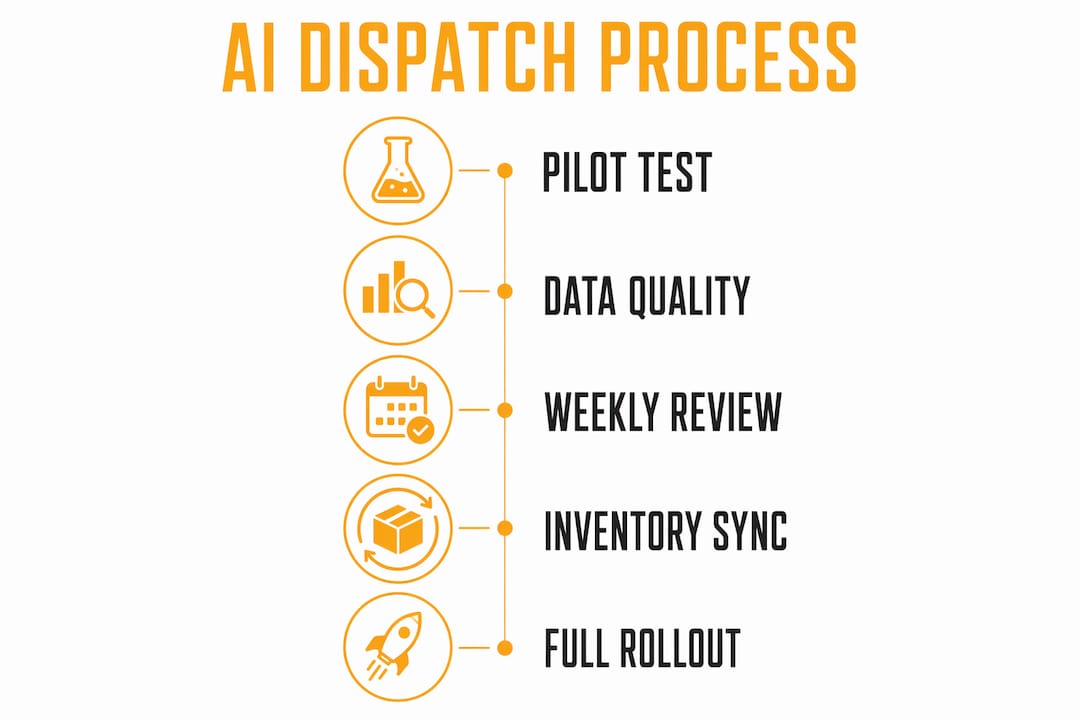
The fastest way to fail is flipping a switch and telling your dispatch team the machine is in charge. Trust collapses, overrides spike, and within a quarter the platform sits unused.
A phased rollout works far better:
- Phase 1 — Suggest, don't assign. The AI proposes the optimal schedule each morning. Dispatchers review, adjust, and approve. The system learns which overrides are rule-driven versus preference-driven.
- Phase 2 — Auto-assign routine jobs. Standard jobs with clean credential matches dispatch automatically. Anything with credential expiry within 14 days, overtime risk, or a first-time customer routes to a human.
- Phase 3 — Exception-only review. The AI runs the day. Dispatchers manage the 5–10% of jobs outside normal rules.
- Phase 4 — Continuous learning. The system adjusts predictions based on your patterns: jobs in a specific zip code consistently run long, one tech is faster on heat pumps, Friday installs in a dense district need a parking buffer.
Start with a pilot on a single route or service unit to prove ROI before a company-wide rollout. This also gives you clean data to calibrate the system before it touches your full schedule.
Data quality is the real foundation. As operational experts note, AI dispatch is not a black box but a continuous optimization process that depends entirely on high-quality inputs: live OBD telematics, traffic APIs, and accurate job histories. Flawed data produces flawed recommendations, regardless of how sophisticated the software is. This mirrors what AI automation adoption practitioners have found across workflow tools: the technology performs to the quality of the data and processes feeding it.

Pro Tip: Track your override rate weekly from day one. A healthy adoption curve sees a substantial reduction in overrides within the first few months. If it stays high, the problem is almost always data quality or a credential mismatch in technician profiles, not the AI itself.
How Tradepilot handles AI dispatching for trade businesses
Tradepilot is built specifically for HVAC, electrical, and plumbing operations. The platform matches every job to the best-fit technician by skill, certification, availability, and location in under a second, with no manual sorting required.
What sets it apart from generic field service tools:
- Single platform for dispatch, invoicing, inventory, and analytics — no data silos between scheduling and billing
- Continuous learning from your operational data — duration estimates and assignment accuracy improve the longer the system runs on your jobs
- Real-time schedule management — the board rebuilds automatically when a tech calls out or a job runs long
- Performance analytics — override rates, first-time fix rates, and utilization metrics tracked in one dashboard
Pro Tip: Connect your inventory data to Tradepilot's dispatch layer from day one. When the system knows what parts are on each truck, it stops sending techs to jobs they can't complete, which is the single fastest way to improve your first-time fix rate.
Key metrics that tell you if AI dispatching is working
The override rate is your leading indicator. It should drop from over 40% in the first week to under 10% within three months as the AI adapts to your operation. If it doesn't, investigate data quality before adjusting the algorithm.
Other metrics worth tracking:
- First-time fix rate — target improvement of 5–10 percentage points within 90 days
- Travel time per technician — up to 50% reduction is achievable; even a 20% reduction represents significant annual savings.
- Utilization rate — 20–30% improvement is typical, freeing capacity without adding headcount
- On-time arrival rate — one regional HVAC company moved from 61% to 89% within 90 days of AI dispatch adoption
Common challenges to avoid during implementation
The biggest pitfall is treating dispatch as a personnel problem when it's actually a data problem. If your technician profiles are incomplete, certifications are out of date, or job durations are estimated rather than tracked, the AI will produce poor recommendations from day one.
Other common mistakes:
- Skipping the pilot phase — rolling out company-wide before validating ROI on one route
- Ignoring dispatcher feedback — overrides contain signal; review them weekly to identify gaps in the system's logic
- Underestimating integration requirements — your dispatch engine needs to connect to your CRM, time tracking, and payroll; closed platforms create new manual work
What AI dispatching costs and when you see ROI
Pricing for AI dispatch software varies by platform and team size, typically structured as a per-seat monthly subscription. ROI from AI dispatch often materializes within 6–12 months, driven by travel time reduction, utilization gains, and first-time fix rate improvements. For a 15-person team, the math is straightforward: a 10-percentage-point improvement in first-time fix rate alone saves $150,000 annually. Travel time savings add another layer on top.
When evaluating cost, factor in the reduction in overtime, the dispatcher hours recovered from manual scheduling, and the customer retention impact of fewer missed windows. Piloting on a single route before full deployment also limits upfront risk and gives you real numbers to build a business case.
What AI dispatching looks like in practice
A regional HVAC company running 48 technicians across 280 daily jobs had a dispatch coordinator spending the first two hours of every morning manually assigning work. By 9 AM the schedule was already 40 minutes behind. On-time arrival sat at 61%, and missed windows were the top driver of negative reviews. After switching to AI dispatch, on-time arrival reached 89% within 90 days and the team completed 23% more jobs per week with the same headcount.
For electrical and plumbing businesses, the gains show up differently but follow the same pattern: fewer return visits, less overtime, and dispatchers spending their time on escalations instead of schedule rebuilding. The phased AI deployment approach that works in other service industries applies directly here: pilot, validate, scale.
Data privacy and security when using AI dispatch
AI dispatch platforms process sensitive operational data: technician locations, customer addresses, job histories, and in some cases payment information. Before committing to any platform, verify:
- Data residency — where your data is stored and whether it stays within the U.S.
- Access controls — role-based permissions so dispatchers see only what they need
- Encryption standards — data encrypted in transit and at rest
- Integration security — API connections to your CRM and ERP should use OAuth or equivalent, not shared credentials
- Vendor data use policies — confirm the vendor does not use your operational data to train models that benefit competitors
Self-hosted deployment options exist for operations with stricter security requirements, though most cloud-based platforms serving U.S. field service businesses operate under SOC 2 compliance frameworks.
Tradepilot gives you the right tech, every time
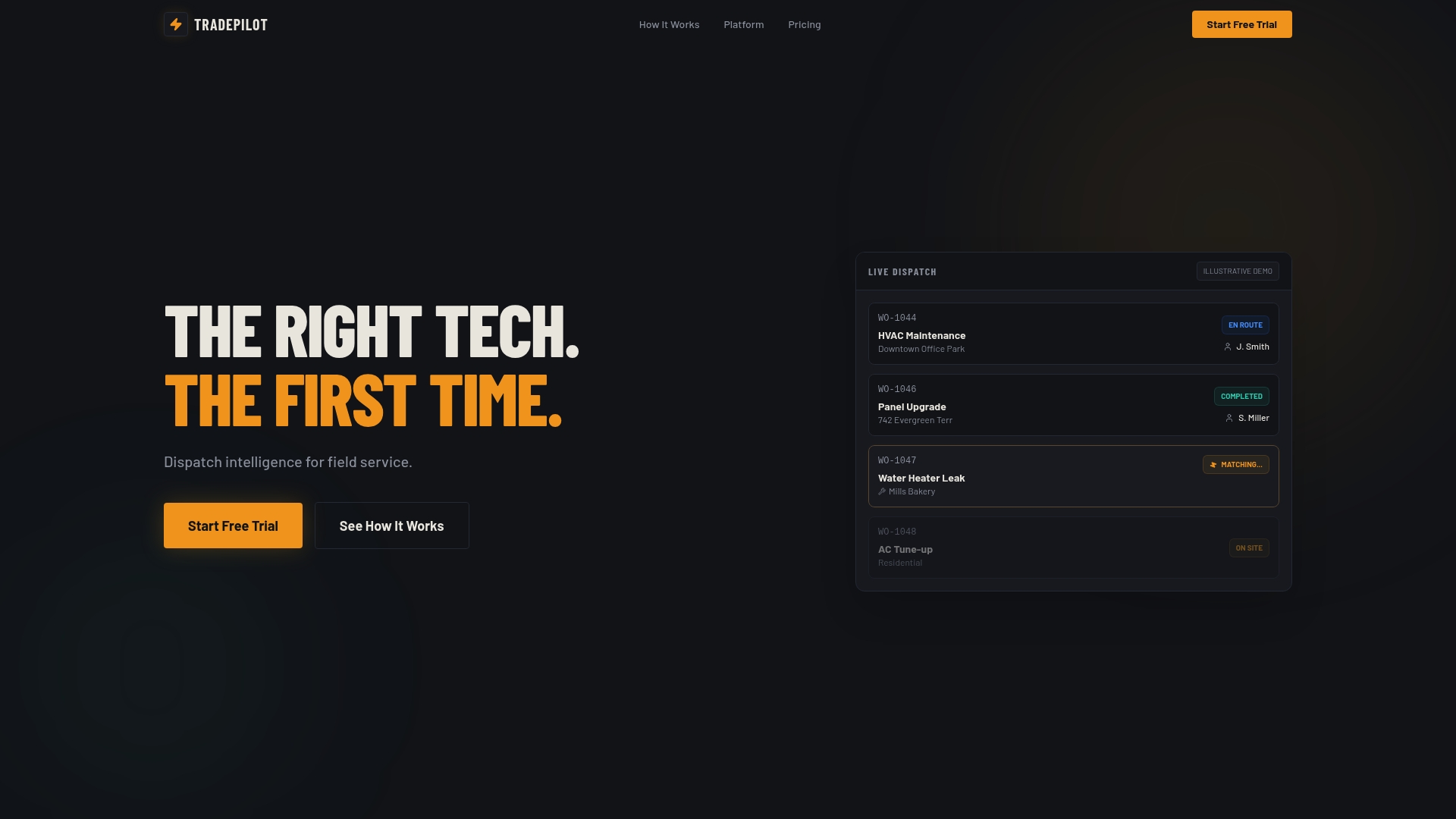
Most dispatch tools were built for logistics or trucking and retrofitted for trade work. Tradepilot was designed from the ground up for HVAC, electrical, and plumbing businesses. The AI matches every job to the best-fit technician by skill, certification, availability, and location in under a second. Dispatch, invoicing, inventory, and analytics live on one platform, so nothing falls through the gap between scheduling and billing.
For a 10-person team, that means 2–3 jobs more per week without adding headcount. For a 40-person operation, it means hundreds of thousands in recovered productive hours annually. The system learns from your data, not a national average, so accuracy improves the longer it runs on your jobs.
See what Tradepilot does for your operation at tradepilotnet.com.
Key Takeaways
AI dispatching delivers measurable ROI for HVAC, electrical, and plumbing businesses when built on clean data, phased adoption, and consistent metric tracking.
| Point | Details |
|---|---|
| Data quality drives results | Flawed technician profiles and inaccurate job histories produce poor AI recommendations regardless of software quality. |
| Phased rollout protects trust | Start with AI suggestions for human approval, then automate routine jobs, then move to exception-only review. |
| Override rate is the key signal | A healthy adoption curve drops from over 40% overrides in the first week to under 10% within three months. |
| ROI timeline is 6–12 months | Travel time reduction, utilization gains, and first-time fix improvements typically cover platform costs within a year. |
| Tradepilot is built for trade businesses | Tradepilot matches every job to the best-fit technician in under a second, combining dispatch, invoicing, inventory, and analytics on one platform. |