
AI for field service is defined as the application of machine learning, autonomous agents, and predictive algorithms to automate and augment field operations. Field service managers in HVAC, electrical, plumbing, and industrial maintenance now use these tools to cut repair times, reduce unscheduled downtime, and match the right technician to every job. The industry frameworks guiding this shift include Prognostics and Health Management (PHM) and the emerging Maintenance 5.0 standard, which places human judgment at the center of AI-assisted workflows. The practical result is faster service, lower costs, and a workforce that spends less time guessing and more time fixing.
How AI for field service transforms predictive maintenance
Predictive maintenance is the practice of using real-time data to catch equipment faults before they cause failures. AI makes this possible at scale by processing sensor readings, images, and maintenance logs simultaneously, then flagging anomalies before a technician ever sets foot on site.
The accuracy gains are significant. Attention-enhanced deep learning for predictive maintenance achieves fault detection with F1 scores as high as 96.85% and diagnostic accuracy of 97.45%. That level of precision means fewer false alarms and fewer missed faults, both of which drain dispatcher time and inflate service costs.
Multimodal generative AI takes this further by combining sensor data, photographic evidence, and text-based maintenance records into a single diagnostic model. A study published in may 2026 found that multimodal AI reduces repair times by 64% and lowers per-unit carbon intensity by over 8%. That carbon reduction matters because regulators and enterprise clients increasingly require service providers to report on their environmental footprint.
The core AI techniques driving these results include:
- Deep learning with attention mechanisms: These models weigh the most relevant sensor signals at each moment, filtering noise from genuinely critical readings.
- Cache-augmented generative AI: Stores recent operational context so the model does not reprocess historical data from scratch on every diagnostic cycle.
- Multimodal data fusion: Merges image, text, and time-series inputs into one unified fault prediction, reducing the blind spots that single-source models miss.
Pro Tip: Set your AI predictive maintenance thresholds conservatively at first. A high-sensitivity model generates more alerts, but your team needs time to build trust in the system before acting on every flag.
Linking maintenance decisions to gate-to-gate energy use and carbon intensity also gives field service managers a new lever for sustainability reporting. This is no longer a compliance checkbox. It is a competitive differentiator when bidding on contracts with large commercial clients.
What do AI agents actually do in field coordination?
AI agents are software programs that execute coordination tasks autonomously, without waiting for a dispatcher to trigger each step. They handle the repetitive, time-consuming work that stalls jobs and frustrates clients.
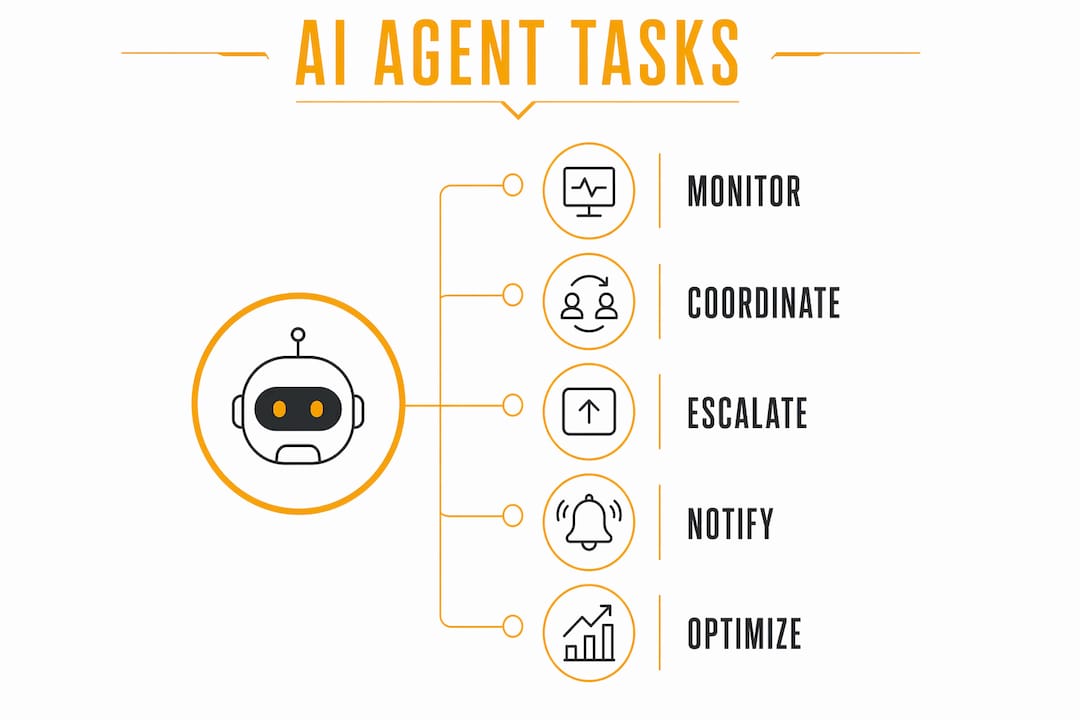
Specifically, AI agents manage routine tasks such as parts confirmation, supplier chasing, and client status updates across phone, email, and text simultaneously. A dispatcher who previously spent two hours per day following up on stalled jobs can redirect that time to complex decisions that require human judgment.
The multi-channel persistence of these agents is what separates them from simple automated emails. AI agents operate across all channels dynamically, mimicking the follow-through of a skilled dispatcher without manual intervention. If a supplier does not respond to an email, the agent escalates to a phone call. If a client misses a text, the agent logs the attempt and retries.
AI agents should never replace human judgment on complex exceptions. The right design configures escalation thresholds so that SLA breaches, safety concerns, and high-value client issues always route to a human decision-maker. Compliance logging of every agent action also creates an audit trail that protects the business in disputes.
The numbered sequence of how an AI agent handles a stalled job looks like this:
- The agent detects a parts delay based on supplier confirmation data.
- It contacts the supplier via email and logs the timestamp.
- If no response arrives within the defined window, it escalates to a phone follow-up.
- It sends the client a proactive status update with a revised ETA.
- If the SLA breach threshold is crossed, it alerts the dispatcher for manual intervention.
- Every action is logged with timestamps for compliance and traceability.
Pro Tip: Configure your AI agent's escalation thresholds around your actual SLA terms, not generic defaults. A 4-hour SLA for emergency HVAC calls needs a different escalation window than a 48-hour SLA for routine inspections.
How does AI improve scheduling and real-time visibility?
AI-driven scheduling moves dispatch from a reactive, phone-based process to a proactive, data-driven one. The difference shows up in first-time fix rates and technician utilization.

Real-time AI photo analysis flags equipment issues, missing PPE, and safety violations directly from field photos, improving inspection accuracy and compliance without requiring a supervisor on site. A technician submits a photo of a completed installation, and the AI checks it against safety standards before the job is closed. This catches errors that would otherwise surface as callbacks or, worse, as liability claims.
AI-driven asset and team tracking provides a live map-based view of equipment locations and technician positions, giving dispatchers the context they need to make fast, accurate assignments. Workload balancing becomes visible in real time rather than relying on a dispatcher's memory of who is busy.
The table below shows how AI-driven scheduling compares to traditional dispatch across key operational metrics:
| Metric | Traditional dispatch | AI-driven scheduling |
|---|---|---|
| Job-to-technician matching | Manual, experience-based | Automated by skill, location, and availability |
| Safety compliance checks | Supervisor review after the fact | Real-time photo analysis at job close |
| Asset visibility | Periodic check-ins | Continuous live map tracking |
| Anomaly detection | Reactive, post-failure | Automated alerts from sensor and photo data |
Automated inspection scheduling removes another manual bottleneck. Instead of a manager tracking which assets are due for inspection, the AI flags overdue equipment and generates work orders directly. This keeps maintenance cycles consistent across multiple sites without relying on individual memory or spreadsheet reminders.
How does AI-powered knowledge management help technicians?
Technician productivity depends on fast access to accurate information. The average field technician loses significant time searching through paper manuals, outdated PDFs, or calling back to the office for guidance. AI copilots solve this by indexing all documentation and returning exact, source-cited answers in seconds.
AI copilots convert scattered manuals, SOPs, and videos into instant technical guidance, with each answer linked to the exact source document. That source citation is critical. It prevents the AI from hallucinating a procedure and gives the technician a way to verify the answer before acting on it. Onboarding time drops because new technicians can query the system instead of shadowing a senior colleague for weeks.
The workflow benefits extend beyond individual lookups:
- Executable checklists: AI converts a troubleshooting answer into a step-by-step checklist that the technician follows and checks off, creating an audit-ready record of the procedure.
- CMMS integration: Completed checklists export directly to the Computerized Maintenance Management System, eliminating manual data entry after the job.
- Escalation reduction: When technicians can resolve questions independently, fewer calls go to senior engineers, freeing specialists for genuinely complex problems.
- Cross-site standardization: Every technician at every location follows the same AI-verified procedure, reducing variation in repair quality.
The key design principle here is source-cited answers that link to exact manuals or SOPs. Without that traceability, technicians cannot trust the output, and adoption stalls. Trust in the AI's reasoning is not a soft concern. It is the primary adoption barrier in field service deployments.
Key Takeaways
AI for field service delivers measurable gains in repair speed, scheduling accuracy, and technician productivity when deployed with clear escalation rules and source-cited knowledge tools.
| Point | Details |
|---|---|
| Predictive maintenance accuracy | Attention-enhanced deep learning achieves diagnostic accuracy of 97.45%, cutting unscheduled downtime. |
| AI agents reduce dispatcher load | Autonomous agents handle parts chasing, client updates, and supplier follow-ups across all channels. |
| Real-time photo analysis | AI flags safety violations and equipment defects at job close, replacing after-the-fact supervisor review. |
| Knowledge copilots cut escalations | Source-cited AI answers let technicians resolve issues independently, reducing calls to senior engineers. |
| Human judgment stays central | Configurable escalation thresholds and Maintenance 5.0 principles keep humans in control of complex decisions. |
Why I think most field service teams are adopting AI in the wrong order
Most teams I have seen start with scheduling automation because it is the most visible problem. Dispatchers are overwhelmed, jobs are misassigned, and the pressure to fix that is immediate. Scheduling AI does help. But teams that skip predictive maintenance and knowledge management first end up with faster dispatch of technicians who still arrive unprepared or get called out to failures that should never have happened.
The trustworthiness and interpretability of AI diagnostics are the real adoption barriers. If a technician does not understand why the AI flagged a fault, they will ignore the alert. If the knowledge copilot gives an answer without a source, they will not act on it. The technology is not the hard part. Building the trust infrastructure around it is.
The Maintenance 5.0 framework gets this right. It treats AI as a tool that supports technician self-sufficiency rather than replacing technician judgment. Human-centered AI design means the system explains its reasoning, surfaces the source of every recommendation, and escalates to a human when confidence is low. Teams that deploy AI with this philosophy see faster adoption and fewer rollback decisions six months in.
My honest recommendation: start with knowledge management. Give your technicians an AI copilot that answers questions from your own documentation. That builds trust in AI outputs before you ask your team to act on predictive fault alerts or automated dispatch decisions. Trust compounds. Build it early.
— Mark
Tradepilotnet: AI-matched dispatch for HVAC, electrical, and plumbing teams
Field service managers running HVAC, electrical, or plumbing operations face a specific version of the dispatch problem. Every job has a different skill requirement, and the cost of sending the wrong technician is a callback, a dissatisfied client, and a wasted day.
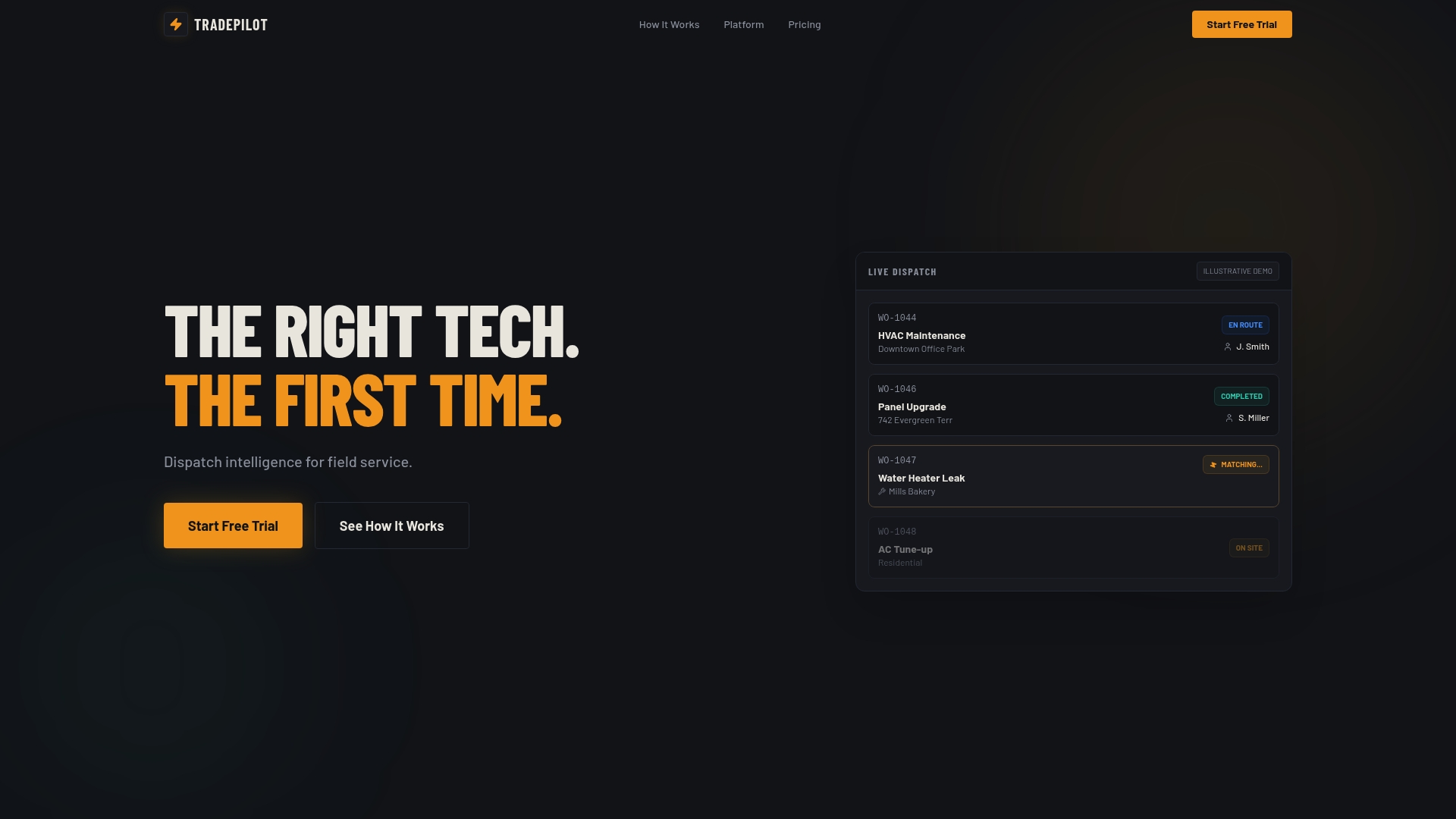
Tradepilotnet matches every job to the best-fit technician by skill, availability, and location in under a second. The platform covers dispatch, invoicing, inventory, and analytics in one place, so your team stops switching between tools and starts closing jobs faster. If your dispatch process still relies on a dispatcher's memory or a whiteboard, Tradepilotnet is worth a close look.
FAQ
What is AI for field service?
AI for field service is the use of machine learning, autonomous agents, and predictive algorithms to automate scheduling, maintenance, and coordination tasks in field operations. The goal is faster repairs, fewer unscheduled failures, and better technician utilization.
How accurate is AI in predicting equipment faults?
Attention-enhanced deep learning models achieve fault detection accuracy of up to 97.45%, making AI-driven predictive maintenance significantly more reliable than manual inspection schedules.
Can AI agents replace dispatchers?
AI agents handle routine coordination tasks like parts chasing and client updates, but they escalate SLA breaches and complex decisions to human dispatchers. The design intent is to reduce dispatcher workload, not eliminate the role.
How does AI reduce repair times?
Multimodal generative AI combines sensor data, images, and maintenance records to diagnose faults faster and more accurately. Studies show this approach cuts repair times by 64% compared to traditional diagnostic methods.
What is Maintenance 5.0 and why does it matter?
Maintenance 5.0 is an industry framework that centers human judgment within AI-assisted maintenance workflows. It matters because it defines how AI tools should be designed to support technician decision-making rather than override it, which is the key to sustainable adoption.