
What are the best field service management apps in 2026?
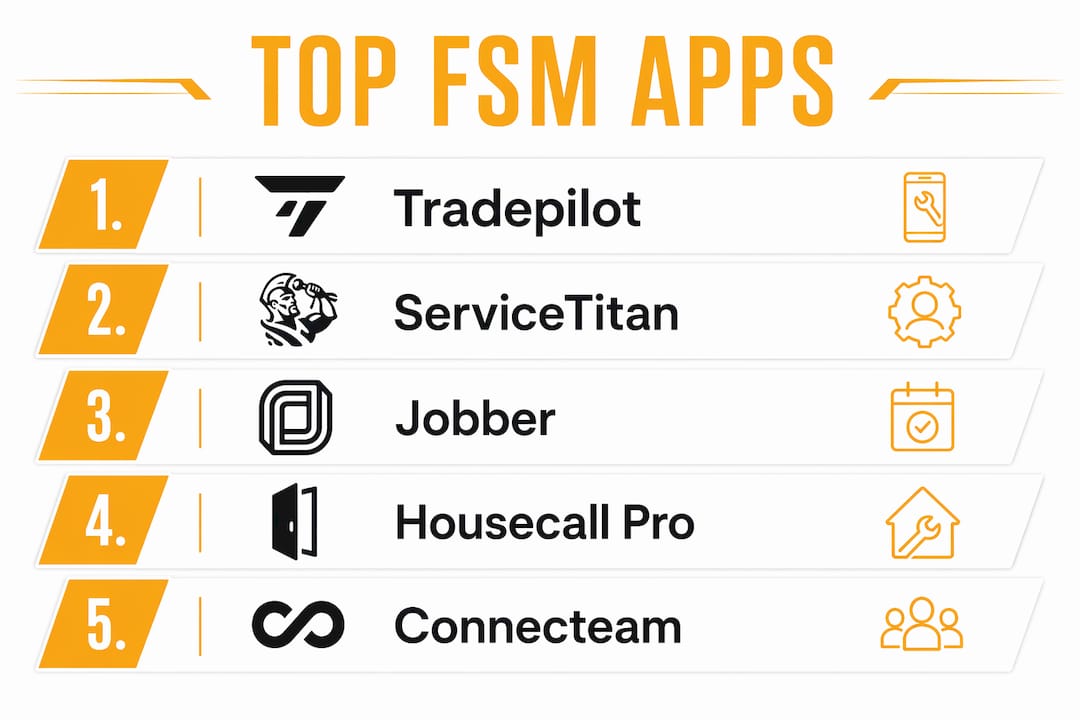
The short answer: Tradepilot, ServiceTitan, Jobber, Housecall Pro, and Connecteam lead the pack for trades businesses in 2026, each built for a different slice of the market. Choosing the wrong one costs you more than money. It costs you dispatched jobs, missed invoices, and technicians showing up to the wrong address with the wrong parts.
Field service management (FSM) software connects your scheduling, dispatch, invoicing, and field team into one system. For HVAC, electrical, and plumbing businesses, that connection is the difference between running five jobs a day cleanly and scrambling through a whiteboard and a group text. The G2 Spring 2026 Grid Report highlights satisfaction scores across ease of use, support quality, and feature depth for the top platforms, giving buyers a reliable benchmark.
Here is how the leading options stack up across the dimensions that matter most to trades SMBs.
| Product | Best For | Key Features | Pricing | Ease of Use | US Market |
|---|---|---|---|---|---|
| Tradepilot | HVAC, electrical, and plumbing SMBs needing AI dispatch | AI dispatch, invoicing, inventory, analytics | Not publicly listed | High | Yes |
| Salesforce Field Service | Teams on Salesforce CRM needing intelligent scheduling | Offline mobile app, AI scheduling, CRM integration | From $125/user/month | Moderate | Yes |
| Jobber | Small trades businesses needing simple management | Scheduling, invoicing, client management | From $22/month | Very High | Yes |
| Connecteam | Deskless teams across multiple sites | GPS tracking, time tracking, scheduling, communication | From $29/month for 30 users | Very High | Yes |
| Housecall Pro | Small to mid-sized home service businesses | Scheduling, dispatch, billing, payments | — | High | Yes |
| ServiceTitan | Larger service enterprises | CRM, end-to-end workflows, reporting | Not publicly listed | Moderate | Yes |
| Service Fusion | Home service SMBs | Scheduling, billing, invoicing | Not publicly listed | High | Yes |
| Zuper | Mid-market firms valuing automation | Scheduling, dispatch, workforce management | Not publicly listed | High | Yes |
| ServiceM8 | Solo contractors and very small teams | Job management, free tier option | Free tier available | Very High | Yes |
| Contractor+ | Contractors needing job and client management | Estimates, invoicing, scheduling | Not publicly listed | High | Yes |
| Zoho FSM | Businesses in the Zoho ecosystem | Zoho CRM integration, scheduling | Not publicly listed | High | Yes |
| SafetyCulture | Compliance and field data capture | Form builder, real-time analytics | Not publicly listed | High | Yes |
| NimbCrew | SMBs needing simple scheduling | Workflow automation, mobile updates | Not publicly listed | High | Yes |
| Intuit Field Service Management | Businesses wanting accounting integration | Financial management, scheduling | Not publicly listed | High | Yes |
| Simpro | Trades needing complex job management | Job costing, inventory, project tracking | Not publicly listed | Moderate | Yes |
| Skedulo | Complex resource allocation needs | Scheduling algorithms, analytics | Not publicly listed | Moderate | Yes |
| Kickserv | Small businesses needing simple tools | Scheduling, invoicing, CRM, desktop/mobile sync | Not publicly listed | Very High | Yes |
| Workiz | Small to medium service businesses | Marketing tools, scheduling, payments | Not publicly listed | High | Yes |
| Microsoft Dynamics 365 Field Service | Enterprise and mid-market on Microsoft stack | Power Platform integration, Azure services | Not publicly listed | Moderate | Yes |
Table of Contents
- How do the top field service apps compare in depth?
- How to choose the best field service management software for your business
- How AI-powered dispatching transforms field service management
- Key Takeaways
- The real problem with how trades businesses pick FSM software
- Tradepilot gives HVAC, electrical, and plumbing businesses a smarter way to dispatch
How do the top field service apps compare in depth?
The table above gives you the snapshot. What it cannot show is where each platform actually earns its keep and where it falls short for a trades business running 5–50 technicians.
Tradepilot sits in a specific lane: HVAC, electrical, and plumbing businesses that are tired of dispatch being a guessing game. Its AI matches every job to the right technician by skill, availability, and location in under a second. That is not a scheduling calendar with a drag-and-drop interface. It is a system that reads your workforce in real time and makes the call before your dispatcher finishes their coffee. Dispatch, invoicing, inventory, and analytics live in one platform, so nothing falls through the gap between systems.

Salesforce Field Service (now branded Agentforce Field Service) is the enterprise-grade choice for teams already running on Salesforce CRM. Starting at $125/user/month, it is priced for organizations that need intelligent scheduling, an offline-first mobile app, and deep CRM integration. For a 10-person plumbing company, that price point is hard to justify. For a 200-person facilities management firm, it is table stakes.
Jobber is the go-to for small trades businesses that want to get organized without a six-week implementation. Plans start at an affordable entry-level price, and the mobile app earns consistent praise from field technicians for letting them manage jobs, collect payments, and update job status from their phones. It does not have AI dispatch or deep inventory management, but for a two-person electrical crew, it does not need to.
Connecteam approaches the problem from a workforce management angle rather than a pure FSM angle. Starting at a moderate monthly price for up to 30 users, it covers GPS tracking, time tracking, shift scheduling, and team communication in one mobile-first package. Trades businesses with deskless crews spread across multiple job sites find it particularly useful. The tradeoff is that it lacks the job costing and invoicing depth that dedicated FSM platforms offer.
Housecall Pro hits the sweet spot for home service businesses that need scheduling, dispatch, billing, and payment processing without a steep learning curve. Plans start at a mid-range monthly price, and the mobile app is well-regarded for its clean design. It works well for HVAC and plumbing shops with a handful of techs, though it can feel limiting as teams grow past 15–20 people.
ServiceTitan is the platform trades businesses graduate to when they outgrow simpler tools. It covers CRM, end-to-end service workflows, and detailed reporting, and it is built specifically for the trades. Pricing is not publicly listed, and implementation takes time, but for a 30-plus-person operation, the depth pays off.
ServiceM8 deserves a mention for solo contractors and very small teams. It offers a free tier, a clean interface, and enough job management capability to replace a paper system without overwhelming a one-person shop.
Simpro targets trades businesses with complex project and job management needs, including job costing and inventory tracking that go deeper than most platforms in this category. It is not the easiest to set up, but for electrical or plumbing contractors running multi-phase projects, that depth matters.
Workiz stands out for service businesses that want marketing tools built into their FSM platform. Most platforms in this category treat customer acquisition as someone else's problem. Workiz integrates call tracking, online booking, and review management alongside scheduling and payments.
Microsoft Dynamics 365 Field Service belongs in the enterprise column alongside Salesforce Field Service. It connects deeply with the Power Platform and Azure services, making it the natural choice for mid-market and enterprise organizations already running on Microsoft infrastructure.
The remaining platforms, including Zuper, Contractor+, Zoho FSM, SafetyCulture, NimbCrew, Intuit Field Service Management, Skedulo, and Kickserv, each serve specific niches. Zoho FSM makes sense if your business already runs on Zoho CRM. SafetyCulture is purpose-built for compliance and field data capture, not job dispatch. Kickserv suits small businesses that want a simple, cloud-based tool with desktop and mobile sync. Skedulo handles complex resource allocation for organizations with sophisticated scheduling requirements.
Pro Tip: Before committing to any platform, ask the vendor for a live demo using your actual job types and technician count. Generic demos hide the friction points that only show up when you model your real workflow.
How to choose the best field service management software for your business
The right FSM platform for your business depends on three things: your team size, your workflow complexity, and how much you are willing to invest in setup. Most buyers get this wrong by focusing on feature lists instead of fit.
Core features to prioritize
Start with the non-negotiables for any trades business:
- Scheduling and dispatch: Can the platform assign jobs to technicians based on skill and location, or does it just show you a calendar?
- Mobile access: Do your technicians get a real mobile app with offline capability, or a browser wrapper that breaks in the field?
- Invoicing and payments: Can you generate and collect payment on-site, or does billing happen back at the office hours later?
- Job history and customer records: Does the system track what was done at each address, what parts were used, and what was quoted?
Highly rated FSM apps consistently prioritize GPS tracking, time clocks, and integrated communication tools, because those are the features field technicians actually use every day.
Mobile usability and offline functionality
Your technicians are not sitting at desks. They are in crawl spaces, on rooftops, and in basements where cell service is unreliable. An FSM app that requires a live internet connection to function is a liability in the field. Look for platforms with offline-first mobile apps that sync when connectivity returns. Salesforce Field Service and Tradepilot both emphasize offline capability as a core design principle, not an afterthought.
Integration with your existing systems
If you are already running QuickBooks, a CRM, or an ERP, your FSM platform needs to talk to those systems. Integration with CRM and ERP systems synchronizes customer, scheduling, and asset data across platforms, cutting the manual re-entry that eats hours every week. Zoho FSM integrates naturally with Zoho CRM. Intuit Field Service Management connects with QuickBooks. Salesforce Field Service is built on Salesforce CRM. Tradepilot consolidates dispatch, invoicing, and inventory in one platform, reducing the number of integrations you need in the first place.
Pricing and budget reality
Pricing models range from free tiers for limited users to per-user monthly subscriptions at higher price points, depending on functionality and scale. For most trades SMBs, the practical range is $29–$125/user/month. ServiceM8 offers a free tier for very small teams. Jobber starts at $22/month for the whole account, making it one of the most affordable entry points in the category.
The real cost question is not the subscription fee. It is the cost of a bad dispatch, a missed invoice, or a technician driving 45 minutes to a job that should have gone to someone closer. A platform that eliminates those errors pays for itself fast.
Onboarding and implementation timelines
Simple platforms like Jobber, Housecall Pro, and Connecteam can be up and running in a day or two. Enterprise platforms like ServiceTitan and Microsoft Dynamics 365 Field Service require weeks of configuration and training. Be honest about your team's capacity for change. A powerful platform that nobody uses correctly is worse than a simple one that everyone adopts.
Vendor support and credibility
Check whether the vendor offers live support, not just a knowledge base. For a trades business running jobs six days a week, a support ticket that takes 48 hours to resolve is a real operational problem. Ask specifically about support hours, response times, and whether you get a dedicated account manager or a shared queue.
Pro Tip: Run a 30-day pilot with your two or three most tech-comfortable technicians before rolling out to the whole team. Their feedback will surface the friction points that no demo ever shows you.
How AI-powered dispatching transforms field service management
Manual dispatch is a bottleneck that most trades businesses have simply accepted. A dispatcher looks at a board, makes a judgment call, and assigns a job. That call is only as good as the dispatcher's memory of who is where, who has which certifications, and who finished their last job early. AI dispatch replaces that judgment call with a real-time calculation.
AI-enhanced FSM platforms enable intelligent scheduling that increases first-time fix rates and reduces admin overhead. The mechanism is straightforward: the system reads technician skills, current location, availability, and job requirements simultaneously, then assigns the best match in seconds. What used to take a dispatcher five minutes of phone calls and map-checking happens automatically.
For HVAC, electrical, and plumbing businesses, first-time fix rate is one of the most important metrics in the business. A callback costs you the labor for a second visit, the customer's trust, and often a negative review. Getting the right technician to the right job the first time is not a nice operational goal. It directly affects your revenue and your reputation.
Tradepilot's AI dispatch matches every job to the best-fit technician by skill, availability, and location in under a second. That speed matters when you are managing 20 jobs across a metro area and a new emergency call comes in at 2:00 PM. The system recalculates the entire day's schedule in real time, not after a dispatcher has spent 10 minutes on the phone.
The broader operational effect is that your dispatcher stops being a bottleneck and starts being a manager. Instead of spending the day on the phone coordinating logistics, they can focus on customer communication, escalations, and quality control. That shift in role is where the real productivity gain lives.
Pro Tip: When evaluating AI dispatch tools, ask the vendor to show you how the system handles a mid-day emergency job insertion. That scenario reveals whether the AI is genuinely dynamic or just a smarter calendar.
Key Takeaways
The best field service management software for trades businesses in 2026 depends on team size, workflow complexity, and whether AI dispatch is a priority or a future consideration.
| Point | Details |
|---|---|
| AI dispatch changes the game | Platforms like Tradepilot match jobs to technicians by skill, location, and availability in under a second, cutting callbacks and admin time. |
| Pricing ranges widely | FSM software runs from free tiers for small teams to $125/user/month for enterprise platforms like Salesforce Field Service. |
| Mobile and offline capability matter | Field technicians need apps that work without cell service; offline-first design is a must-have, not a bonus feature. |
| Match the platform to your size | Jobber and Housecall Pro suit small trades businesses; ServiceTitan and Microsoft Dynamics 365 Field Service fit larger operations. |
| Tradepilot for trades SMBs | HVAC, electrical, and plumbing businesses needing integrated dispatch, invoicing, inventory, and analytics in one platform. |
The real problem with how trades businesses pick FSM software
Most trades business owners pick their FSM platform the same way they pick a truck: they go with what the guy down the street uses, or they buy the one with the most features listed on the website. Neither approach works.
The feature-list trap is particularly dangerous in this category. Every platform in this comparison claims to handle scheduling, dispatch, invoicing, and mobile access. The differences live in the execution: how fast the dispatch actually works, whether the mobile app holds up when a technician is in a basement with no signal, and whether the invoicing flow matches how your business actually bills.
The platforms that consistently get adopted by field teams are the ones that were designed around the technician's experience, not the manager's dashboard. Connecteam's mobile app earns its reputation because field workers can clock in, check their schedule, and message their supervisor without switching apps. Jobber's invoicing works because a plumber can send a bill from their truck before they pull out of the driveway.
Where most articles get this wrong is by treating AI dispatch as a future feature rather than a current differentiator. For HVAC, electrical, and plumbing businesses running more than 10 technicians, manual dispatch is already a ceiling on growth. You cannot scale past a certain job volume without the system doing the matching work. That is the real argument for platforms like Tradepilot: not that AI is impressive technology, but that it removes the human bottleneck that limits how many jobs you can run in a day.
The other underrated factor is vendor longevity and support. A platform that goes dark or gets acquired mid-contract is a real risk in this market. Prioritize vendors with clear pricing, responsive support, and a track record in your specific trade.
Tradepilot gives HVAC, electrical, and plumbing businesses a smarter way to dispatch
Every platform in this comparison handles scheduling. Tradepilot handles the part that comes before scheduling: figuring out which technician should take the job in the first place. Its AI reads skill sets, real-time location, and availability simultaneously, then makes the assignment in under a second. That is the specific problem that costs trades businesses the most money, and it is the one most FSM platforms leave to a human dispatcher.
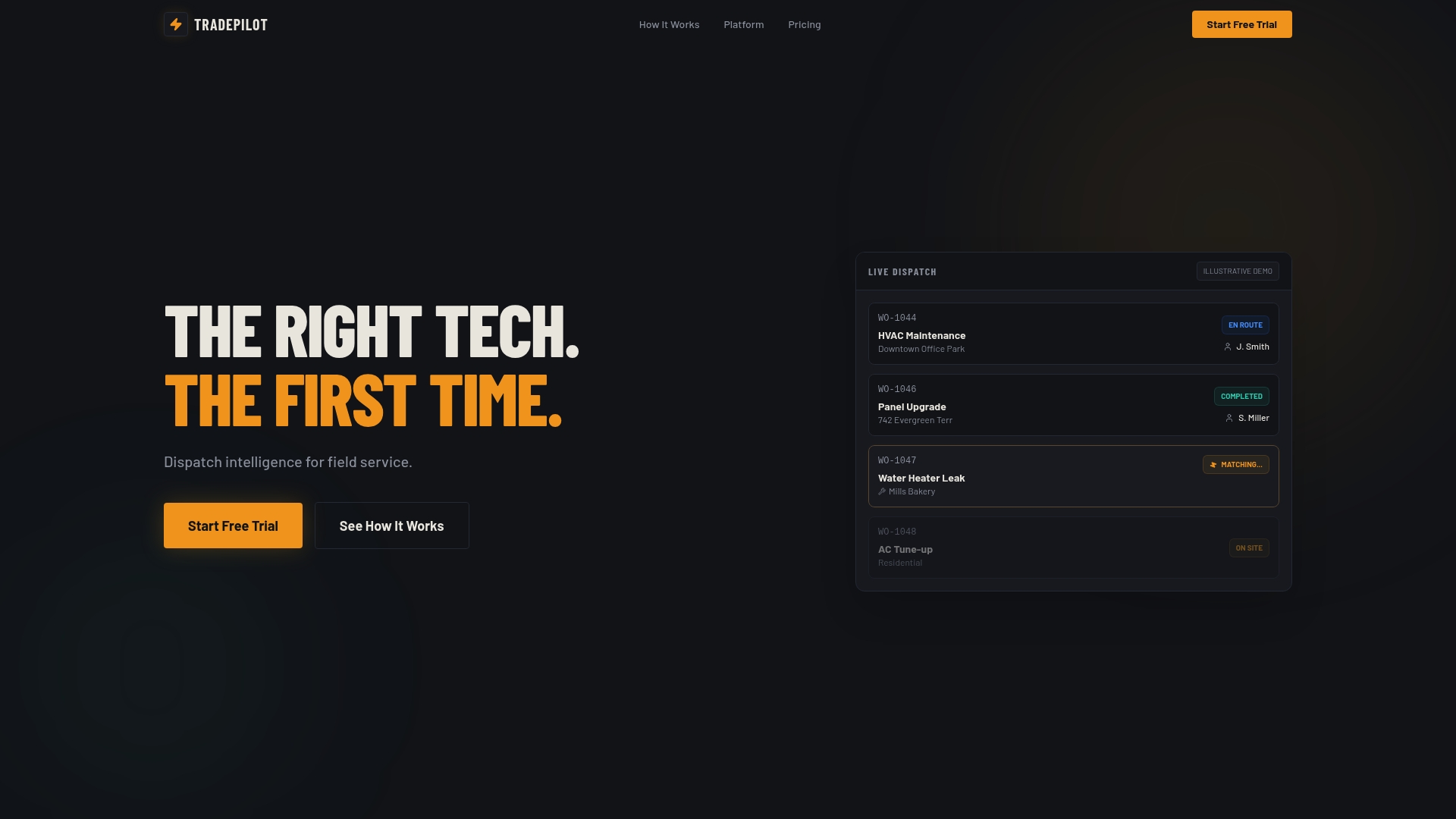
Beyond dispatch, Tradepilot brings invoicing, inventory tracking, and performance analytics into the same platform. For an HVAC, electrical, or plumbing business, that means your dispatcher, your office manager, and your technicians are all working from the same data. No re-entry between systems, no invoices that get lost between the field and the office, and no inventory surprises when a technician opens a job and the part is not in stock.
Tradepilot is built specifically for trades SMBs, not adapted from a generic workforce management tool, according to Techrunners - Expert Tech Consulting & Computer Repair in Essex County, NJ. If your business runs on service calls and your biggest operational headache is getting the right tech to the right job without burning half your dispatcher's day, see how Tradepilot works and request a demo.