
What's the best HVAC dispatch software right now?
The short answer: it depends on your team size and how much automation you actually want. But across the nine platforms worth considering in 2026, a clear pattern holds. Businesses that switch to AI-powered dispatch see significant operational efficiency gains through intelligent routing and automated technician assignment. That's not a marginal improvement. It's the difference between a dispatcher juggling a whiteboard and a system that assigns the right tech before the customer hangs up.
The nine platforms below cover every business size, from a solo tech running Jobber on an iPhone to a multi-branch enterprise running FIELDBOSS on Microsoft Dynamics 365.
| Platform | Best For | Key Features | Pricing | Ease of Use | AI/Automation | Integrations |
|---|---|---|---|---|---|---|
| TradePilot | Mid-size to large HVAC businesses | AI dispatch, invoicing, inventory, analytics | Subscription tiers | High | AI job-to-tech matching in under a second | CRM, accounting, inventory |
| ServiceTitan | Growing HVAC companies | Scheduling, dispatch, CRM, reporting | Premium (custom) | Moderate | Automated workflows | Broad (wide integrations) |
| Field Edge | Small to medium HVAC businesses | Dispatch, customer management, job tracking | Mid-range | High | Basic automation | QuickBooks, CRM |
| Housecall Pro | Small teams and solo techs | Mobile scheduling, customer comms, payments | Affordable tiers | Very high | Automated reminders | QuickBooks, Stripe |
| FIELDBOSS | Large HVAC enterprises | Enterprise dispatch, analytics, contracts | Enterprise (custom) | Moderate | Advanced automation | Full Microsoft 365 ecosystem |
| BuildOps | Mid to large HVAC companies | Reporting, workflows, project management | Custom | Moderate | Workflow automation | ERP, accounting |
| WennSoft | Medium to large HVAC firms | ERP integration, dispatch automation | Custom | Moderate | Dispatch automation | Microsoft Dynamics, ERP |
| Jobber | Small businesses new to software | Scheduling, quoting, invoicing | Affordable tiers | Very high | Basic automation | QuickBooks, Stripe |
| FieldCamp | Small HVAC teams | AI dispatch, drag-and-drop scheduling | Affordable, free trial | High | AI-enhanced scheduling | Core integrations |
Standout advantages across the field:
- TradePilot matches jobs to technicians by skill, location, and availability in under a second
- ServiceTitan offers the broadest integration library of any platform on this list
- FIELDBOSS delivers enterprise-grade analytics through the full Microsoft 365 stack
- Housecall Pro and Jobber lead on ease of use for teams with no prior software experience
- FieldCamp offers AI-enhanced scheduling with a free trial, lowering the barrier to entry
- BuildOps gives mid-market operators detailed reporting and customizable job workflows
- WennSoft connects dispatch directly to ERP for companies with complex back-office needs
- Real-time updates and professional job management contribute to high customer satisfaction scores.
Customer support quality varies significantly. ServiceTitan and FIELDBOSS both offer dedicated onboarding teams and ongoing training programs. Housecall Pro and Jobber lean on self-serve help centers and live chat. TradePilot, BuildOps, and WennSoft each provide structured onboarding for new accounts.
Table of Contents
- How to choose the best HVAC dispatch software for your business
- What features should HVAC dispatch software actually have?
- How AI and IoT are reshaping HVAC dispatch in 2026
- Tradepilot: AI dispatch built for HVAC operators who want one platform
- Key Takeaways
How to choose the best HVAC dispatch software for your business
The wrong software costs more than the subscription fee. It costs you technician time, dispatcher frustration, and customers who don't call back. Getting the selection right means working through a short list of non-negotiable criteria before you ever book a demo.
Start with your actual team size and service mix. A six-tech residential shop has completely different needs than a 40-tech commercial contractor running preventive maintenance contracts. Platforms like Jobber and Housecall Pro are built for the former. ServiceTitan, FIELDBOSS, and BuildOps are built for the latter. Trying to run a large operation on a small-business tool, or paying enterprise prices for a two-person crew, both create problems.

AI and automation features are now table stakes, not extras. Skill-based AI dispatch cuts dispatch time significantly and improves first-call fix rates considerably. If a platform you're evaluating can't match technicians to jobs based on certification, proximity, and current workload, it's already behind. Ask vendors specifically how their dispatch logic works, not just whether they have "AI."
Key criteria to evaluate before signing:
- Team size fit: does the platform scale with your headcount without a pricing cliff?
- AI dispatch logic: skill-based, location-aware, and workload-balanced assignment
- CRM and accounting integration with automatic data sync to eliminate double entry
- Mobile app quality: offline functionality for attic and basement work matters more than most buyers realize
- Pricing transparency: subscription tiers with clear per-seat costs versus opaque custom quotes
- Onboarding support: dedicated implementation help versus a self-serve knowledge base
- Emergency dispatch: automated alerts and priority scheduling for urgent calls
Pro Tip: Before committing to any platform, run a 30-day pilot with your actual dispatchers and at least two field technicians. Real-world friction shows up in week two, not in a demo. Most platforms offer trial periods; use them.
Pricing models deserve a closer look. Subscription tiers with pay-for-use modules let growing businesses align costs with actual usage rather than paying for features they won't touch for 18 months. Platforms with fully custom enterprise pricing, like ServiceTitan and FIELDBOSS, often require a sales call to get numbers. That's not necessarily a red flag, but budget extra time for the evaluation process.
What features should HVAC dispatch software actually have?
Not every feature list in a vendor's marketing deck reflects what field teams actually use. These are the capabilities that move the needle on a real HVAC operation.
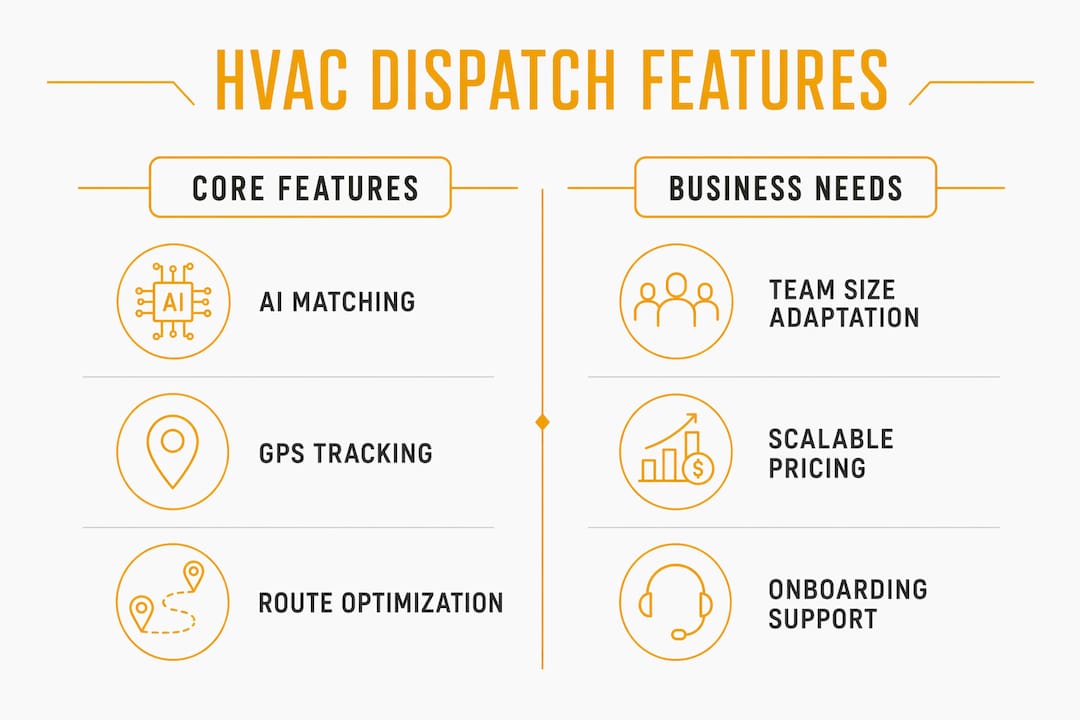
AI-powered technician-job matching is the core of any modern dispatch platform. The system should consider technician certifications, current location, workload, and job priority simultaneously, not just who's available. Platforms that only check availability without factoring in skill or proximity still leave money on the table.
Real-time GPS tracking gives dispatchers live visibility into where every technician is, how long they've been on-site, and whether a job is running over. GPS tracking improves job completion rates and response times by removing the guesswork from reassignment decisions. When an emergency call comes in, a dispatcher with a live map can act in seconds.

Mobile apps with offline functionality are non-negotiable for field technicians. Attics, basements, and mechanical rooms routinely have no cell signal. A mobile app that only works online is a liability in those environments. Look for automatic sync when connectivity returns, so job updates, photos, and notes don't get lost.
Additional capabilities that separate good platforms from great ones:
- Emergency dispatch with automated technician alerts and priority queue management
- Work order management with photo capture, customer signatures, and job notes
- Rotating shift scheduling and skill-based workload balancing
- Access to equipment histories, service manuals, and warranty records from the field
- Performance dashboards tracking first-call fix rates, job completion times, and technician productivity
- Role-based access controls so field techs see only what they need, while managers see everything
- Parts-on-truck inventory tracking so dispatchers know which tech carries the right parts before assigning a job
Security and data privacy matter more as HVAC businesses store customer payment data, equipment histories, and service contracts in the cloud. Role-based access controls, encrypted data storage, and SOC 2 compliance are worth asking about during any vendor evaluation.
How AI and IoT are reshaping HVAC dispatch in 2026
The biggest shift in field service management over the past two years isn't scheduling software. It's predictive maintenance powered by AI and IoT sensors. AI and IoT-driven predictive maintenance reduces HVAC equipment downtime by detecting failures well before a breakdown occurs. For a commercial HVAC contractor with service contracts, that window is the difference between a planned repair visit and an emergency call at 2 AM.
IoT sensors monitoring vibration, pressure, and refrigerant levels feed data into AI models that flag anomalies before they become failures. The dispatch software then schedules a preventive visit automatically, assigning the right technician with the right parts. The customer never experiences downtime. The contractor avoids the cost and chaos of emergency response.
| Predictive Maintenance Benefit | Impact |
|---|---|
| Equipment downtime reduction | 45% reduction |
| Failure detection window | 48–72 hours before breakdown |
| Dispatch time reduction (AI skill-based) | 40% reduction |
| First-call fix rate (AI dispatch) | 95% |
| Operational cost reduction (route optimization) | 30% reduction |
Route optimization is where AI delivers its most immediate ROI. When dispatch software factors in real-time traffic, technician location, job priority, and skill requirements simultaneously, operational costs drop significantly through reduced drive time and better resource use. A technician who spends less time in traffic completes more jobs per day. That math compounds quickly across a team of ten or twenty techs.
The platforms integrating AI automation services most effectively are those that connect dispatch logic to back-office data, so the system knows not just who is available, but who has the right certification, the right parts on their truck, and the shortest drive. That level of dispatch intelligence is what separates a modern field service platform from a digital version of the old whiteboard.
Pro Tip: When evaluating AI dispatch claims, ask vendors for a live demo with a realistic scenario: two techs available, one closer but missing the required certification. A real AI system assigns the certified tech. A basic scheduler assigns the nearest one.
Tradepilot: AI dispatch built for HVAC operators who want one platform
Every platform on this list solves part of the problem. Tradepilot solves the whole thing in one place.
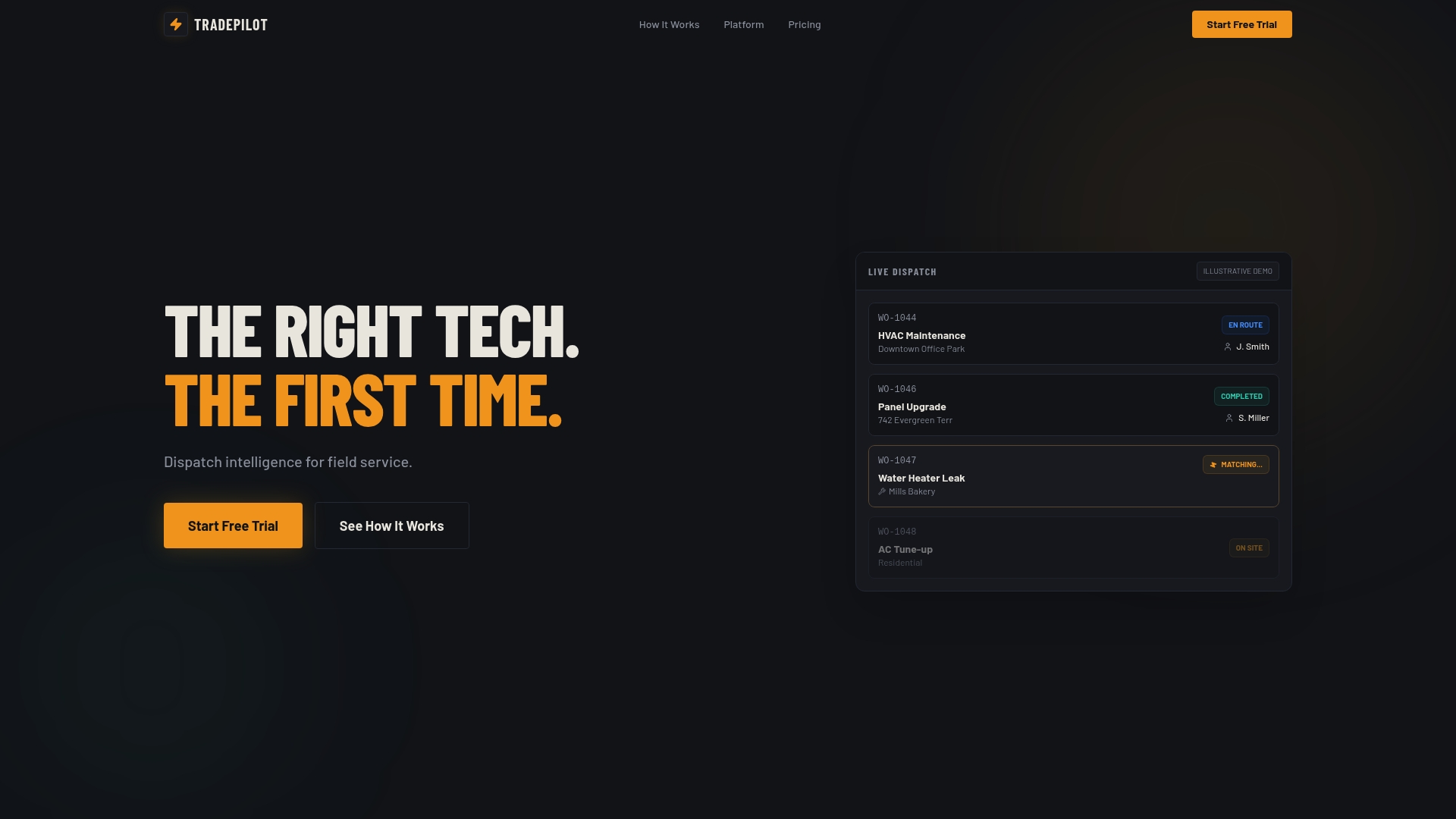
For mid-size to large HVAC businesses that are tired of stitching together separate tools for dispatch, invoicing, inventory, and reporting, Tradepilot is built around a single idea: get the right technician to the right job the first time, every time. Its AI matches jobs to technicians by skill, availability, and location in under a second, which is faster than any dispatcher working a phone and a spreadsheet. The platform covers dispatch, invoicing, inventory tracking, and performance analytics under one subscription, so your team isn't toggling between four different tabs to close out a job.
Where Tradepilot differs from ServiceTitan or FIELDBOSS is simplicity at scale. Enterprise platforms carry enterprise complexity. Tradepilot is built for operators who want the power of AI dispatch without a long implementation project. If your business runs a mid-sized team and you want a platform that works on day one, start with Tradepilot, and see how fast the dispatch bottleneck disappears.
Key Takeaways
AI-powered dispatch is a high-ROI upgrade an HVAC business can make, cutting dispatch time by 40% and improving first-call fix rates to 95%.
| Point | Details |
|---|---|
| AI dispatch cuts time and costs | Skill-based AI dispatch reduces dispatch time by 40% and operational costs by 30% through route optimization. |
| Predictive maintenance prevents downtime | AI and IoT sensors detect equipment failures 48–72 hours before breakdowns, reducing downtime by 45%. |
| Match platform to business size | Small teams fit Jobber or Housecall Pro; mid-size to large operations need TradePilot, ServiceTitan, or FIELDBOSS. |
| Offline mobile apps are non-negotiable | Field technicians need apps that work without cell signal and sync automatically when connectivity returns. |
| Tradepilot for integrated AI dispatch | Tradepilot combines AI job matching, invoicing, inventory, and analytics in one platform for HVAC operators. |