
First-time fix rate (FTFR) measures the percentage of field service jobs resolved completely on the initial technician visit, with no callbacks, no return trips, and no parts ordered after the fact. The formula is straightforward: divide the number of jobs completed on the first visit by total jobs completed, then multiply by 100. If your team handled 200 calls last quarter and closed 160 on the first visit, your FTFR is 80%. That puts you at the industry average, which ranges from 75% to 80%, while best-in-class operations can achieve 88% to 98%.
A few things worth knowing upfront:
- FTFR is not the same as work order closure. A closed ticket does not mean the job was truly fixed on the first visit.
- Parts unavailability drives 51% of failed first fixes, making inventory readiness the single biggest lever most teams underuse.
- Skill mismatches account for roughly 25% of repeat dispatches, a problem that starts at assignment, not on-site.
- Low FTFR (under 70%) correlates directly with drops in customer retention, asset uptime, and SLA compliance, per Aberdeen Group research.
- FTFR benchmarks range from 70% to 90% depending on industry and technical complexity. HVAC and consumer service typically target 80% or higher, while industrial machinery environments may accept around 70%.
Table of Contents
- Why first-time fix rate matters more than you think
- How to calculate and accurately measure first-time fix rate
- Common causes of low first-time fix rate in field service
- Proven strategies to improve first-time fix rate
- How intelligent dispatching drives first-time fix rate improvement
- Tradepilot puts the right technician on every job, the first time
- Key Takeaways
Why first-time fix rate matters more than you think
FTFR is not just a scorecard number. It reflects the health of your entire service operation, from how you take a call to how you stock a truck.
Every repeat visit costs money twice: once for the wasted truck roll, and again for the technician time that could have gone to a new job. Beyond direct costs, repeat visits erode customer trust faster than almost any other service failure. Customers who wait a second time for the same problem are far more likely to churn, and in HVAC, electrical, and plumbing markets where referrals drive growth, that churn compounds.
A high one-visit fix percentage also signals something deeper: your intake process is solid, your technicians are matched correctly, and your parts are where they need to be. When FTFR drops, it rarely means your technicians are underperforming. It usually means the system around them is broken.
Key operational benefits of a strong FTFR:
- Lower cost per job through fewer truck rolls and less technician overtime
- Higher customer retention and stronger referral rates
- Better SLA compliance, reducing penalty exposure
- Greater technician capacity, freeing time for revenue-generating calls
- Improved asset uptime for commercial and industrial clients
How to calculate and accurately measure first-time fix rate
The formula is simple. Applying it consistently is where most teams stumble.

FTFR = (Jobs completed on first visit ÷ Total jobs completed) × 100
Example: 160 first-visit completions out of 200 total jobs = 80% FTFR.
The harder question is what counts as "completed on the first visit." True fix rate measurement requires customer resolution as the standard, not work order closure. A job is only a first-time fix if no callback occurs and no additional parts are ordered within a defined window, typically 7–30 days. Closing a ticket the same day the tech leaves does not meet that bar.
Common measurement errors to avoid:
- Counting ticket closure as resolution. A closed ticket with a follow-up part on order is a failed first fix.
- Inconsistent callback windows. If one dispatcher uses 7 days and another uses 30, your data is useless for benchmarking.
- No segmentation. Aggregate FTFR hides which job types, assets, or technicians are dragging the number down.
Best practices for reliable fix rate measurement:
- Add a dedicated "resolved on first visit" flag in your CMMS or FSM platform, then cross-reference it against future ticket data for the same asset or customer.
- Segment FTFR by job type, technician, asset class, and fault category to expose specific bottlenecks.
- Standardize closeout criteria across your entire team so completion means the same thing to every technician.
Pro Tip: Cross-reference your "first visit resolved" flags against ticket history 30 days out. Internal measurement methods that rely only on same-day closure can overstate FTFR by 10%–20% compared to external or callback-based methods.
Common causes of low first-time fix rate in field service
Low FTFR is almost never a technician problem in isolation. It is a systems problem that shows up at the technician level.
Parts unavailability is the dominant cause, responsible for more than half of all repeat visits. When a technician arrives without the right component, the job cannot close. The second most common driver is skill mismatch: sending a generalist to a specialized piece of equipment, or a technician without the right certification for a site, guarantees a return trip. Together, these two causes account for the majority of failed first fixes before the technician even touches the equipment.
Top causes of low FTFR:
- Parts unavailability (51% of failures): Technicians arrive without the right components because inventory visibility is poor or staging was skipped.
- Skill or certification mismatch (~25% of failures): The assigned technician lacks the specific training or credentials the job requires.
- Incomplete job information: Missing device history, wrong site contact, or no prior service notes means the technician spends the first visit gathering data instead of fixing the problem.
- Insufficient time allocation: Jobs scheduled too tightly leave no room to diagnose properly, forcing a return visit to finish.
- Poor intake and triage: Fault details were not confirmed before dispatch, so the technician arrives uncertain about what they are walking into.
- Inadequate documentation systems: When service history and manuals are incomplete or inaccessible in the field, diagnostic time increases and errors multiply.
Proven strategies to improve first-time fix rate
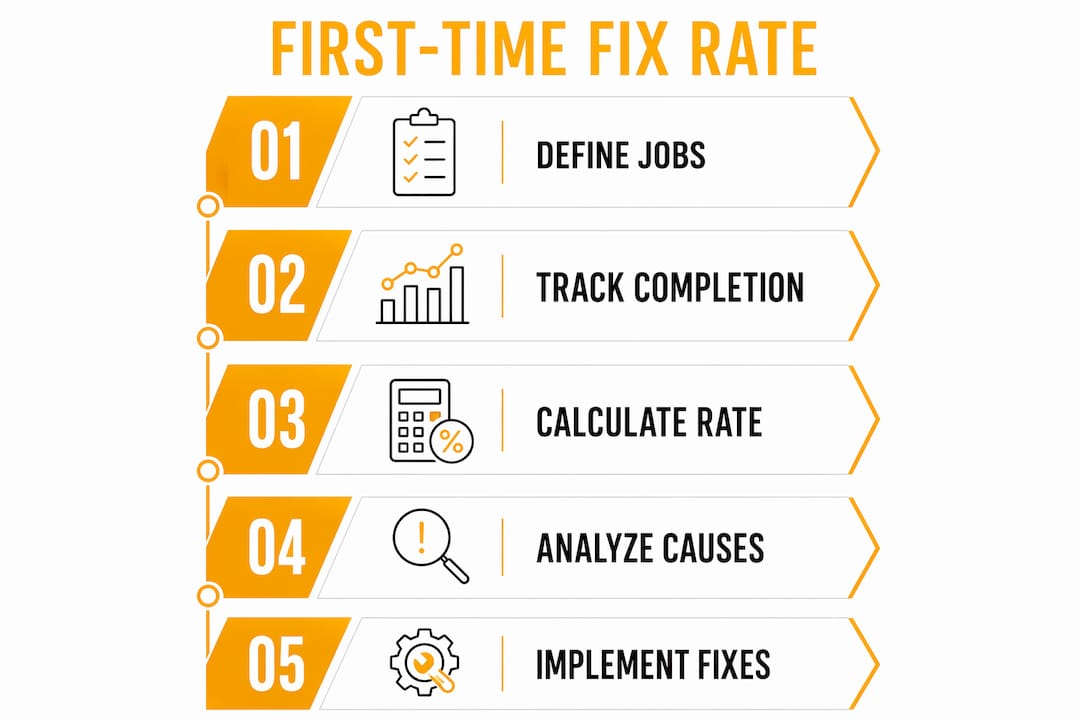
Improving FTFR requires treating it as a system problem, not a training problem. Here is a sequence that works.
-
Define "first-time fix" consistently across your entire operation. Dispatch, operations, and SLA reporting must use the same definition. Without this, your metric is unreliable as a management tool.
-
Tighten your intake and triage process. Before any technician is assigned, confirm the fault description, identify the parts likely needed, and verify technician skill requirements. First-time fix success starts at dispatch, not on-site.
-
Match technicians by skill and certification, not just availability. Automated dispatch tools that filter by skill set make this consistent at scale without adding manual overhead to every assignment.
-
Verify parts availability before dispatch. Confirm the required components are either on the truck or staged at the site before the technician leaves. Real-time inventory visibility is not optional here.
-
Equip technicians with complete job information. Device model, known issue history, site access requirements, on-site contact, and prior service notes should all be in the technician's hands before arrival.
-
Use guided digital work orders with checklists and failure code entry. Digital work orders reduce missed steps and prevent technicians from self-reporting completion inconsistently.
-
Build a continuous feedback loop. Capture the reason for every repeat visit and segment that data by asset, technician, and fault type. This turns FTFR management into a targeted discipline rather than a reactive scramble.
-
Invest in ongoing technician training. Regular training should cover new equipment, advanced diagnostics, and reporting tools, not just initial certification.
Pro Tip: These strategies work best when connected. Triage feeds dispatch quality. Dispatch quality feeds parts readiness. Parts readiness feeds technician preparation. Treating them as isolated fixes produces isolated results.
How intelligent dispatching drives first-time fix rate improvement
The sharpest insight in field service operations is this: first-time fix starts at dispatch, not on-site. Without accurate fault validation and parts confirmation before assignment, technicians face uncertainty the moment they arrive. That uncertainty produces repeat visits.

AI-powered dispatch systems address this directly. Instead of assigning based on who is available and nearby, they match each job to the technician best suited by skill, certification, location, and performance history, in seconds. The result is fewer mismatches, fewer return trips, and a measurable lift in service first visit success rates.
Intelligent dispatching best practices:
- Filter by skill and certification automatically, not manually, so every assignment meets the job's technical requirements.
- Incorporate technician performance history into assignment logic. Past completion rates on similar work predict first-visit outcomes better than availability alone.
- Integrate inventory data into dispatch decisions so parts availability is confirmed before the technician is assigned, not after.
- Use real-time scheduling visibility to allocate sufficient time per job, preventing the rushed visits that force return trips.
- Capture and analyze repeat visit data by fault mode to continuously refine dispatch rules and training priorities.
Pro Tip: A global services company that built performance history into its dispatch criteria automatically assigned more than 90% of projects while maintaining SLA performance. The data already exists in most FSM platforms. The gap is using it.
Tradepilot puts the right technician on every job, the first time
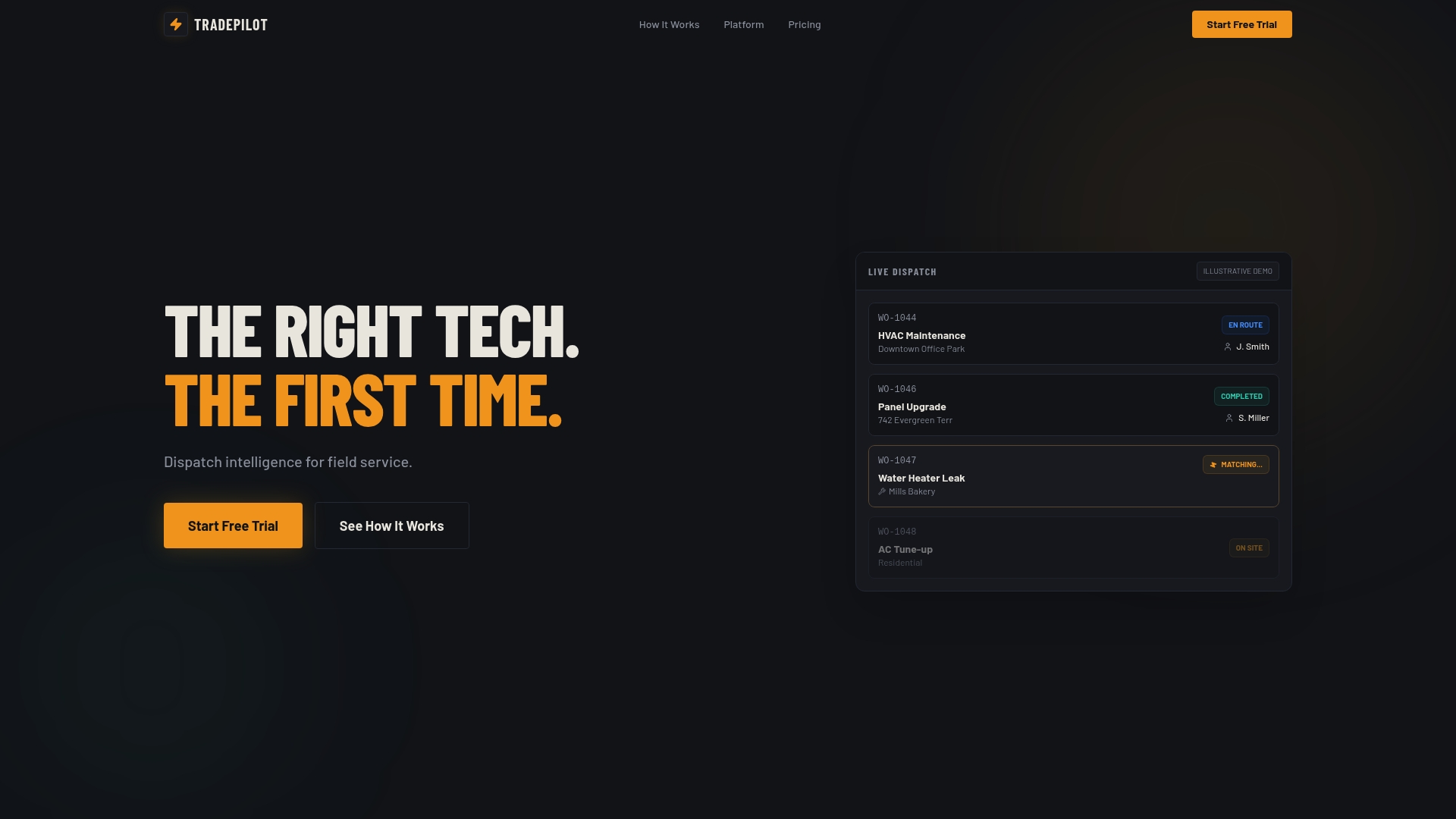
For HVAC, electrical, and plumbing businesses, the gap between an 80% and a 95% first-time fix rate usually comes down to one thing: whether the right technician with the right parts and the right information showed up on the first call. Most dispatch processes leave that to chance. Tradepilot does not.
Tradepilot's AI matches every job to the best-fit technician by skill, availability, and location in under a second. Inventory tracking, scheduling, invoicing, and performance analytics all live in one platform, so dispatch decisions are informed by real data, not guesswork. When your team can see parts availability, technician qualifications, and job history before assigning a call, your one-visit fix percentage goes up and your repeat dispatch costs go down.
Field service managers running HVAC, electrical, or plumbing operations can start a free trial at tradepilotnet.com and see how AI-driven dispatch changes the numbers.
Key Takeaways
A high first-time fix rate requires consistent measurement, accurate dispatch, verified parts availability, and a continuous feedback loop that targets the specific causes of repeat visits.
| Point | Details |
|---|---|
| Industry benchmark | Average FTFR runs 75%–80%. Best-in-class operations reach 88%–98%. |
| Parts are the top cause | Parts unavailability drives 51% of failed first fixes, making inventory readiness the highest-impact lever. |
| Measure resolution, not closure | True FTFR counts only jobs with no callback and no additional parts within a defined window, not ticket closure. |
| Dispatch determines outcomes | Skill mismatches cause roughly 25% of repeat visits; matching technicians before dispatch is the fix. |
| Tradepilot | Tradepilot's AI dispatch matches HVAC, electrical, and plumbing technicians by skill, availability, and location in under a second, directly targeting the root causes of low FTFR. |