
What are the best Housecall Pro alternatives in 2026?
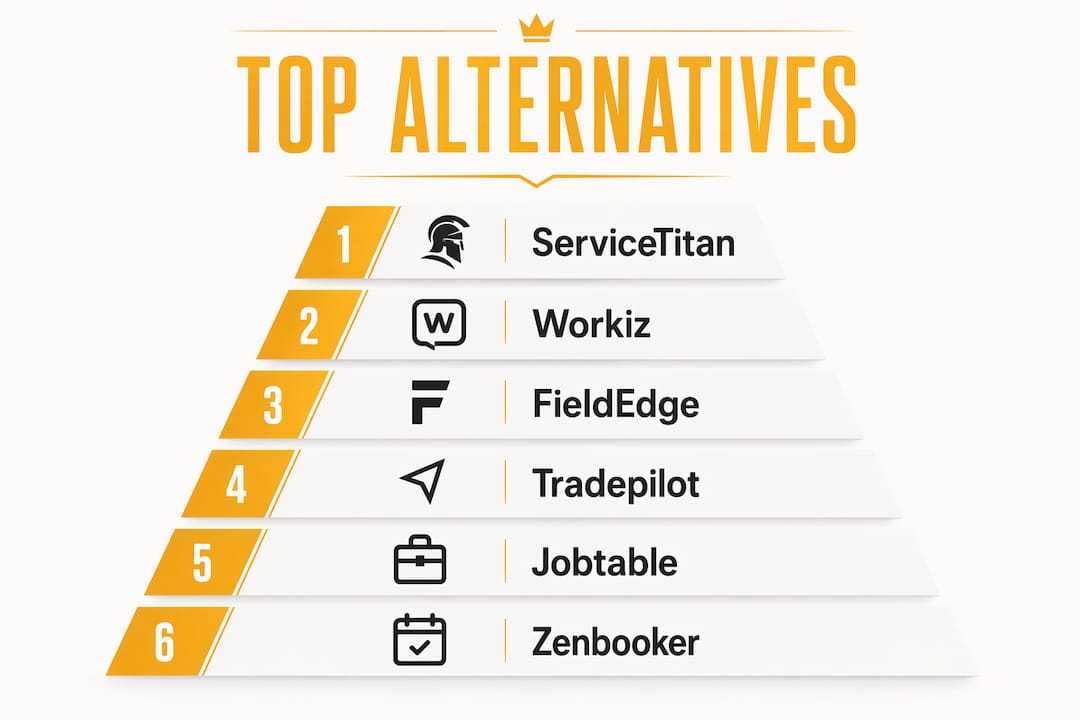
Housecall Pro works well for high-volume, short service call businesses, but its pricing and complexity often price out solo contractors and project-based teams. The Basic and Essentials plans start at monthly fees suitable for businesses with varying needs, and many owners find they're paying for dispatch infrastructure that they never touch. The top alternatives for 2026 are Zenbooker, Workiz, ServiceTitan, FieldEdge, Jobtable, and Tradepilot, each built around a different operational model.
The three most common reasons owners switch: cost on scaling teams, lack of multi-stage project management, and no AI-powered quoting. Per-user pricing compounds fast once you add technicians, pushing total monthly spend well past what smaller operations can justify.
| Tool | Best For | Starting Price | Key Features | Industry Fit | Ease of Use |
|---|---|---|---|---|---|
| Zenbooker | Online booking, small teams | Not publicly listed | Online booking, scheduling, payments | Cleaning, home services | Very easy |
| Workiz | Inbound call-heavy businesses | — | VoIP, lead tracking, job costing | Junk removal, appliance repair | Moderate |
| ServiceTitan | Large residential service firms | — | Dispatch, reporting, customer portal | HVAC, plumbing, electrical | Complex |
| FieldEdge | HVAC and plumbing specialists | Not publicly listed | Dispatch, QuickBooks sync, flat-rate pricing | HVAC, plumbing | Moderate |
| Jobtable | Small teams, simple workflows | Not publicly listed | Scheduling, invoicing, client management | General trades | Easy |
| Tradepilot | AI-driven dispatch, HVAC/electrical/plumbing | Subscription tiers | AI dispatch, invoicing, inventory, analytics | HVAC, electrical, plumbing | Easy to moderate |
Pros and cons at a glance:
- Zenbooker: Clean booking experience; limited depth for complex dispatch needs
- Workiz: Strong lead and call tracking; expensive for solo operators at $225/month for five users
- ServiceTitan: Deepest feature set in the industry; steep learning curve and price point suit only larger operations
- FieldEdge: Tight QuickBooks integration and flat-rate pricing; less flexible for non-HVAC trades
- Jobtable: Lightweight and fast to learn; lacks advanced reporting and automation
- Tradepilot: AI dispatch matching in under a second; purpose-built for HVAC, electrical, and plumbing
Deep profiles of the top Housecall Pro competitors
Zenbooker
Zenbooker targets service businesses that live and die by online bookings, particularly cleaning companies and home service providers with straightforward, repeatable jobs. The platform keeps the customer-facing booking flow clean and conversion-focused, which matters when a significant share of new clients come through your website rather than a phone call. Pricing is not publicly listed, so you'll need to contact them for a quote.
Where it falls short: Zenbooker is not built for complex dispatch or multi-technician routing. If your operation involves more than a handful of techs or jobs that require skill-matching, you'll hit its ceiling quickly.
Workiz
Workiz built its product around businesses that get most of their work through inbound calls and lead aggregators like Angi and Thumbtack. Every call is logged directly inside the platform and can be tied to a job, which gives junk removal, garage door, and appliance repair businesses a clean audit trail from first contact to invoice. Pricing starts at a monthly fee for one user, with higher tiers available that may be costly for smaller operations.

Pro Tip: If your business relies heavily on Angi or Thumbtack leads, Workiz's multi-source lead tracking can pay for itself by showing you exactly which channels convert, so you stop spending on the ones that don't.
The VoIP integration is the real differentiator here. Contractors who work primarily from referrals won't get much value from it, but for high-volume inbound operations, it removes a layer of manual data entry that adds up over hundreds of calls a month.
ServiceTitan
ServiceTitan is the enterprise option, and it earns that label. Dispatch boards, technician tracking, a customer portal, and reporting depth that most platforms can't match. G2 reviewers consistently cite the reporting and automation as standout features. The tradeoff is real: pricing starts at roughly $200-$400+/month, onboarding takes weeks, and the platform is designed for operations with five or more technicians.

For a two-truck HVAC shop, ServiceTitan is overkill. For a 15-technician residential plumbing company, it's probably the right call.
FieldEdge
FieldEdge focuses tightly on HVAC and plumbing businesses, and its QuickBooks sync is one of the cleaner integrations in the field service space. Flat-rate pricing tools are built in, which speeds up technician quoting in the field. Pricing is not publicly listed, so expect a sales conversation before you see numbers.
The platform's narrower industry focus is both its strength and its limitation. HVAC and plumbing contractors get a tool that speaks their language. General contractors or multi-trade businesses may find it too rigid.
Jobtable
Jobtable sits at the lightweight end of the spectrum, designed for small teams that need scheduling, invoicing, and client management without a steep learning curve. Setup is fast, the interface is clean, and there's no six-week onboarding process. Pricing is not publicly listed.
The tradeoff is depth. Jobtable lacks the advanced reporting, automation, and integration options that growing businesses eventually need. It's a strong fit for a two-person operation that wants to get organized without committing to a complex platform.
Tradepilot
Tradepilot is purpose-built for HVAC, electrical, and plumbing businesses that need dispatch to work without manual guesswork. The AI matches every job to the right technician by skill, availability, and location in under a second, which is a fundamentally different approach than drag-and-drop scheduling boards. Invoicing, inventory tracking, and analytics all live in the same platform, so there's no stitching together separate tools.
How do you choose the right field service software for your business?
The biggest mistake contractors make is evaluating software by feature count rather than operational fit. Platforms optimized for short service calls can actively work against long-cycle project management businesses, and the mismatch tends to surface within the first year. Matching the software's scheduling logic to your actual business model is the decision that matters most.
Ask yourself these questions before committing to any platform:
- What's your job type? Short service calls (HVAC tune-ups, appliance repair) need dispatch-first software. Multi-day projects need stage-based job management.
- How many technicians do you have now, and where will you be in two years? Per-user pricing compounds fast on growing teams.
- Where do your leads come from? Inbound call volume justifies VoIP integration. Referral-heavy businesses don't need it.
- What tools are you already using? QuickBooks, Google Calendar, and CRM integrations are key decision factors for most field service businesses.
- What does onboarding look like? A platform that takes six weeks to learn costs you in lost productivity, not just subscription fees.
- Is there a free trial or refund policy? Most reputable platforms offer a trial period. Use it to run real jobs through the system, not just click through demos.
Pro Tip: Don't evaluate software in a vacuum. Run two or three real jobs through any trial platform before you decide. The friction points that matter show up in actual workflows, not feature checklists.
AI-driven dispatch solutions represent a newer category worth evaluating separately from traditional scheduling tools. The scheduling logic is different enough that it warrants its own trial run, especially for HVAC and electrical businesses where technician skill-matching directly affects first-call resolution rates.
How AI-powered dispatch changes field service management
Traditional scheduling software puts a dispatcher in the middle of every job assignment. They look at a board, check availability, and make a judgment call. That works at low volume, but it doesn't scale, and it introduces human error on every assignment.
Tradepilot's AI dispatch matches jobs to technicians by skill, availability, and location in under a second. The practical effect is that the right technician gets the right job the first time, without a dispatcher manually cross-referencing three different spreadsheets or calendar views.
Tradepilot's AI dispatch engine processes skill, availability, and location simultaneously, assigning the best-fit technician in under a second. For HVAC, electrical, and plumbing businesses, that speed and accuracy directly reduces callbacks, overtime, and the cost of sending the wrong tech to a job.
For a business running eight technicians across a metro area, the difference between a manual dispatch board and AI matching shows up in fuel costs, callback rates, and technician utilization. A dispatcher working a board can realistically track five or six variables at once. The AI handles all of them simultaneously, every time.
Tradepilot also consolidates invoicing, inventory tracking, and analytics in the same platform. That matters because the alternative, connecting a dispatch tool to a separate invoicing app and a separate inventory system, creates data gaps and manual reconciliation work that grows with your team. For AI-powered workflow automation in field services, consolidation is where the real efficiency gains live.
The contrast with legacy platforms is sharpest in HVAC and electrical, where technician certifications and skill sets vary significantly across a team. Sending an uncertified tech to a job that requires a specific license is a compliance problem, not just an efficiency one. AI dispatch that accounts for skill at the assignment level removes that risk from the dispatcher's plate entirely.
Key Takeaways
The best Housecall Pro alternative depends on your job type, team size, and how your leads arrive, not on which platform has the longest feature list.
| Point | Details |
|---|---|
| Match scheduling logic to job type | Short service calls and multi-stage projects need fundamentally different software architectures. |
| Per-user pricing scales fast | Housecall Pro's cost structure can become prohibitive as your team grows beyond two or three technicians. |
| Trial with real jobs | Run actual workflows through any trial platform; demos hide the friction points that matter day-to-day. |
| Integrations drive adoption | QuickBooks sync, CRM connections, and calendar integrations are top decision factors for field service businesses. |
| Tradepilot for AI dispatch | Tradepilot matches jobs to technicians by skill, availability, and location in under a second, purpose-built for HVAC, electrical, and plumbing. |
What most field service software comparisons get wrong
The standard advice is to make a feature checklist, score each platform, and pick the winner. That process produces the wrong answer more often than people admit. Features are easy to list. Operational fit is harder to measure, and it's the thing that actually determines whether your team uses the software six months after you buy it.
The platforms that win on feature checklists are usually the most complex ones. ServiceTitan scores well on paper for a two-truck HVAC shop. In practice, the onboarding alone can cost weeks of productivity, and the interface adds cognitive load to every job a dispatcher touches. The right question isn't "does this platform have the feature I need?" It's "does this platform's core logic match how my business actually runs?"
AI dispatch is the clearest example of this gap. Most field service platforms treat scheduling as a calendar problem. Tradepilot treats it as a matching problem, which is closer to what dispatch actually is. The difference only becomes obvious when you run real jobs through both approaches.
For HVAC, electrical, and plumbing businesses specifically, the skill-matching dimension of dispatch is where manual boards consistently fail. A dispatcher can track availability. Tracking availability, location, certification, and job history simultaneously, on every assignment, is where AI earns its place.
Tradepilot gives HVAC, electrical, and plumbing businesses a faster path to the right technician
Every platform in this comparison handles scheduling. Tradepilot handles it differently. The AI assigns the best-fit technician by skill, availability, and location in under a second, which means fewer callbacks, less overtime, and no more dispatchers manually cross-referencing boards at 7 AM.
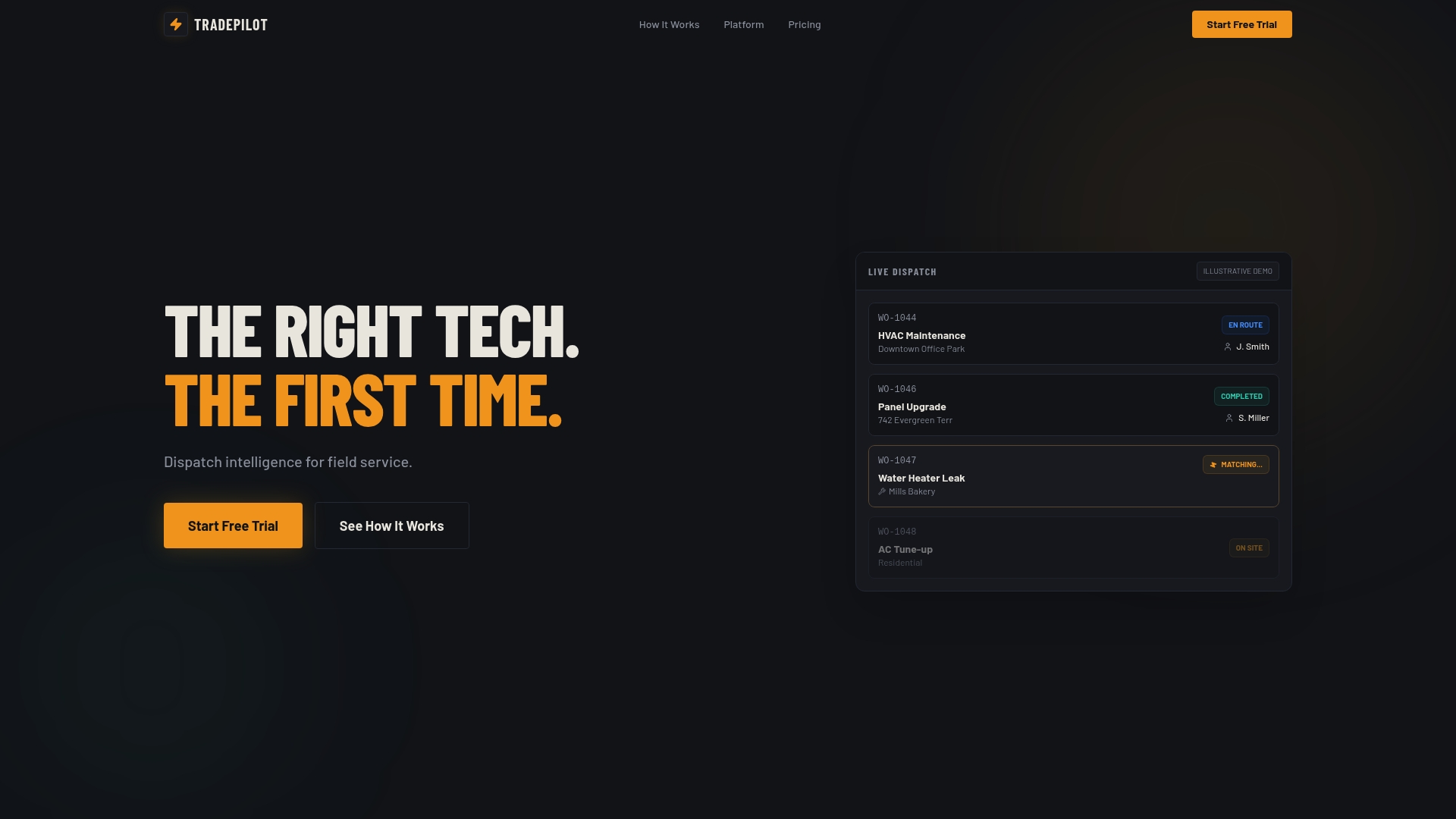
For HVAC, electrical, and plumbing businesses that have outgrown drag-and-drop scheduling, Tradepilot's unified platform covers dispatch, invoicing, inventory, and analytics without requiring you to stitch together four separate tools. The subscription tiers are seat-based, so your cost scales with your actual team size rather than a flat enterprise fee you pay whether you use it or not.
If you're evaluating Housecall Pro alternatives and your business runs on skilled technicians who need to be matched to jobs precisely, see how Tradepilot works and request a demo to run your own workflows through it before you decide.