
Accurate job costing for contractors is the difference between knowing your profit margin on a project and guessing at it after the fact. At its core, job costing is the process of tracking every dollar spent on a specific construction job: labor, materials, equipment, subcontractors, and overhead, all assigned to that one project rather than pooled into a general ledger. Unlike standard business accounting, which tells you how the company performed overall, job costing gives you project-level financial intelligence. You see exactly where money went, whether estimates held up, and what you should charge next time.
The major cost categories tracked in construction job costing are:
- Direct labor: wages and burden for workers on the job
- Direct materials: lumber, pipe, wire, fixtures, and any physical inputs consumed
- Equipment: owned or rented machinery allocated by usage
- Subcontractors: committed contract amounts versus actual invoices
- Overhead: indirect costs like supervision, insurance, and office expenses allocated to the project
Table of Contents
- What types of costs actually drive your project budget?
- How to do job costing step by step
- Which overhead allocation method fits your operation?
- How job costing software improves accuracy and saves time
- How AI-powered dispatch connects to smarter job costing
- How to build a job costing system that actually holds up
- Common job costing mistakes that quietly kill your margins
- How to read a job costing report and act on what it tells you
- Real-world job costing in practice
- How to update job costing estimates as a project progresses
- How to train your team and subcontractors on job costing
- Key Takeaways
What types of costs actually drive your project budget?
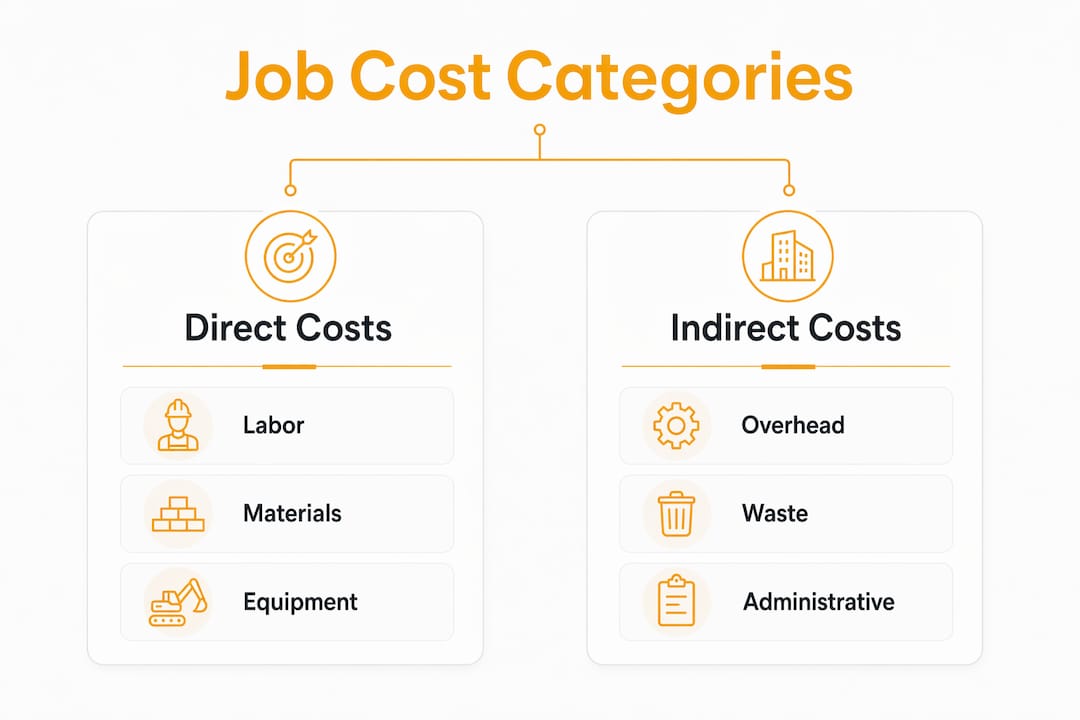
Construction costs split cleanly into two buckets: direct and indirect. Direct costs tie to a specific job and can be traced there without ambiguity. Indirect costs support multiple projects and must be allocated using a consistent method.
Direct costs include:
- Labor: labor costs typically represent 40–60% of total project spend, making them the single largest variable. Tracking accuracy can vary greatly, with variances between estimated and actual labor costs frequently running 10–40% when hours are recorded from memory.
- Materials: price volatility and on-site waste are the two biggest culprits for budget overruns. Tracking materials at the point of purchase order creation, not just at invoice receipt, gives you committed cost visibility before the damage is done.
- Equipment: owned equipment needs an internal usage rate; rented equipment needs verification against actual time on site, not just the rental company's invoice.
- Subcontractors: the gap between what a sub commits to in a contract and what they ultimately invoice can swing a project's margin significantly, especially when change orders enter the picture.
Indirect costs and overhead cover everything that keeps the project running but cannot be traced to a single job: project management salaries, site supervision, general liability insurance, small tools, and a share of office expenses. These costs are real, and failing to allocate them means every job looks more profitable than it actually is.
Pro Tip: Track materials waste separately from materials cost. When you know that a framing crew consistently uses 8% more lumber than estimated, you can build that into future bids rather than absorbing the loss silently.
How to do job costing step by step
Effective job costing follows a six-step process. Each step builds on the last, and skipping any one of them introduces gaps that compound by project close.
- Assign a unique job number. Every cost transaction, labor entry, material receipt, equipment log, and overhead allocation, gets tagged to a job code (for example, JOB-2026-047). This creates an auditable trail and prevents costs from bleeding between projects.
- Track direct materials at the source. Log materials when the purchase order is created and again when they arrive on site. The difference between ordered and received quantities is your first signal of waste or theft.
- Capture direct labor hours in real time. The further a time entry is from when the work actually happened, the less accurate it is. Labor cost variances between estimated and actual hours commonly run 10–40% on projects that rely on memory-based timekeeping.
- Estimate and pool overhead costs. Total your indirect production costs for the period and choose an allocation base, typically direct labor hours or total direct costs.
- Allocate overhead to specific jobs. Apply your predetermined rate to each active job based on its share of the allocation base. This distributes indirect costs proportionally rather than arbitrarily.
- Aggregate all costs and analyze profitability. Compare total actual costs against the original estimate. Investigate any variance above 10% to determine whether the cause was a scope change, a productivity problem, or an estimating error.
Pro Tip: Run variance reports weekly, not at project close. A cost overrun caught at 5% over budget leaves you options. The same overrun discovered after completion is just a loss.
Which overhead allocation method fits your operation?
Overhead cannot be traced to a single job the way materials and labor can, so it must be allocated using one of three standard methods. The right choice depends on how much administrative capacity you have and how much accuracy you need.
| Method | How it works | Pros | Cons | Best for |
|---|---|---|---|---|
| Actual costing | Applies real overhead incurred after the period closes | Most accurate | Too slow for live pricing; creates month-to-month profit swings | Post-project reconciliation |
| Normal costing | Uses a predetermined rate based on historical overhead and an allocation base | Timely; usable for quoting | Rate is an estimate; requires periodic reconciliation | Most contractors |
| Activity-based costing (ABC) | Splits overhead into activity pools (purchasing, production planning, inventory handling) and charges each job only for activities it uses | Granular and fair | High administrative burden | Complex multi-trade operations |
Actual costing is the most accurate but the least practical for day-to-day pricing because you cannot know the true overhead until the books close. Normal costing solves that timing problem by setting a rate in advance from historical data. Activity-based costing goes further, splitting overhead into separate pools so a support-light job is not penalized by the overhead driven by a support-heavy one. Experienced contractors tend to favor normal or activity-based costing precisely because actual costing, while precise, can create confusing profit fluctuations from one month to the next.
How job costing software improves accuracy and saves time
Manual job costing on spreadsheets works until it doesn't. The moment you are running more than two or three active projects simultaneously, the data entry burden grows faster than the team managing it, and errors accumulate quietly.
Job costing software addresses this by automating the data flows that manual methods get wrong most often:
- Digital cost capture at the source: field teams log labor hours and material receipts from mobile devices, eliminating the transcription step entirely.
- Automatic data flow to accounting systems: costs post to the general ledger without a manual export, reducing double-entry errors.
- Multi-project dashboards: you see budget versus actual across every active job on one screen, not buried in separate spreadsheets.
- Variance calculation in real time: the system flags when a cost category crosses a threshold, rather than waiting for a weekly report.
- Historical database for future estimates: every completed project feeds a library of actual cost data, making future bids more grounded than gut feel.
- Audit trails: every cost entry carries a timestamp, a user ID, and a job code, which matters when a client disputes a charge or an auditor asks questions.
Cloud-based platforms extend these benefits to the field. A foreman can approve a material delivery receipt from a phone, and that approval posts to the job cost record within seconds. The gap between when a cost occurs and when it appears in your financial picture shrinks from days to minutes.
How AI-powered dispatch connects to smarter job costing

The dispatch decision, which technician goes to which job, has a direct cost consequence that most contractors underestimate. Send the wrong technician and you pay for a callback, a longer job duration, or a subcontractor brought in to fix the error. Each of those outcomes inflates your actual labor cost against the estimate.
Tradepilot is built around exactly this problem. The platform's AI dispatch engine matches HVAC, electrical, and plumbing jobs to the right technician in under a second, drawing on skill profile, real-time availability, and location simultaneously. Dispatch, invoicing, inventory, and analytics all live in one platform, so the cost of a completed job flows directly into the financial record without a manual handoff.
Consider a mid-sized electrical contractor running 15 technicians across a metro area. Before AI dispatch, scheduling decisions were made by a coordinator working from a whiteboard and a phone. Callbacks from mismatched assignments added untracked labor hours to jobs that were already closed in the estimate. After moving to an integrated platform, those callback hours became visible as a discrete cost category, and the coordinator could see in real time which job types were generating them. That visibility alone changed how the contractor estimated similar work going forward.
How to build a job costing system that actually holds up
A job costing system is only as good as the data discipline behind it. The technology is the easy part. Getting every person on the project to use it consistently is where most systems break down.
Start with cost codes that people will actually use. If your code structure is too granular, field staff will default to a catch-all code rather than look up the right one. Aim for a structure that is specific enough to be useful but simple enough to memorize for common work types. The Construction Specifications Institute's MasterFormat provides a widely used framework that many contractors adapt for their own cost code libraries.
Build change order tracking into the system from day one, not as an afterthought. Change orders that get absorbed into the original budget without a separate code make it impossible to distinguish between an estimating error and a legitimate scope addition. Keep them separate, always.
Finally, set a regular cadence for reviewing job cost reports, weekly at minimum. Frequent updates to job costing data, ideally daily or weekly, improve forecast accuracy and enable proactive financial management. A project that is 8% over on labor in week three is recoverable. The same project at 25% over in week eight usually is not.
Common job costing mistakes that quietly kill your margins
The most expensive job costing mistakes are not dramatic errors. They are small, repeated failures in data discipline that compound over months.
Late or infrequent cost updates are the most common. When labor hours are entered weekly from memory, or materials are logged only when invoices arrive, you are always looking at a lagging picture of project health. By the time the overrun is visible, the opportunity to correct it has often passed.
Ignoring indirect costs is the second most common mistake. Contractors who track only direct costs consistently underprice their work because they are not recovering supervision time, small tool costs, or their share of office overhead. Every job looks profitable until the year-end numbers tell a different story.
Mixing change orders into the original budget destroys the integrity of your variance analysis. If a $12,000 scope addition gets absorbed into the original line items, your estimate looks worse than it was, and you lose the data needed to price similar change orders accurately in the future.
Misallocating equipment charges is a subtler problem. Assigning equipment costs to whichever job is most convenient, rather than the job that actually used the equipment, skews profitability across multiple projects simultaneously.
How to read a job costing report and act on what it tells you
A job costing report is not a scorecard. It is a decision-making tool, and reading it correctly means looking for patterns, not just totals.

Start with the variance column. For each cost category, compare actual spend to the budget. A labor variance of 21% over budget on a framing package means something different than the same variance on a finishing package, because finishing labor is harder to accelerate and more sensitive to rework. Context matters.
Look at the cost-to-complete column alongside the cost-to-date column. A project that is 60% spent but only 45% complete has a problem that the total budget figure alone will not reveal. The cost-to-complete estimate, updated with current productivity rates rather than original assumptions, gives you a realistic forecast of final margin.
Proactive cost analysis complements job costing by forecasting overruns during delivery phases, giving contractors the chance to adjust plans before budgets are exceeded. The contractors who use job cost reports most effectively treat them as a weekly conversation with the project, not a monthly accounting exercise.
Real-world job costing in practice
A concrete example makes the mechanics tangible. Take a plumbing contractor bidding a commercial tenant fit-out. The estimate breaks down as follows: $18,000 in labor (450 hours at $40 per hour), $14,000 in materials, $3,500 in equipment, $8,000 in subcontracted work, and $4,200 in allocated overhead. Total estimated cost: $47,700 against a contract price of $55,000, projecting a margin of roughly 13%.
At the midpoint of the project, the job cost report shows labor at 280 hours against a budget of 225 hours for work completed. That is 24% over on labor for the first half of the job. Materials are tracking on budget. Equipment is slightly under. The contractor investigates and finds that the rough-in phase took longer than estimated because the structural drawings had a discrepancy that required field coordination. That is a legitimate scope issue, not a productivity problem, and it supports a change order conversation with the general contractor.
Without the job cost report, that labor overrun would have been invisible until the final invoice. With it, the contractor has documentation, a cause, and a path to recovery.
How to update job costing estimates as a project progresses
The original estimate is a forecast, not a contract with reality. Updating it as conditions change is not an admission of failure. It is how you maintain a useful financial picture throughout the project.
Set a weekly review cadence. Pull actual costs from the previous week, compare them to the budget for work completed, and update your cost-to-complete forecast based on current productivity rates. If labor productivity has dropped because of weather delays, your remaining labor budget needs to reflect that, not the original assumption.
When a change order is approved, add it to the job cost record immediately as a separate budget line, not as a revision to the original scope. This preserves the integrity of your variance analysis and gives you clean data for future estimates on similar work.
The formula stays constant throughout: Total Job Cost = Direct Labor + Direct Materials + Direct Equipment + Direct Subcontractors + Indirect Costs + Overhead Allocation. What changes are the inputs as actuals replace estimates, line by line, week by week.
How to train your team and subcontractors on job costing
The best job costing system fails if the people feeding it data do not understand why their inputs matter. Training is not a one-time event at system launch. It is an ongoing practice.
Start with the "why" before the "how." A foreman who understands that an inaccurate time entry affects the company's ability to bid future work accurately is more likely to take the extra 90 seconds to log hours correctly than one who sees it as administrative busywork.
For subcontractors, the key discipline is invoice and change order documentation. Require subs to reference the job number and cost code on every invoice. When invoices arrive without that information, they create allocation guesswork that undermines the accuracy of the entire system.
Run short, job-specific cost reviews at the start of each project phase. Show the crew what the labor budget is for the next two weeks, what the current variance looks like, and what it would mean for the project if the trend continues. That kind of transparency builds cost awareness without requiring anyone to become an accountant.
Key Takeaways
Accurate job costing is the foundation of contractor profitability: it separates project-level financial results from company-wide accounting and gives you the data to price, manage, and improve every job.
| Point | Details |
|---|---|
| Labor is your biggest variable | Labor typically represents 40–60% of project costs, with variances between estimated and actual labor costs often running 10–40% when time is recorded from memory. |
| Overhead must be allocated, not ignored | Indirect costs like supervision and insurance are real project expenses; skipping them understates true job costs. |
| Update costs weekly, not at close | Frequent updates let you catch overruns early, when corrective action is still possible. |
| Change orders need separate codes | Mixing change orders into the original budget destroys variance analysis and future estimating accuracy. |
| Software closes the data gap | Integrated platforms capture costs at the source, eliminate manual transcription, and surface variances in real time. |