
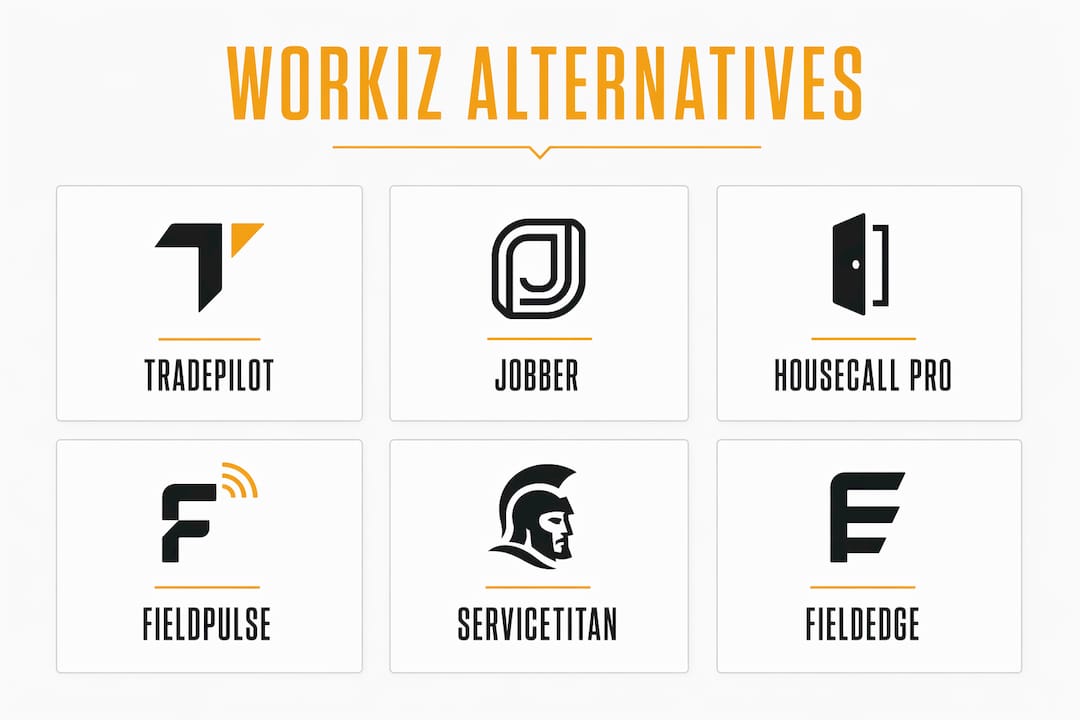
For dispatch-heavy HVAC, electrical, and plumbing businesses, Tradepilot is the recommended alternative to Workiz, with Jobber, Housecall Pro, FieldPulse, and ServiceTitan rounding out the shortlist depending on team size and budget.
The right pick depends on dispatch complexity, integration needs, and whether your team prioritizes low onboarding effort or deep enterprise features. No single tool wins for every buyer, but the shortlist below covers the realistic options for U.S. field service businesses in 2026.
Top picks at a glance:
- Tradepilot — Best for dispatch-heavy HVAC, electrical, and plumbing teams; AI matches jobs to technicians by skill, location, and availability in under a second, with invoicing, inventory, and analytics on one platform.
- Jobber — Best for small-to-mid-size teams that want a clean, easy-to-learn platform without enterprise complexity.
- Housecall Pro — Best for growing home service businesses that need strong customer communication tools alongside scheduling.
- FieldPulse — Best for small teams wanting a full-featured platform at a lower price point.
- ServiceTitan — Best for larger, multi-trade operations that need enterprise-grade reporting and integrations.
The single most important question to ask before switching: Does this platform handle your dispatch workflow the way your technicians actually work in the field — or does it just look good in a demo?
Table of Contents
- Which Workiz alternatives should you actually consider?
- What each platform actually delivers
- How do the core features actually compare?
- How to choose the right platform for your business
- How to switch from Workiz without losing revenue
- Why Tradepilot works for dispatch-heavy HVAC, electrical, and plumbing teams
- Key Takeaways
- When Tradepilot is the right call — and when it might not be
- See Tradepilot in action before you decide
- Useful sources
Which Workiz alternatives should you actually consider?
The table below covers the core decision dimensions. Start with the "Best for" column and your team size, then check pricing and AI/automation before anything else.
| Platform | Best for / team size | Starting price | Core features | Integrations / API | Ease of use | Support & training | AI / automation | Free trial / demo |
|---|---|---|---|---|---|---|---|---|
| Tradepilot | Dispatch-heavy HVAC, electrical, plumbing / 3–50+ techs | Contact for pricing | AI dispatch, invoicing, inventory, analytics | API available | Low onboarding effort | Dedicated onboarding | AI job-to-tech matching, automation rules | Demo available |
| Jobber | Small-to-mid service businesses / 1–25 techs | ~$49/mo (Core) | Scheduling, invoicing, client hub, mobile app | Zapier, QuickBooks, Stripe | Very easy | Live chat, email, help center | Automated reminders, follow-ups | 14-day free trial |
| Housecall Pro | Growing home service teams / 1–30 techs | ~$79/mo (Basic) | Scheduling, dispatch, invoicing, customer messaging | QuickBooks, Stripe, Zapier | Easy | Phone, chat, community | Automated review requests, reminders | 14-day free trial |
| FieldPulse | Small teams wanting full features / 1–20 techs | ~$99/mo (flat) | Scheduling, invoicing, estimates, GPS tracking | QuickBooks, Stripe | Easy | Email, chat | Automated workflows | Free trial available |
| ServiceTitan | Enterprise multi-trade operations / 10–200+ techs | Custom (enterprise) | Full dispatch, marketing, reporting, payroll | Deep integrations, open API | Steep learning curve | Dedicated CSM, training | AI call scoring, automation | Demo only |
| FieldEdge | HVAC and plumbing specialists / 5–50 techs | Custom pricing | Dispatch, flat-rate pricing, service agreements | QuickBooks (deep), API | Moderate | Phone, email, training | Automated agreements, reminders | Demo available |
| Workiz (reference) | General field service / 1–20 techs | Free Lite; paid tiers ~$200–$350/mo | Scheduling, invoicing, client CRM, phone | Zapier, QuickBooks | Easy | Chat, email | Automated notifications | Free Lite plan |
How to read this table: If your business runs more than five technicians and dispatch errors cost you real money, weight the AI/automation and integrations columns heavily. For a solo operator or two-tech shop, ease of use and starting price matter more than enterprise features.
What each platform actually delivers
Understanding the shortlist means going past feature lists. Here is what each platform does well, who it fits, and where it falls short.
Tradepilot
Tradepilot is built specifically for HVAC, electrical, and plumbing businesses where dispatch is the daily bottleneck. Its AI matches every incoming job to the best-fit technician by skill, real-time availability, and location in under a second, which cuts the manual back-and-forth that slows most dispatch coordinators down. Invoicing, inventory tracking, and analytics all live in the same platform, so you are not stitching together three tools to get a complete picture of the day.

Best for: Dispatch-heavy teams of 3–50+ technicians in HVAC, electrical, or plumbing. Pros: AI-driven dispatch reduces mismatched assignments; single platform eliminates integration headaches. Con: Overkill for a solo operator or a team that rarely juggles more than a handful of jobs per day.
Jobber
Jobber has earned its reputation as the easiest field service platform to get up and running. The interface is clean, the mobile app is reliable, and the client hub keeps customer communication organized without requiring a dedicated office manager. It integrates with QuickBooks and Stripe out of the box, and the 14-day free trial gives you a real feel for the workflow before committing.

Best for: Small-to-mid-size home service businesses (1–25 techs) that want simplicity over depth. Pros: Very low learning curve; strong client communication tools. Con: Dispatch logic is basic compared to AI-driven platforms, which becomes a problem as team size grows.
Housecall Pro
Housecall Pro leans hard into customer experience: automated review requests, two-way texting, and a customer-facing booking portal are all built in. Scheduling and dispatch work well for growing teams, and the pricing is transparent at entry level. Where it starts to strain is at the higher end of team size, where more complex dispatch routing and deeper reporting become necessary.
Best for: Home service businesses with 1–30 techs that prioritize customer communication alongside scheduling. Pros: Strong automated messaging and review tools; clean mobile app. Con: Reporting depth is limited for businesses that need granular technician performance data.
FieldPulse
FieldPulse punches above its price point. For a flat monthly fee, small teams get scheduling, invoicing, estimates, GPS tracking, and customer management in one place. The platform is less well-known than Jobber or Housecall Pro, but reviews on Capterra and G2 consistently highlight its value for money. The trade-off is a smaller integration ecosystem and fewer automation options than the enterprise-tier tools.
Best for: Small teams (1–20 techs) that want a full-featured platform without paying enterprise prices. Pros: Flat-rate pricing is predictable; solid feature set for the cost. Con: Integration library is narrower than Jobber or ServiceTitan.
ServiceTitan
ServiceTitan is the enterprise choice. If you run a multi-trade operation with 10 or more technicians, complex reporting requirements, and a need for deep integrations across payroll, marketing, and accounting, it is the most capable platform on this list. The catch is cost and complexity: pricing is custom and typically significant, and onboarding takes months, not weeks. It is not a tool you adopt casually.
Best for: Large, multi-trade operations (10–200+ techs) that need enterprise-grade everything. Pros: Deepest feature set on the market; strong reporting and marketing tools. Con: High cost and a steep learning curve make it a poor fit for small or mid-size teams.
FieldEdge
FieldEdge targets HVAC and plumbing contractors specifically, with flat-rate pricing built in and a deep QuickBooks integration that accountants tend to appreciate. Service agreement management is a standout feature for businesses that run recurring maintenance contracts. Pricing is custom, which means you need a sales call before you can compare it directly to other options.
Best for: HVAC and plumbing businesses (5–50 techs) with recurring service agreements. Pros: Deep QuickBooks sync; strong flat-rate pricing and service agreement tools. Con: Custom pricing makes budget comparison harder upfront.
Workiz (reference)
Workiz functions as a CRM hub with solid field operations and dispatch management at its core. The free Lite plan makes it accessible for very small teams, and the client CRM stores job history, invoices, and documents in one place. Teams typically outgrow it when pricing at scale becomes a concern, when they hit integration gaps, or when dispatch complexity exceeds what the platform handles well.
How do the core features actually compare?
The table below focuses on the capabilities that affect daily operations and profitability, not the full feature catalog.
| Feature | Tradepilot | Jobber | Housecall Pro | FieldPulse | ServiceTitan | FieldEdge |
|---|---|---|---|---|---|---|
| AI dispatch / job matching | Yes (AI, sub-second) | No | No | No | Partial (AI call scoring) | No |
| Mobile field app | Yes | Yes (strong) | Yes (strong) | Yes | Yes | Yes |
| Offline mobile mode | Yes | Limited | Limited | Yes | Yes | Yes |
| Invoicing / payments | Yes | Yes | Yes | Yes | Yes | Yes |
| Flat-rate pricing | No | No | No | No | Yes | Yes |
| Inventory tracking | Yes | Limited | No | Limited | Yes | Limited |
| Service agreements | Yes | Limited | No | No | Yes | Yes |
| Reporting / analytics | Yes (dashboard) | Basic | Basic | Basic | Advanced | Moderate |
| QuickBooks integration | Yes | Yes | Yes | Yes | Yes | Yes (deep) |
| Open API | Yes | Yes | Yes | Limited | Yes | Yes |
| Automated reminders | Yes | Yes | Yes | Yes | Yes | Yes |
| Custom automation rules | Yes | Limited | Limited | Limited | Yes | Limited |
For small teams (1–5 techs), the mobile app quality and invoicing speed matter most. For mid-size and growing operations, dispatch logic and reporting depth are where you will feel the gap between platforms most acutely. ServiceTitan and Tradepilot are the only two on this list with meaningful automation beyond reminders; the difference is that Tradepilot's AI dispatch is built for the HVAC/plumbing/electrical workflow specifically, while ServiceTitan's automation is broader but requires more configuration.
Pro Tip: During any demo, ask the vendor to show you the mobile app in airplane mode. If the tech cannot complete a job, add notes, or capture a signature offline, that is a real operational risk for field crews in basements, rural properties, or anywhere with spotty signal.
How to choose the right platform for your business
A feature list will not make this decision for you. Work through this checklist first.
- Team size fit. Platforms like Jobber and Housecall Pro are designed for 1–25 techs. ServiceTitan and Tradepilot scale to 50+ without performance degradation. Match the platform's sweet spot to where your team is headed in 18 months, not where it is today.
- Dispatch complexity. If you run more than five techs across multiple job types and locations, manual dispatch is already costing you money. AI-driven dispatch (Tradepilot) or at minimum a smart scheduling engine is worth the extra cost.
- Integration requirements. QuickBooks is table stakes. Beyond that, map your current tech stack: CRM, marketing tools, payroll, parts suppliers. Check the API documentation before the demo, not after.
- Budget at scale. Entry-level pricing is rarely what you pay at month six. Ask every vendor for a quote at your current team size and at 150% of it. Workiz paid tiers can reach $200–$350/month for small teams; ServiceTitan's enterprise pricing is significantly higher. Know the ceiling before you sign.
- Data migration needs. How much customer history, job records, and invoice data do you have? A platform with a clean CSV import and a dedicated migration specialist is worth paying a small premium for.
- Support SLA requirements. If a dispatch system goes down on a Monday morning, how fast do you need a human on the phone? Check whether phone support is included in your tier or costs extra.
Demo questions worth asking every vendor:
- What happens to the mobile app when a tech loses cell signal mid-job?
- Can I bulk-invoice multiple jobs at once, or does each invoice require manual action?
- What is the API rate limit, and do you charge for API access?
- What is your guaranteed response time for critical support issues?
- Can I customize automation rules without a developer, or does it require a support ticket?
Red flags to watch for:
- Pricing that is not published anywhere and requires a sales call to get a ballpark number.
- Onboarding timelines quoted at more than 12 weeks for a team under 20 techs.
- No sandbox or trial environment, only a guided demo where the vendor controls the screen.
- Contract terms that lock you in for two or more years with no data portability clause.
How to switch from Workiz without losing revenue
Switching FSM platforms requires careful planning to avoid disruption. The described steps apply when moving to Tradepilot, Jobber, or other alternatives.
| Step | Action | Small team (2–4 weeks) | Mid-size team (6–12 weeks) |
|---|---|---|---|
| 1. Data export | Export all customer records, job history, and invoices from Workiz as CSV | Days 1–2 | Week 1 |
| 2. Data import and cleanup | Import into new platform; deduplicate and verify records | Days 2–4 | Weeks 1–2 |
| 3. Field app pilot | Run 1–2 techs on the new platform for real jobs | Days 4–7 | Weeks 2–3 |
| 4. Double-run scheduling | Run both platforms in parallel for scheduling only | Days 7–10 | Weeks 3–5 |
| 5. Invoicing cutover | Switch invoicing to new platform; confirm payment processing works | Day 10–12 | Week 6 |
| 6. Full dispatch cutover | Move all dispatch to new platform; decommission Workiz dispatch | Day 12–14 | Week 7–8 |
| 7. Billing and subscription change | Cancel Workiz subscription after confirming all data is migrated | Day 14 | Week 8–10 |
| 8. Post-launch support | Monitor for data gaps, missed automations, or tech app issues | Week 2–4 | Weeks 10–12 |
Typical cost estimates: For a team of 5–10 techs, budget 20–40 hours of internal time for data cleanup and training. Vendor onboarding fees vary; some platforms (Tradepilot, ServiceTitan) include dedicated onboarding in the subscription, while others charge separately. Training time per technician typically runs 2–4 hours for mobile app basics.
Pro Tip: Do not cut over invoicing and dispatch on the same day. Switch invoicing first, confirm payments are processing correctly for a full billing cycle, then move dispatch. A failed payment on cutover day is far more disruptive than running two scheduling tabs for an extra week.
Why Tradepilot works for dispatch-heavy HVAC, electrical, and plumbing teams
Most field service platforms treat dispatch as a scheduling problem: put the job on a calendar, assign a tech, done. Tradepilot treats it as a matching problem, which is closer to how dispatch actually works in a busy HVAC or plumbing operation. The AI evaluates technician skill set, current location, and real-time availability simultaneously, then makes the assignment in under a second. That speed matters when you have six jobs queued and two techs finishing early.
The platform covers the full operational loop: dispatch, invoicing, inventory tracking, and analytics in one place. No separate invoicing tool. No spreadsheet for parts. No end-of-week scramble to pull performance numbers from three different dashboards.
What Tradepilot is built to solve: Dispatch errors, mismatched technician assignments, and the operational blind spots that come from running your business across disconnected tools. One platform. The right tech. The first time.
| Tradepilot capability | What it means for your operation |
|---|---|
| AI job-to-tech matching | Fewer callbacks, fewer mismatched skill assignments |
| Real-time schedule management | Coordinators see the full day at a glance; changes propagate instantly |
| Integrated invoicing | Techs close jobs and send invoices from the field; no re-entry |
| Inventory tracking | Parts usage logged per job; reorder alerts before you run out |
| Analytics dashboard | Job completion rates, technician performance, and revenue by trade in one view |
| Single-platform onboarding | One login, one training session, one support contact |
To validate Tradepilot's fit during a demo, ask to see a live dispatch scenario with three or more techs available and two jobs with different skill requirements. Watch how the AI assigns them. Then ask to complete a job and send an invoice from the mobile app without touching a desktop. If both take less than two minutes, the platform is doing its job.
Key Takeaways
The right Workiz alternative depends on dispatch complexity and total cost of ownership, not feature count alone.
| Point | Details |
|---|---|
| Top recommended pick | Tradepilot leads for dispatch-heavy HVAC, electrical, and plumbing teams needing AI job matching and a single platform. |
| Lightweight alternatives | Jobber and Housecall Pro suit small teams (under 20 techs) that prioritize ease of use over dispatch depth. |
| Enterprise fit | ServiceTitan is the right call for multi-trade operations with 10+ techs and complex reporting needs. |
| Top red flags | Avoid vendors with opaque pricing, no data portability clause, or onboarding timelines over 12 weeks for small teams. |
| Migration timeline | Small teams can switch in 2–4 weeks; mid-size teams should budget 6–12 weeks and stagger invoicing and dispatch cutovers. |
When Tradepilot is the right call — and when it might not be
The honest answer is that Tradepilot is not the right fit for every business on this list. If you run a solo operation or a two-tech crew and your main pain point is sending invoices faster, Jobber or FieldPulse will get you there at a lower monthly cost with less setup. Tradepilot's AI dispatch earns its keep when you have enough concurrent jobs and technicians that manual assignment is genuinely costing you time and money.
Where Tradepilot stands apart is the combination of AI dispatch speed and a fully integrated operational stack. Most platforms in this category make you choose: either a lightweight tool that is easy to learn but thin on dispatch logic, or an enterprise platform that is powerful but takes months to configure. Tradepilot sits in the middle of that range, built specifically for the trades rather than for generic field service.
One thing buyers underestimate when evaluating field service management software: the cost of switching twice. Choosing the cheapest tool today and outgrowing it in 18 months means another migration, another round of technician retraining, and another period of operational disruption. If your business is growing, price the platform at your projected team size, not your current one.
See Tradepilot in action before you decide
If dispatch errors, mismatched technician assignments, or disconnected tools are slowing your operation down, Tradepilot is worth a direct look. The demo takes under 30 minutes and covers the full dispatch-to-invoice workflow.
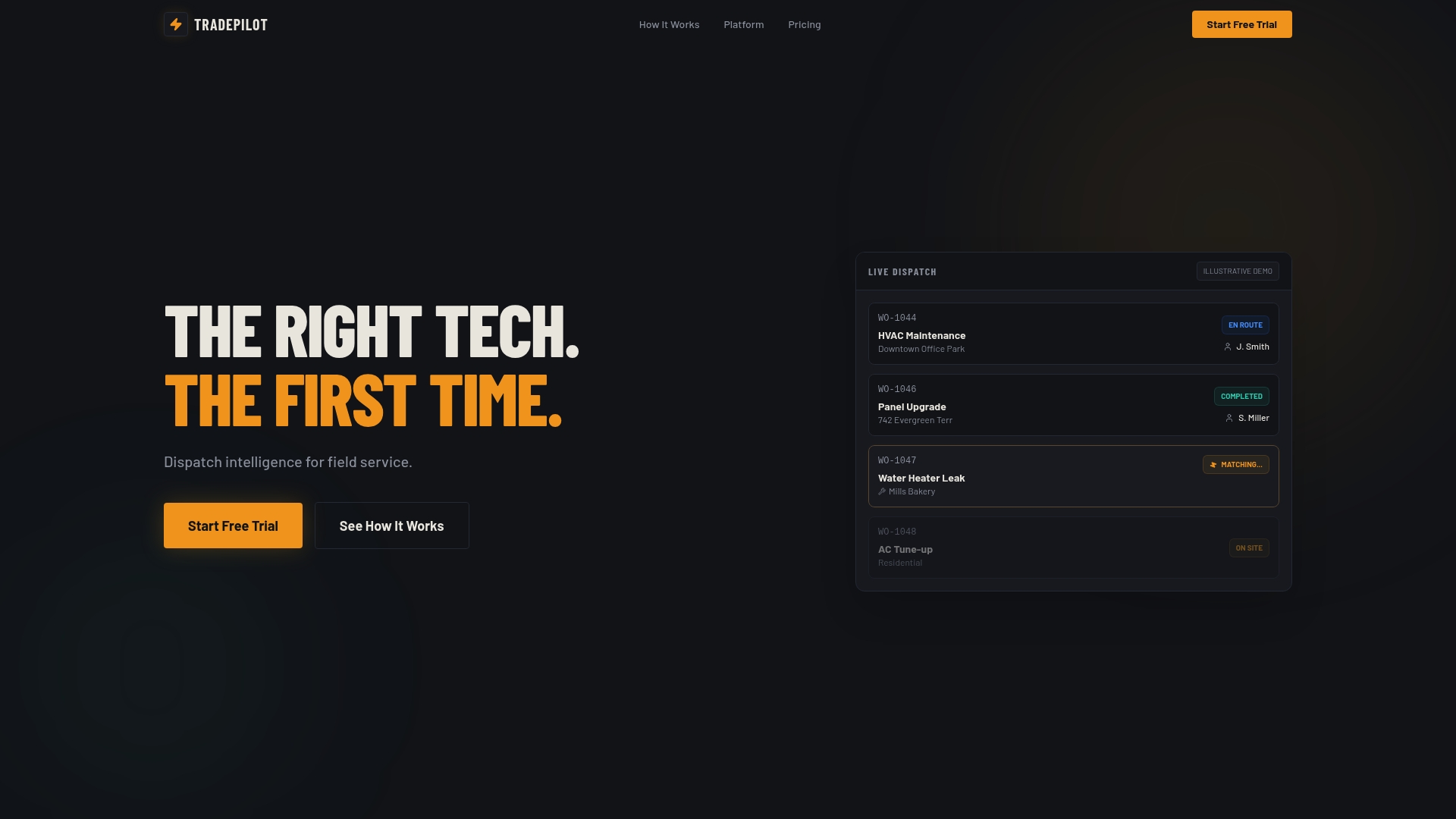
Three things to validate in your Tradepilot demo:
- Dispatch speed: Ask to see a live multi-tech dispatch scenario. The AI assignment should complete in under a second.
- Mobile app ease: Have a team member complete a job and send an invoice from the mobile app without desktop assistance.
- Invoicing cutover: Ask how long the average HVAC or plumbing team takes to process their first week of invoices on the platform.
Start your Tradepilot demo and see whether the dispatch logic fits the way your team actually works in the field.
Useful sources
- Tradepilot platform overview — AI dispatch, invoicing, inventory, and analytics for HVAC, electrical, and plumbing businesses.
- Best Workiz Alternatives in 2026: 8 Tools Compared — editorial roundup covering top alternatives by team size and use case.
- Workiz pricing in 2026 — independent breakdown of Workiz plans, costs, and add-on fees.
- Workiz Client CRM feature page — official documentation on Workiz's CRM functionality.
- Top 10 Workiz Alternatives on G2 — user-rated alternatives with verified reviews.
- Jobber reviews on G2 — verified user reviews covering scheduling, invoicing, and mobile app experience.
- Jobber on Capterra — ratings and reviews from verified small business users.
- FieldPulse reviews on Capterra — user feedback on FieldPulse pricing, features, and support.
- FieldPulse on G2 — detailed user review covering FieldPulse's feature set and value.
- ContractorRanks Workiz review — starting price comparisons and ratings for ServiceTitan, Jobber, Housecall Pro, and FieldEdge.