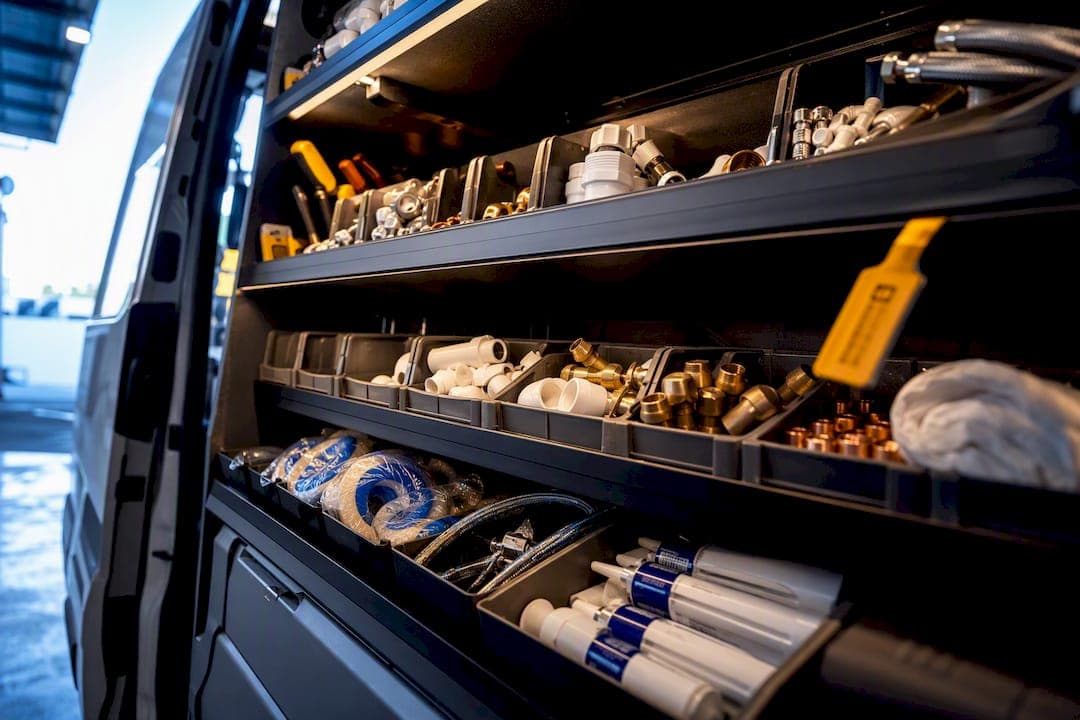
The single biggest lever for first-time-fix rates is a par-level stocking system paired with an organized, standardized layout, not a bigger van or more parts. A well-run residential plumbing truck typically carries $2,500 to $5,000 in parts and stocked correctly, covers 85 to 90% of common service calls without a supply-house detour. Everything else, from shelving choice to inventory software, exists to keep that number high.
TL;DR:
- Keeping par levels based on item velocity reduces overstocking of rarely used parts and saves weight, improving van agility and fuel efficiency.
- Proper van layout and shelf selection, tailored to van dimensions and part categories, prevent clutter and streamline restocking processes.
- Using barcode scanning and inventory software enables real-time, offline tracking per van, reducing stockouts and preventing scheduling mistakes.
- Connecting inventory data with dispatch systems minimizes re-runs, cuts mid-job supply trips, and improves first-time fix rates.
- Regular daily, weekly, and monthly stock audits support accurate par levels, reduce dead stock, and ensure readiness for common service calls.
Table of Contents
- The plumbing van stock checklist every service truck needs
- Van layout and racking: shelving systems, pipe storage, and upfit tradeoffs
- Which tools belong on a service van, and which stay on a dedicated truck?
- Par-level system and restock process: daily, weekly, monthly workflows
- Inventory tech and workflows: barcode scanning and per-van visibility
- A practical playbook: combining par levels, dispatch, and inventory data
- Field-tested checklist: quick start for a one-day van refresh
- How TradePilot ties van stock into smarter dispatch
- Sources
The plumbing van stock checklist every service truck needs
Getting plumbing van stock right starts with knowing which parts move fast and which ones just take up space. Break your inventory into four buckets: consumables, common repair parts, core tools, and specialty kit. Each bucket needs its own par range, meaning a minimum quantity that triggers a restock and a maximum that keeps you from hoarding dead weight.
Consumables are the small stuff that disappears every week. Wax rings, PTFE tape, solder, flux, hex bushings, and rubber washers belong here, and they should live in labeled bins near the door, not buried under bigger parts. Common repair parts cover the calls that make up most of your day:
- Toilet rebuild kits (fill valves, flappers, tank bolts): stock 4–8 kits, since toilet repairs are among the highest-frequency residential calls.
- Faucet cartridges, both universal and brand-specific: carry Moen 1225 and 1224 cartridges plus Delta RP-series replacements, since those two brands dominate the installed base in most markets.
- P-traps and tailpieces in 1.25 and 1.5 inch: keep 3–5 of each size, since drain assemblies vary by fixture age.
- Supply lines in braided and PEX versions, 12 and 20 inch: stock 4–8 of each length.
- Angle stops and ball valves, quarter turn, in the two or three sizes your territory actually uses: 6–10 units.
- Water heater parts: thermocouples, gas valves, T&P relief valves, and anode rods, at least one of each common size.
- PEX and copper fittings: a small assortment of elbows, couplings, and crimp rings covers the majority of repipe patches.
- Drain cable sections for your cable machine, enough spares to survive a snapped cable mid-job.
Here's the part most techs get wrong: universal cartridges and repair kits save van space, but brand-specific parts close jobs faster on the calls where you already know the fixture. If half your territory is 1990s tract housing with Moen single-handle faucets, stock the exact cartridge instead of a universal kit that needs field-fitting under a customer's sink.
Pro Tip: Sort small parts by frequency, not by category. Put your top 20 fastest-moving SKUs within arm's reach of the side door. Everything you use once a month can live in a drawer three steps further back.
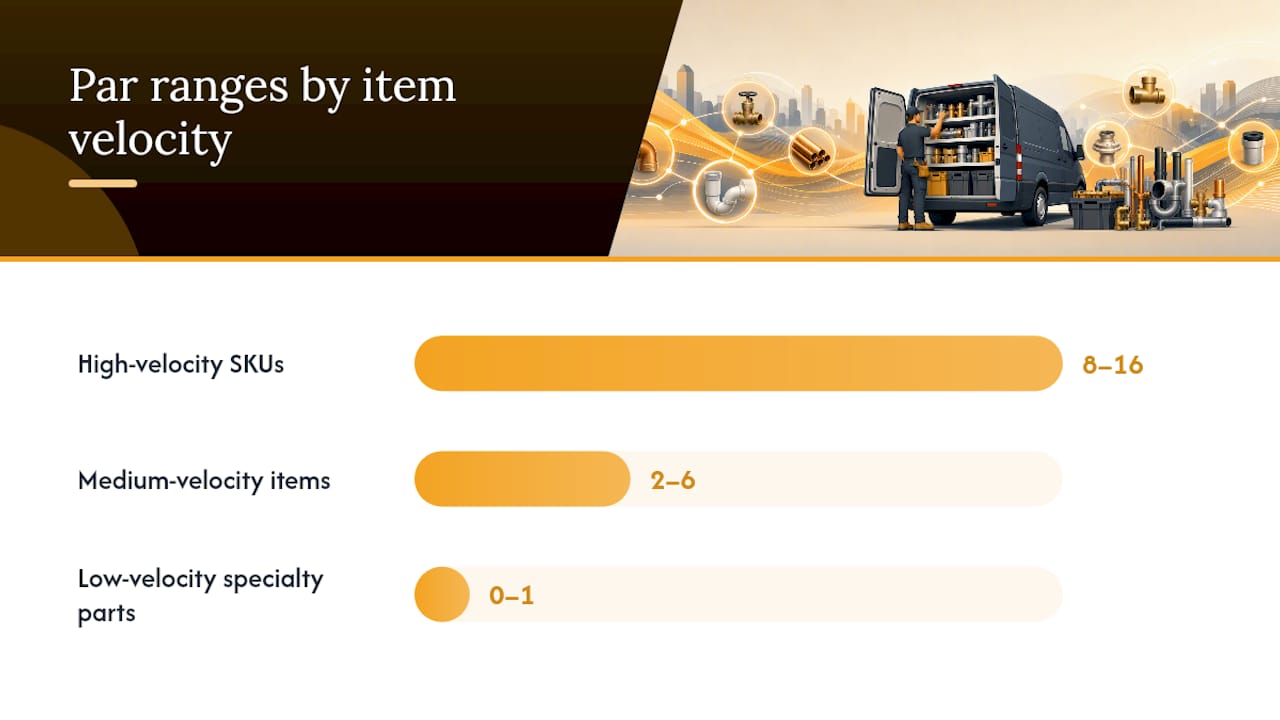
Setting par ranges by velocity keeps the math simple. High-velocity SKUs like wax rings or supply lines might run an 8–16 par. Medium-velocity items like cartridges sit closer to 2–6. Low-velocity specialty parts, the kind you use once a quarter, need a par of one or zero on the van and a fast-order relationship with your supply house instead. Weight and volume matter too. Every pound of dead-stock inventory is a pound you're not carrying in fuel-efficient rolling stock, and a van packed with rarely used parts is harder to navigate on a service call where seconds count.
Van layout and racking: shelving systems, pipe storage, and upfit tradeoffs
Layout decides whether your par-level system actually works or just becomes a mess of bins nobody restocks correctly. Most efficient plumbing vans follow a similar zone pattern: pipe carriers run along the driver-side wall, small fittings and cartridges sit in bins above the wheel arch at chest height, water-heater parts and bulkier components go in lower cabinets, and anything with weight, like a drain machine, gets secured near the rear doors on a slide-out tray or anchored shelf.
The vendor you choose for shelving shapes almost everything downstream. Adrian Steel, Ranger Design, and Sortimo/EXXPAND dominate North American plumbing van shelving, and each solves a different problem:
- Adrian Steel runs budget-friendly steel shelving, durable but less modular, a solid pick for a first upfit on a tight budget.
- Ranger Design positions itself as the workhorse option, with strong warranties and a reputation for holding up under daily abuse.
- Sortimo/EXXPAND sits at the high end with fully modular drawer and bin systems that reconfigure as your parts mix changes.
- Custom Solutions' SH2/SH3 systems use modular shelving built for 474mm organizer boxes, which lets a shop standardize the same drawer boxes across an entire fleet, so a tech can pull a box from Van 3 and drop it straight into Van 7.
- PlumbingVans.com sells ready-configured packages, like a Sprinter high-roof plumber package built for a 144-inch wheelbase, that bundle shelving, pipe trays, and drawer stacks pre-matched to that van's dimensions.
- Weather Guard and Knapheide both offer dedicated plumbing/cable packages with shelving, secure drawers, and a bulkhead, typically installed for a few thousand dollars.
The single most common upfit mistake is buying shelving before confirming van dimensions. A short-wheelbase van with a standard roof can't hold the same pipe-tray length as a long-wheelbase high-roof model, and drawer boxes that don't match your roof height waste vertical space you'll want back the first week.
| Upfit type | Typical installed cost | Best fit |
|---|---|---|
| Basic steel shelving (Adrian Steel style) | $2,500 to $5,000 | Budget-conscious first upfit, SWB vans |
| Workhorse modular (Ranger Design style) | $2,500–$4,500 | Daily heavy-use vans, warranty-driven shops |
| Full modular drawer system (Sortimo/EXXPAND, Custom Solutions SH3) | $4,000–$8,000+ | Multi-van fleets wanting standardized boxes |
| Manufacturer plumber package (PlumbingVans.com, Weather Guard, Knapheide) | $2,500 to $5,000 | Shops wanting a pre-configured, wheelbase-matched build |
Run the payback math before you sign off. If a $4,000 modular upfit shaves even 20 minutes off restock and pick time per day, and that tech bills at $125 an hour, the upfit pays for itself in well under a year through reclaimed billable hours alone.
Which tools belong on a service van, and which stay on a dedicated truck?
Every plumbing van needs a core set of hand and power tools: basin wrenches, pipe wrenches in two sizes, a press tool or torch kit, a cordless drill/driver with spare batteries, tubing cutters, a full set of pliers, and a multimeter for water heater diagnostics. Carry at least two of anything that breaks or gets left at a job site, like screwdrivers and hex keys.
- Drain cable machine: a mid-size drum machine with two to three spare cable sections handles most residential clogs.
- Drain camera: priced between $1,200 and $4,500, a camera pays back faster than almost any other tool because it turns a guess into a billable locate fee.
- Jetter: heavy at 300 to 600 pounds and priced from $8,000 to $22,000, a jetter usually belongs on a dedicated drain truck unless your call volume justifies the payload and capital cost.
Secure everything heavy. Floor anchors and partitions keep a cable machine or camera reel from becoming a projectile in a hard stop. Stock PPE too, gloves, eye protection, knee pads, and a basic sign or cone set for job-site safety, since these are cheap compared to the liability of skipping them.
Par-level system and restock process: daily, weekly, monthly workflows
Par levels only work if someone actually checks them. The rhythm that turns most shops from roughly 70% to 90% first-time-fix rates runs on three cadences layered on top of each other.
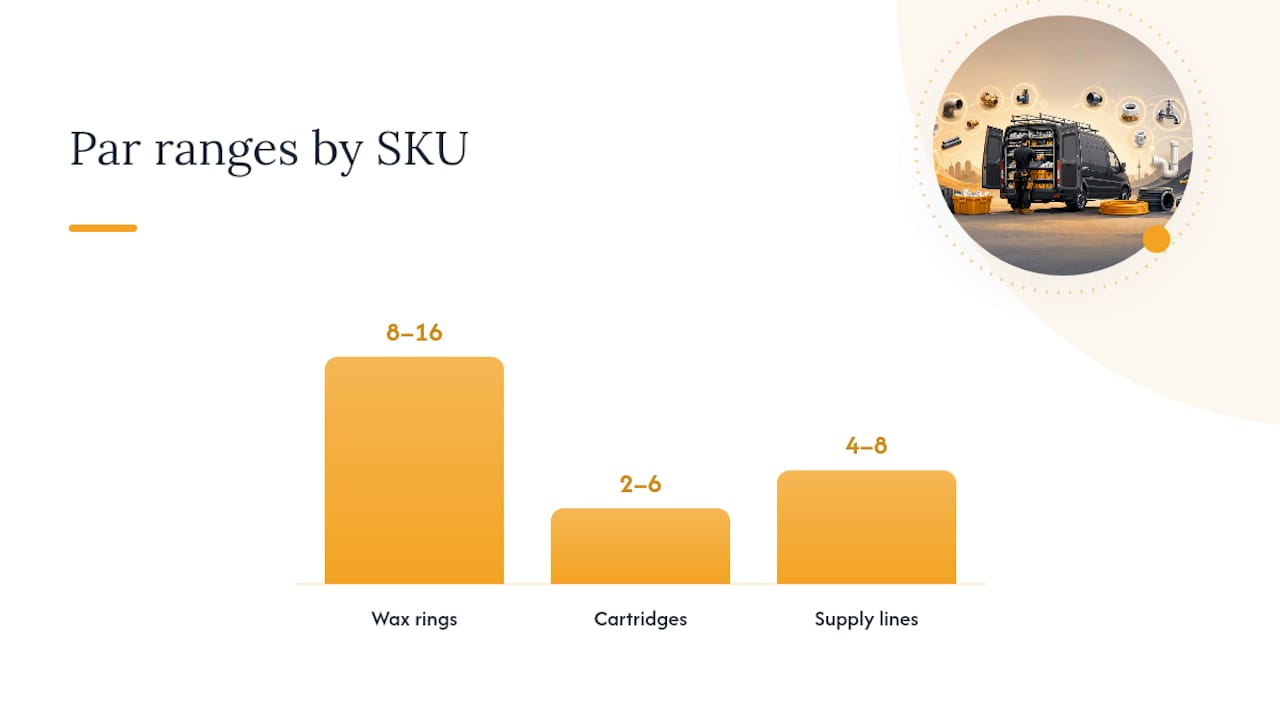
Daily is a five-minute end-of-shift glance at your highest-velocity SKUs, wax rings, cartridges, supply lines, nothing more. Weekly is a full restock run against a written par sheet, pulled from the supply house before the week's first job. Monthly is an audit that catches slow leaks: parts quietly running low that don't trip a daily check, plus a look at anything that hasn't moved in 90 days.
Numeric par examples make this concrete. Wax rings might run an 8–16 min/max. Cartridges sit around 2–6. Supply lines land at 4–8. When a tech pulls the last unit above the minimum, that SKU goes on the weekly run sheet automatically, and the parts manager, not the tech, owns ordering.
- Track first-time-fix rate as your north star KPI.
- Track re-roll count, meaning trips back to a job because a part was missing.
- Track low-stock incidents flagged before, not during, a service call.
Dead stock deserves a rule too: anything untouched for 90 days gets returned to the supply house or reassigned to a lower-turnover van, since dead inventory hurts cashflow more than the occasional stockout. A realistic rollout starts with your top 40 SKUs by usage, mapped against historical job data, then adjusted monthly as real numbers replace guesses.
Inventory tech and workflows: barcode scanning and per-van visibility
Paper par sheets work until a shop hits four or five vans, then they fall apart fast. Barcode and QR-based inventory apps solve the biggest practical problem in this trade: most inventory checks happen in basements and crawl spaces with no cell signal, so offline-capable scanning isn't optional, it's the baseline requirement.
Before picking a system, confirm it covers these features:
- Per-van location tracking, so the office knows exactly what's on Van 3 versus Van 7.
- Low-stock alerts tied to your par minimums.
- Import from Excel or CSV so you're not retyping your current parts list.
- Tool checkout logging, useful for expensive gear like cameras.
- Offline scanning that syncs once you're back in signal range.
- Simple reports a parts manager can read in under a minute.
Apps like HomyScan and Ply present similar feature sets, per-van locations, low-stock alerts, and mobile scanning, as functional benchmarks worth evaluating rather than a single right answer. What matters more than the brand is whether the data actually connects to dispatch. If a job gets assigned to a van that's out of wax rings, that's a scheduling failure, not a stocking one, and it's exactly the kind of gap that connecting inventory to dispatch is meant to close.
A practical playbook: combining par levels, dispatch, and inventory data
The workflow that actually moves the needle looks like this: scan every van's inventory into a system, record real per-van par levels instead of a single fleet-wide guess, then let a dispatch engine match each job to a tech who's both skilled for the work and stocked for it. That third step is where most shops still rely on a dispatcher's memory, and memory doesn't scale past a handful of trucks.
Shops that connect barcode inventory scanning to dispatch tend to see the same pattern: fewer re-rolls, because the system won't send a water-heater call to a van that's out of thermocouples. Fewer mid-job supply runs, because low-stock alerts fire before the tech leaves the shop, not after. Faster technician matching, because the dispatcher isn't cross-checking a spreadsheet by hand.
TradePilot's own van stock management guidance walks through setting up this loop for a multi-van shop, and the field service app comparison covers what to look for if you're evaluating platforms beyond a single inventory tool.
Field-tested checklist: quick start for a one-day van refresh
Block one afternoon. Count high-velocity SKUs first, replenish anything under par, and label every bin. Write a par sheet on paper if nothing else exists yet. A parts manager orders; a tech counts and labels. Skip the trap of overstocking parts you rarely install, and pick one cartridge brand per fixture type instead of carrying three.
How TradePilot ties van stock into smarter dispatch
TradePilot connects the two problems this article covers separately: what's actually on the van, and who gets sent where. Its AI matching engine assigns jobs based on technician skill, availability, and location, but it can also factor in what a van is stocked with, so a water-heater call doesn't land on a truck that's out of thermocouples. Barcode-style scanning gives each van its own inventory record instead of one fleet-wide guess, which is the same per-van visibility that separates a working par system from a spreadsheet nobody trusts.
Shops that pair per-van inventory with dispatch typically see fewer re-rolls and fewer mid-day supply-house runs, since the system flags a shortage before a job gets assigned, not after a tech is already under the sink. Setup starts with a trial run on the TradePilot platform, where you can connect your current parts list, set par levels per van, and see how dispatch performs against real stock data within the first week. If re-rolls are eating into billable hours, that's the place to start.