
A software rollout plan is a structured document that defines how a new system moves from approved to fully operational across your organization, covering who does what, when, and what "done" actually looks like. Before you write a single task, lock down five things:
- Success criteria: measurable outcomes that define a successful launch (adoption rate, task completion time, support ticket volume)
- Rollout approach: pilot/phased, all-at-once, or feature-flagged, chosen based on your risk tolerance and org size
- Roles and RACI: named owners for every major activity, not just job titles
- Technical readiness: integrations tested, data migrated and reconciled, security controls verified
- Go/no-go and rollback plan: specific thresholds that trigger a pause or a full revert, tested before go-live
If you cannot answer all five with specifics, stop and refine the plan. Vague answers here are the most reliable predictor of a delayed, over-budget launch.
Key Takeaways
A successful software rollout plan requires defined success criteria, a tested rollback procedure, and structured adoption support sustained for at least 90 days post-launch.
| Point | Details |
|---|---|
| Define success criteria first | Write measurable KPIs (adoption rate, task time, ticket volume) before any technical work starts. |
| Run a pilot before full cutover | Use 10–15 users including skeptics; treat it as a configuration and training lab, not a checkbox. |
| Budget 10–15% for change management | Allocate this share of project cost to training, communications, and stakeholder engagement from the first estimate. |
| Monitor for 90 days minimum | Track adoption rate, workflow compliance, and ticket trends daily in weeks 1–2, then weekly through month 2. |
| Tradepilot for field-service rollouts | Tradepilot's AI dispatch, integrated invoicing, and analytics reduce the three core field-service rollout risks from day one. |
Table of Contents
- What is a software rollout plan and why does it matter?
- How do you choose the right rollout approach?
- What should every rollout plan document?
- What technical prep must you complete before go-live?
- How do you build a training and communication plan that drives adoption?
- How do you build a risk register and rollback plan?
- Ready-to-use checklist and downloadable templates
- How do you monitor adoption and performance after go-live?
- A sample 8-week rollout plan for a small business
- How do field-service businesses need to adapt a rollout plan?
- Common rollout mistakes and how to avoid them
- Tradepilot: built for field-service rollouts from day one
- Sources
What is a software rollout plan and why does it matter?
A software rollout plan is not a feature checklist. It is a business-outcome document: it connects the system you are deploying to the results the organization needs, then maps every task, person, and decision point required to get there.
Capterra's implementation research found that successful adopters are roughly twice as likely to create a formal implementation plan before rollout, and many businesses expect ROI within a few months. Rollout delays routinely push that window out, which is exactly the problem a solid plan prevents.
The business case for planning is concrete. A well-built software implementation plan reduces shadow systems (people reverting to spreadsheets because the new tool feels unfamiliar), clarifies accountability so nothing falls through the gaps, and compresses the time between go-live and measurable value. Without it, you get the classic failure pattern: a technically successful deployment that nobody uses.
How do you choose the right rollout approach?
Three deployment patterns cover most real-world scenarios. Pilot/phased rollouts work best for medium and larger organizations, complex integrations, or any deployment where a failure would disrupt core operations. All-at-once (or "big bang") rollouts are appropriate only for very small teams with simple setups and no significant data migration. Feature-flagged rollouts suit iterative delivery environments where you can ship incrementally and toggle features per user group.
| Approach | Pros | Cons | Best for | Signal to use it |
|---|---|---|---|---|
| Pilot/phased | Limits blast radius; real feedback before full launch | Slower; parallel systems cost more to run | Mid-to-large orgs; complex integrations | 3+ integrations, regulated data, or high user count |
| All-at-once | Fast; no parallel systems | High risk; no fallback window | Small teams (<20 users), simple setup | Minimal integrations, low data complexity |
| Feature-flagged | Granular control; easy rollback per feature | Requires DevOps maturity; flag debt accumulates | Iterative SaaS delivery | CI/CD pipeline in place; product team owns releases |
ConsultClarity recommends running a pilot group of 10–15 people that includes both enthusiastic adopters and healthy skeptics. Treat the pilot as a configuration-and-training lab, not a checkbox. Every finding from the pilot feeds back into training materials and system configuration before you touch the broader user base.
Use this decision checklist before committing to an approach:
- How many users are affected, and are they in one location or distributed?
- How many integrations does the new system require, and are they tested?
- How complex is the data migration? Is there a reconciliation step?
- Are there regulatory or compliance requirements that affect timing?
- What does the vendor's support SLA cover during go-live?
- Are users trained and ready, or does training need to precede rollout?
For field-service businesses specifically, phased rollouts aligned to technician crews or geographic regions tend to work better than department-based phases. More on that in the field-service section below.
What should every rollout plan document?
A complete software implementation plan has ten sections. Skip any one of them and you create a gap that surfaces at the worst possible moment.
The ten canonical sections:
- Objectives and success metrics: what the business needs to achieve, expressed as measurable KPIs
- Scope and out-of-scope: what the rollout covers and, critically, what it does not
- Timeline and milestones: phase dates, go-live date, and post-launch review checkpoints
- Roles and RACI: who is Responsible, Accountable, Consulted, and Informed for each major activity
- Technical tasks: integrations, data migration, environment setup, testing
- Communications plan: messages, channels, cadence, and owners
- Training plan: audience segments, format, timing, and proficiency measures
- Risk register and rollback plan: documented risks with owners and triggers
- Budget and resources: line items including change-management activities
- Acceptance criteria: the specific conditions that must be met before sign-off
RACI matrix template
R = Responsible, A = Accountable, C = Consulted, I = Informed
KPIs tied to business outcomes
Strong KPIs connect system behavior to business results. Six worth tracking:
- Adoption rate: percentage of target users logging in and completing core workflows within 30 days
- Task completion time: average time to complete a key workflow (e.g., creating an invoice) before vs. after rollout
- Double-entry reduction: volume of manual re-entry tasks eliminated by the new system
- Support ticket volume: number of help desk tickets per 100 users in weeks 1–4 post-launch
- Workflow compliance rate: percentage of transactions processed through the new system vs. workarounds
- Time-to-value: days from go-live to first measurable business outcome (e.g., first invoice processed, first dispatch completed)
On budget: ConsultClarity's benchmarks suggest allocating 10–15% of total project cost to change-management activities, including training, communications, and stakeholder engagement. That line item is almost always the first one cut and the most expensive one to restore after adoption stalls.
What technical prep must you complete before go-live?
Technical readiness must be validated end-to-end before a single user touches the production system. The most common failure modes are integration breakdowns, data migration errors, and gaps in monitoring, per Capterra's implementation data.

Prelaunch test matrix
| Test type | Who runs it | Pass criteria | Fail action |
|---|---|---|---|
| Unit testing | Developer/vendor | All functions pass per spec | Fix before UAT |
| Integration testing | IT lead + vendor | APIs return correct data; error handling works | Block go-live |
| Performance testing | IT lead | Response times within SLA under peak load | Tune or escalate |
| User acceptance testing (UAT) | Dept. managers + power users | Core workflows completed without errors | Resolve before go-live |
| Rollback testing | IT lead | Full revert completes within defined window | Mandatory pass |
Data migration steps:
- Audit source data: identify duplicates, missing fields, and format inconsistencies
- Clean and standardize: apply transformation rules before migration
- Map fields: document source-to-destination field mapping with data types
- Run a test migration in a staging environment and reconcile record counts
- Get sign-off from the data owner before migrating to production
Integration checks to run:
- Confirm API contracts match current vendor documentation
- Test rate limits under realistic load
- Verify error handling and retry logic
- Set up monitoring and alerting on all integration endpoints
Security and compliance checklist:
- Access control: role-based permissions configured and tested
- Audit logging: all user actions logged and retrievable
- Encryption: data at rest and in transit confirmed
- Backup and restore: tested and documented with recovery time objective (RTO) confirmed
In-Com's guidance on change management in software development recommends requiring a tested rollback plan for every deployment and integrating change controls into CI/CD pipelines where possible, so authorization happens earlier rather than at a last-minute change advisory board.
How do you build a training and communication plan that drives adoption?
Adoption succeeds when training is role-based, timed just before use, and reinforced after go-live. One-time training events almost never hold. Capterra's research recommends training shortly before go-live and scheduling refresher sessions within the first month after launch.

Audience training matrix
Communication plan essentials:
- Sponsorship message: a named executive communicates the "why" before any training begins
- Cadence: weekly updates from project lead during the final four weeks; daily during go-live week
- Channels: email for formal updates, team chat (Slack, Teams) for real-time support, intranet for self-service resources
- Manager enablement: give managers talking points and a FAQ so they can answer their teams' questions without escalating everything
The Wallace Foundation communication workbook provides audience-mapping and message-crafting templates that translate directly into a rollout communication plan. The audience-mapping exercise alone prevents the most common mistake: sending the same message to every stakeholder regardless of their role or concern.
Eden Metrics emphasizes that engaging middle managers early is not optional. When managers receive the same information as their teams at the same time, they cannot answer questions or model the right behaviors. Brief them first, give them tools, and they become your most effective adoption channel.
Post-training measurement:
- Coach-and-observe sessions in week 1 post-launch to catch confusion early
- Support ticket volume by category to identify systemic training gaps
- Proficiency check at 30 days: can users complete core workflows without assistance?
How do you build a risk register and rollback plan?
Every rollout needs a documented risk register and a rollback procedure that has been tested before go-live. A rollback plan that exists only on paper is not a real rollback plan.
Risk register template
Go/no-go checklist
Before authorizing go-live, confirm all of the following:
- All UAT test cases passed with no critical defects open
- Rollback test completed successfully within the defined time window
- Data migration reconciled and signed off by data owner
- All integrations passing under load
- Training completion rate at or above 90% of target users
- Support team staffed and runbook reviewed
- Executive sponsor has confirmed availability during go-live window
- Communication sent to all affected users with go-live date and support contacts
Rollback plan essentials:
- Document exactly what gets reverted: database state, configuration, integrations
- Name the single person authorized to call a rollback (pre-authorized, not requiring a committee)
- Prepare a user communication template for rollback scenarios before go-live
- Set a rollback decision window: if critical issues are not resolved within X hours of go-live, rollback is automatic
In-Com's change management guidance notes that in DevOps environments, pre-authorized standard changes and automated impact analysis in the CI/CD pipeline prevent last-minute bottlenecks that delay rollback decisions.
Ready-to-use checklist and downloadable templates
The artifacts below are designed to be copied directly into your project plan. Each one maps to a section of this guide.
One-page prelaunch checklist (tick before go-live):
- Success criteria documented and approved by sponsor
- Rollout approach selected and documented with rationale
- RACI completed with named individuals, not just job titles
- All UAT test cases passed; no critical defects open
- Data migration reconciled and signed off
- All integrations tested under load
- Security controls verified (access, logging, encryption, backup)
- Training completed by 90%+ of target users
- Rollback plan tested and authorization pre-confirmed
- Go/no-go meeting scheduled with decision criteria shared in advance
- User communication sent with go-live date and support contacts
- Support team briefed and runbook reviewed
Downloadable template pack (adapt each for your project):
- Task list: copy the ten canonical plan sections; add tasks under each with owner, due date, and status
- Sample timeline: use the 8-week table in the next section; adjust phase lengths for your scope
- RACI matrix: use the template above; replace role labels with actual names before kickoff
- Risk register: use the table above; review and update weekly from kickoff through week 4 post-launch
- Go/no-go sheet: copy the checklist above; add threshold values specific to your system and org
Implementation planning templates from GitHub include task breakdowns, effort-estimate guidelines, and a definition-of-done table that sizes work from XS to XL. Use the XS/S estimates for single-module rollouts and L/XL for multi-system or multi-site deployments. A typical XS task (e.g., configure a single integration) runs 2–4 hours; an XL task (e.g., full data migration with reconciliation) runs 40–80 hours depending on data volume and quality.
Sample 8-week timeline overview
| Week | Phase | Key tasks | Owner | Acceptance criteria |
|---|---|---|---|---|
| 1 | Planning | Finalize scope, RACI, success criteria, budget | Project Lead | Plan approved by sponsor |
| 2 | Technical setup | Environment provisioning, integration config | IT Lead | Environments ready; integrations connected |
| 3 | Data prep | Data audit, clean, map, test migration | IT Lead + Data Owner | Test migration reconciled |
| 4 | Testing | UAT, integration, performance, rollback test | IT Lead + Power Users | All critical test cases pass |
| 5 | Training (wave 1) | Train power users and managers | Dept. Manager | Power users pass proficiency check |
| 6 | Training (wave 2) | Train end users; distribute job aids | Dept. Manager | 90%+ completion rate |
| 7 | Go-live | Go/no-go meeting; cutover; hypercare support | Project Lead + IT Lead | Go/no-go criteria met; system live |
| 8 | Stabilization | Daily monitoring; triage issues; refresher sessions | IT Lead + Dept. Manager | Ticket volume trending down; adoption >70% |
For smaller teams (under 20 users, one integration), compress weeks 2–4 into two weeks. For larger or multi-site rollouts, add a week of buffer between UAT and go-live and plan a second pilot wave before full cutover.
How do you monitor adoption and performance after go-live?
Monitor adoption and system stability closely for the first 90 days. For major platforms, ConsultClarity recommends planning for a 6–12 month adoption cycle and sustaining structured support throughout.
Core KPIs and target thresholds:
- Adoption rate: 70%+ of target users completing core workflows by day 30
- Support ticket volume: declining week-over-week after week 2
- Workflow compliance: 80%+ of transactions processed through the new system by day 60
- Time-to-complete key tasks: within 20% of pre-rollout baseline by day 30
Post-launch monitoring cadence
| Frequency | What to check | Owner |
|---|---|---|
| Daily (weeks 1–2) | System uptime, error rates, integration health, critical tickets | IT Lead |
| Weekly (weeks 1–8) | Adoption rate, ticket volume by category, training gaps | Project Lead + Dept. Manager |
| Monthly (months 2–6) | KPI trends vs. targets, user feedback themes, backlog prioritization | Project Sponsor + Project Lead |
Triaging the post-launch dip:
Almost every rollout sees a dip in productivity and confidence in weeks 1–2. The dip is not a failure signal; ignoring it is. When adoption stalls:
- Deploy champions to sit alongside struggling users for 30-minute coach-and-observe sessions
- Categorize support tickets to identify whether the problem is training, configuration, or a genuine bug
- Separate quick fixes (configuration changes resolvable in hours) from backlogged changes (feature requests or complex bugs)
- Schedule a refresher session for any user group where proficiency checks show fewer than 70% completing core tasks independently
A sample 8-week rollout plan for a small business
This sample covers a 15-user deployment of a new field-service management platform for a single-location trades business. The chosen approach is phased pilot followed by full cutover, with one integration (accounting software) and a moderate data migration (customer records and job history).
The 8-week timeline table in the previous section maps directly to this scenario. For the RACI-lite view:
| Activity | Owner | Backup | Consulted |
|---|---|---|---|
| Project coordination | Operations Manager | IT Lead | Vendor |
| Technical setup and testing | IT Lead | Vendor | Operations Manager |
| Training delivery | Operations Manager | Dept. Lead | IT Lead |
| Go/no-go decision | Operations Manager | IT Lead | Sponsor |
| Post-launch monitoring | IT Lead | Operations Manager | Vendor |
Tailoring notes:
- For a 5-user team with no integrations, cut the timeline to four weeks and combine training waves
- For a 50-user multi-site deployment, add a second pilot wave (weeks 5–6) before full cutover and extend post-launch monitoring to 12 weeks
- Always add one week of buffer before go-live if data migration involves more than 10,000 records or more than two source systems
How do field-service businesses need to adapt a rollout plan?
Field-service rollouts carry risks that standard IT deployments do not. Dispatch continuity, offline workflows, and technician enablement are the three areas where field-service implementations most often fail.
Field-service prelaunch checklist:
- Dispatch failover documented: what happens if the new system goes down during a live dispatch window?
- Technician schedules protected: no go-live during peak season or high-volume periods
- Parts inventory mapped and migrated: SKUs, quantities, and supplier data reconciled before cutover
- Mobile offline mode tested: technicians can complete jobs and sync when connectivity returns
- Customer communication templates ready: notify customers of any service window changes caused by the transition
- Live dispatch simulation run: full end-to-end test with real job types before go-live
Operational prelaunch tests:
- Run a live dispatch simulation with 5–10 real job types to confirm the AI matching logic routes correctly
- Complete a technician onboarding run with 2–3 technicians who were not involved in UAT
- Process a test invoice and reconcile it against the accounting integration before cutover
Pilot scope for a trades business:
Select 10–15 technicians across at least two regions and include a mix of job types (HVAC service calls, electrical installs, plumbing repairs). Map fallback procedures for every job type before the pilot starts. Document every issue the pilot group surfaces and resolve it before expanding to the full team. For AI dispatching specifically, confirm that skill-based routing rules are configured correctly for each technician before the pilot goes live.
Pro Tip: Schedule your field-service go-live on a Tuesday or Wednesday, never a Monday. Monday go-lives compress your hypercare window because any weekend issues surface at the same time as the normal Monday job surge.
Common rollout mistakes and how to avoid them
The mistakes that sink rollouts are rarely technical. They are planning and people failures that were visible weeks before go-live.
Unclear success metrics. If the team cannot agree on what "successful" looks like before go-live, they will not agree after it either. Fix: write success criteria in the first planning session and get sponsor sign-off before any technical work starts.
Skipping the pilot. Every team thinks their situation is simple enough to skip the pilot. It almost never is. A pilot catches configuration errors, training gaps, and integration edge cases that UAT misses because real users do unexpected things.
Underfunded change management. Training and communications are cut first when budgets tighten. ConsultClarity's benchmarks put the right allocation at 10–15% of project cost.
Ignoring middle managers. Eden Metrics identifies middle managers as the single most important adoption lever. When they are not briefed early and given tools to support their teams, they become the source of mixed messages and quiet resistance.
Untested rollback. A rollback plan that has never been executed is a hypothesis. Run the rollback test in staging before go-live, time it, and confirm the authorization chain works.
Adding it back after adoption stalls costs two to three times as much.*
Tradepilot: built for field-service rollouts from day one
Most field-service businesses face a specific rollout risk: the new platform has to handle live dispatch from day one, with no grace period for the system to "warm up." That is a different problem than deploying an internal productivity tool.
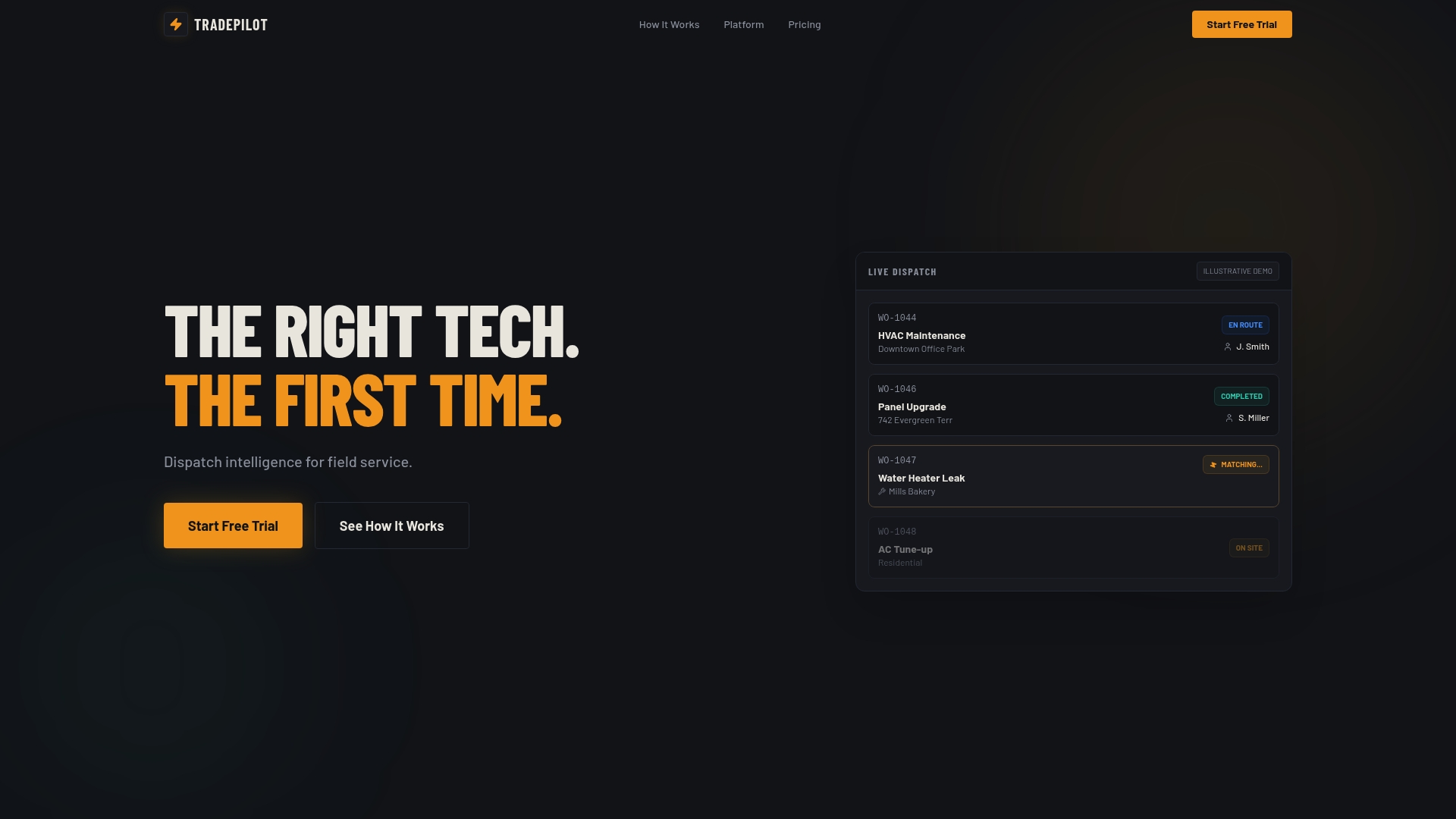
Tradepilot is built for exactly that scenario. The platform's AI matches every job to the right technician by skill, availability, and location in under a second, so dispatch continuity is not a rollout risk you have to engineer around. Drag-and-drop scheduling, integrated invoicing, real-time inventory tracking, and built-in analytics give you the adoption metrics you need to monitor the rollout without bolting on a separate reporting tool. For HVAC, electrical, and plumbing businesses planning a field-service software deployment, Tradepilot removes the three biggest rollout risks: dispatch gaps, invoice reconciliation failures, and technician onboarding friction.
Start a free trial or book a demo at Tradepilotnet to see how the platform fits your rollout timeline.
Sources
- The Ultimate Guide to Successful Software Implementation Plan | Capterra
- 17 Proven Software Change Management Strategies (2026)
- A Guide to Software Change Management - Eden Metrics
- What Is Change Management in Software Development? - In‑Com
- Implementation planning templates and task breakdown (GitHub)
- Workbook A: Communication (The Wallace Foundation)