
Static scheduling locks in the plan before execution starts; dynamic scheduling adjusts that plan in real time as conditions change. The trade-off comes down to determinism and low overhead versus adaptability and higher throughput under uncertainty. Compilers and rigid production plans lean static; out-of-order processors, live rescheduling, and field dispatch platforms lean dynamic, depending on how much variability the workload actually throws at you.
TL;DR:
- Static scheduling is preferable for predictable workloads with strict real-time deadlines and minimal variability, as it provides high determinism and low complexity.
- Dynamic scheduling offers advantages when dealing with unpredictable memory access, frequent interruptions, or variable operation latencies, despite higher hardware and software costs.
- Hybrid approaches leverage static scheduling for stable regions and dynamic mechanisms for unpredictable parts, reducing complexity while maintaining performance.
- In practical settings, dynamic dispatch reduces drive time and increases technician utilization in field services, especially when real-time data and monitoring are implemented.
- Implementing dynamic dispatch systems like Tradepilot can significantly improve operational efficiency for businesses that rely on flexible scheduling and rapid reallocation.
Table of Contents
- Dynamic Scheduling vs. Static: A Side-by-Side Look
- How Do You Choose Between Static and Dynamic Scheduling?
- What Do Static and Dynamic Scheduling Look Like in Practice?
- Can Hybrid Scheduling Beat Pure Static or Pure Dynamic?
- What Should Trades Businesses Take Away From This?
- Put Dynamic Dispatch to Work in Your Business
- Sources
Dynamic Scheduling vs. Static: A Side-by-Side Look
The two approaches diverge on four axes that matter to anyone building or managing a scheduled system: determinism, throughput, complexity, and cost.
Determinism and reproducibility favor static scheduling almost every time. When a compiler fixes instruction order at compile time, or a shop-floor plan is set the night before, you get the same result on every run. That matters when timing has to be provable, not just fast on average. Real-time control systems and safety-certified code depend on this property because a missed deadline isn't a performance hit, it's a failure.
Throughput under variability flips the advantage to dynamic scheduling. A cache miss, a network delay, an unexpectedly long job, none of these are predictable at plan time. Dynamic mechanisms reorder work around the stall instead of stalling everything behind it. This is exactly why out-of-order processors dominate general-purpose CPU design: they hide the latency of a cache miss by executing other ready instructions while the miss resolves, something a purely static instruction order can't do.
Complexity and overhead cut against dynamic scheduling. Building the hardware structures that let a processor reorder instructions on the fly, register renaming, issue queues, wakeup and select logic, costs real silicon area and power. Orchestration software that reschedules jobs live carries its own runtime cost: more state to track, more decisions per second, more code paths to test.
Failure modes differ in kind, not just degree. A static plan breaks cleanly: one unexpected event and the whole schedule can go stale, forcing a full replan. A dynamic system degrades more gracefully but is harder to debug, because the actual execution order isn't fixed and can vary run to run.
- Static: predictable, cheap to build, brittle when conditions shift
- Dynamic: adaptive, more expensive to build, harder to trace after the fact
Statistic callout: Benchmark comparisons from early scheduling research found that static and dynamic code scheduling can deliver comparable performance on many workloads, with the winner depending heavily on program characteristics rather than one method being universally faster.
How Do You Choose Between Static and Dynamic Scheduling?
Pick based on how much your workload actually varies, not on which approach sounds more modern.
Static scheduling advantages show up clearly when these signals are present:
- Tight real-time deadlines where a missed cycle or missed job window is unacceptable, not just inconvenient.
- Simple, predictable control flow with few branches, few surprises, and stable inputs run after run.
- Constrained hardware or budget, where the area and power cost of dynamic logic isn't affordable.
- Low-frequency change, meaning the plan rarely needs to be touched once it's set.
Dynamic scheduling benefits dominate when you see the opposite pattern:
- Irregular I/O or memory access, where latency varies from one operation to the next.
- Frequent interrupts or urgent jobs that can't wait for the next planning cycle.
- Variable-latency operations, whether that's a cache miss or a technician stuck in traffic.
- Field teams with unpredictable call volume, where a fixed route plan goes stale within hours.
Before committing, ask four questions: How much does the workload actually vary day to day? What service-level agreements govern acceptable delay? Do you have the instrumentation to feed a dynamic system accurate, real-time data? And can you absorb the added software or hardware cost?
Pro Tip: Don't hand-optimize code or a plan for a static model when the underlying system is dynamic. Over-specifying instruction order for a compiler, when the target processor reorders instructions anyway, wastes effort and can conflict with the hardware's own scheduling window.
The biggest red flag: choosing dynamic scheduling because it sounds more sophisticated, then discovering the added complexity has no variability to justify it. That's overhead with no payoff.
What Do Static and Dynamic Scheduling Look Like in Practice?
In computing, static scheduling happens in the compiler through techniques like loop unrolling and register allocation, ordering instructions before the program ever runs. Dynamic scheduling happens in hardware: an out-of-order execution engine uses an instruction window and register renaming to reorder ready instructions around a stalled one. Static wins when the workload is predictable enough that the compiler can plan well in advance; dynamic wins when memory latency is unpredictable, which is most general-purpose computing today.
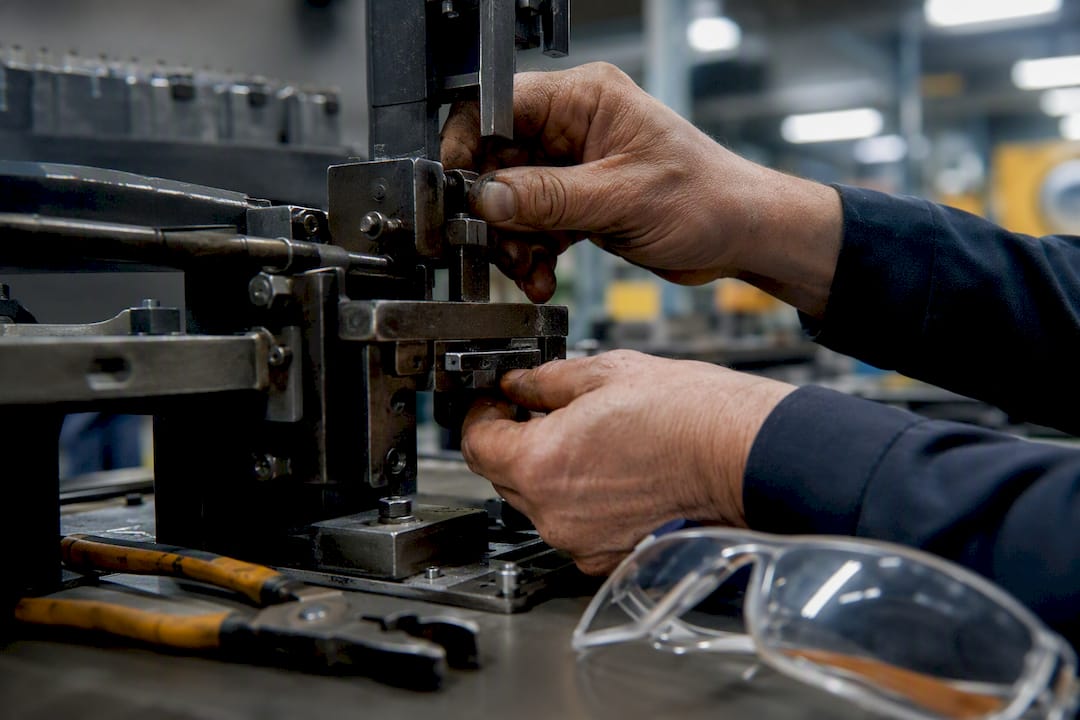
In manufacturing, a static production schedule sets machine assignments and sequencing days or weeks ahead. Dynamic rescheduling pulls in live shop-floor data, machine status, queue depth, sensor alerts, and adjusts the plan when a machine goes down or a rush order arrives. The operational KPIs that shift are throughput, on-time delivery, and machine utilization.
In field operations, a static route plan assigns technicians to jobs the night before. A dynamic dispatch platform reassigns jobs in real time based on skill, location, and availability as the day unfolds. The metrics that move: first-time fix rate, travel time, and technician utilization. Real-time scheduling tends to cut drive hours specifically because it closes gaps a fixed plan can't see coming.
Whichever domain you're in, validate a shift toward dynamic scheduling with monitoring and a dry-run period before fully trusting it, and keep a rollback path in case the live data feeding it turns out unreliable. Priority-based rules are one practical way to bound how much freedom the dynamic system has before you trust it completely.
Can Hybrid Scheduling Beat Pure Static or Pure Dynamic?
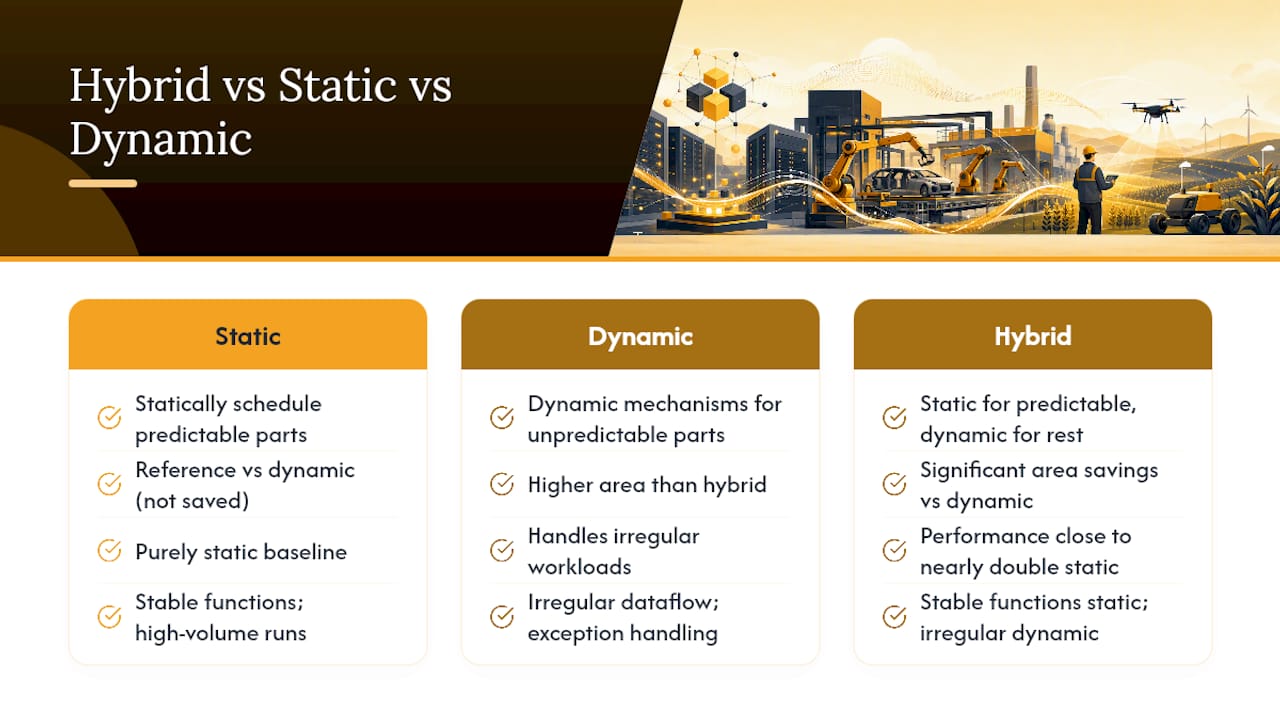
Research on combining the two approaches, often called DASS-style hybrid scheduling, shows you don't have to pick a side. The core idea: statically schedule the parts of a program or process that are predictable, and reserve dynamic mechanisms for the parts that aren't.
Evaluations of hybrid designs report significant area savings compared with purely dynamic implementations, while reaching performance close to nearly double that of purely static designs on the same benchmarks.
That combination works because most real workloads aren't uniformly predictable or uniformly chaotic. A hybrid high-level synthesis flow can treat a stable function as a black box scheduled statically, while the irregular dataflow around it gets dynamic treatment. The same logic applies outside chip design: a manufacturing line might statically schedule its stable, high-volume runs and dynamically reschedule only the exception-handling portion.
The actionable pattern is simple to state, harder to execute well: identify which regions of your workload are predictable, lock those down statically, and spend your dynamic scheduling budget only where variability is actually concentrated.
What Should Trades Businesses Take Away From This?
A technician stuck 40 minutes behind schedule used to mean every job after it slipped too. Dynamic dispatch fixes that by reassigning the next job to whoever's actually closest and free, not whoever was assigned the night before. The gain shows up in first-time fix rate and in fewer wasted drive hours, but only if you're measuring both before and after the change.
Tradepilot's dispatch matching draws on exactly the real time visibility and skill-plus-proximity logic that makes dynamic scheduling work in the field. My advice to ops managers: instrument first, automate second, and iterate on the rules once you can see what's actually happening.
— Mark
Put Dynamic Dispatch to Work in Your Business
Tradepilot is the direct way to run dynamic scheduling in an HVAC, electrical, or plumbing business, without hand-building the logic a hybrid dispatch system actually needs.
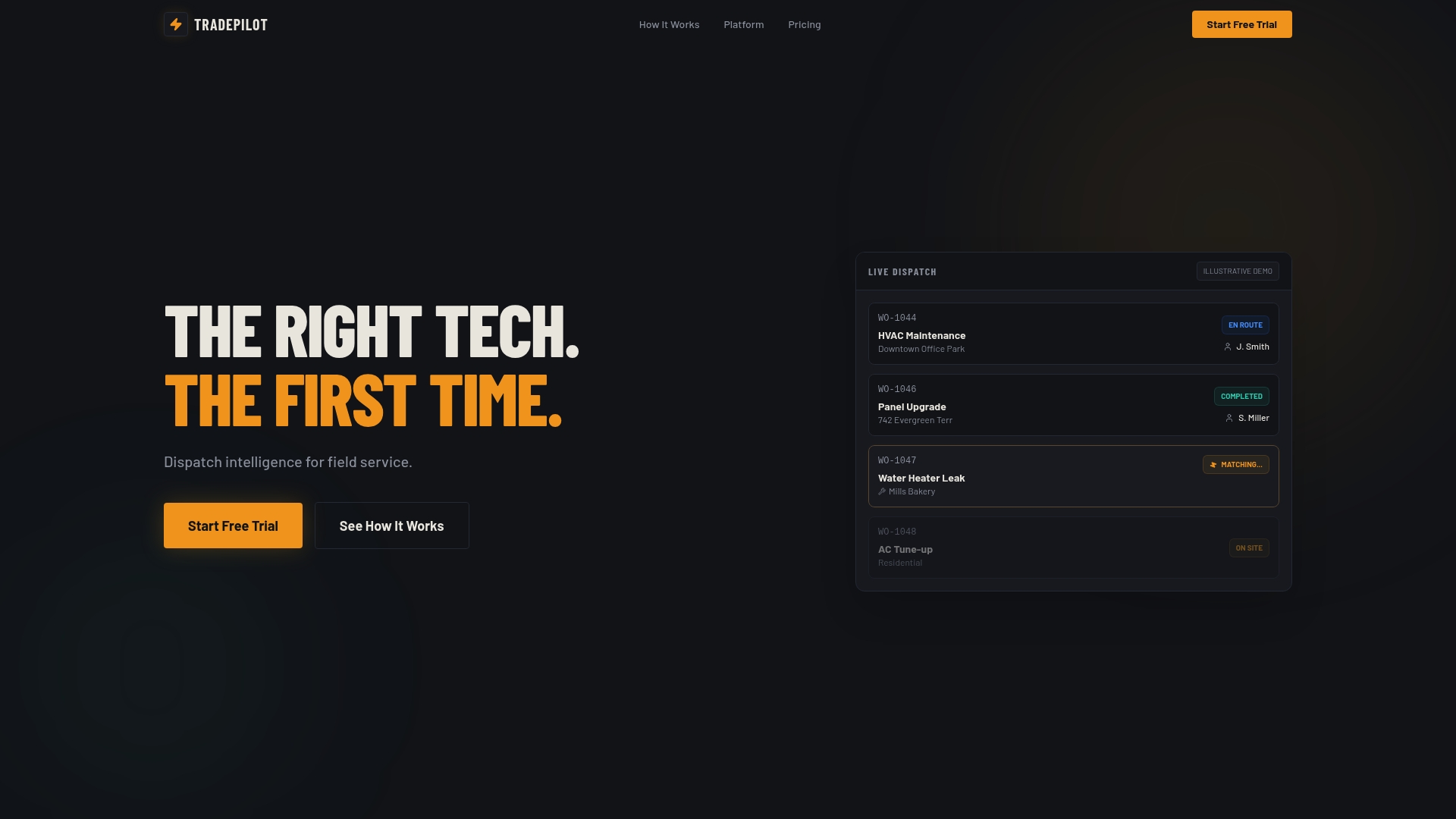
The platform's AI matches every job to the right technician by skill, availability, and location in under a second, the same principle that lets out-of-order processors and hybrid scheduling systems outperform fixed plans under real variability. In practice, that means:
- Less drive time per job, because reassignment happens the moment a technician's status changes
- Higher technician utilization, since idle time between jobs shrinks
- One system for dispatch, invoicing, inventory, and analytics, so you're not stitching together separate tools
If your current schedule is a static plan that falls apart the moment someone calls in sick or a job runs long, that's the exact gap dynamic dispatch closes. See how it fits your operation at the Tradepilot landing page.
Sources
- Unit 14: Out-of-order & dynamic scheduling (CIS5710 slides)
- Code scheduling approaches comparison (Micro-91 paper)
- DASS: Combining dynamic and static scheduling (TCAD paper)