
The single best move for franchise dispatch management is centralizing scheduling rules while letting AI match each job to the right technician by skill, availability, and location. Platforms like TradePilot build on this model and report 20–30% drive-time savings for trade managers who adopt it. Start with a pilot at two or three locations, measure the results, then scale.
TL;DR:
- Centralizing scheduling rules and enabling AI to match technicians by skill and location can cut drive time by 20 to 30 percent.
- Implementing territory boundaries with strict enforcement prevents technicians from crossing zones and protects franchisee economics.
- A dispatch pilot should last four to eight weeks at one to three locations to accurately capture demand patterns and refine rules.
- Integrations with POS, inventory, GPS, and billing systems are essential to optimize routing, tracking, and automation.
- Monitoring KPIs such as first-time fix rate, drive time, technician utilization, and customer satisfaction gauges dispatch effectiveness.
Table of Contents
- What Is Franchise Dispatch Management, and Why Is It Different?
- How Do You Match the Right Technician to Every Job?
- Which Technology and KPIs Actually Prove Dispatch Is Working?
- How Do You Roll Out a New Dispatch System Without Disrupting Service?
- How TradePilot Puts These Principles Into Practice
- What Franchise Operators Get Wrong About Dispatch
- See TradePilot's Dispatch Approach for Yourself
- Further Reading on Franchise Dispatch
- FAQ
What Is Franchise Dispatch Management, and Why Is It Different?
Franchise dispatch management is the system of rules, technology, and oversight that decides which technician handles which job across every location a franchise operates. Corporate sets the rules. Local dispatchers execute them. Customers get the same branded experience whether they call the shop in Dallas or the one in Tampa.
That last part is what makes franchise dispatch harder than dispatch at a single independent shop. You're balancing three tensions at once: brand consistency across locations, franchisee autonomy to run their own crews, and territory enforcement so techs don't poach jobs across zone lines. A franchisee who customizes dispatch logic to fit their own preferences might solve a local headache while creating a corporate reporting nightmare.
Done right, centralized dispatch delivers real payoffs:
- Consistent response times regardless of which location a customer calls
- Cross-location visibility so corporate can spot underperforming units early
- Shared technician pools during demand spikes in one territory
- Lower software and training costs than each location running its own system
Expect implementation costs to include software licensing, data migration for existing technician profiles, and several weeks of dispatcher retraining. Skipping that last piece is the most common way rollouts stall.
How Do You Match the Right Technician to Every Job?
Good dispatch logic isn't a single rule. It's a stack of rules applied in order, and franchises that skip steps end up with the wrong tech showing up, or the right tech buried under twice the workload of everyone else on shift.
- Match skill and certification first. Every technician profile should list specialties (gas line work, panel upgrades, backflow testing) and active certifications, with expiration dates that auto-flag before they lapse.
- Rank jobs by urgency. Separate emergency calls, same-day requests, and scheduled maintenance into distinct queues, each with its own service-level agreement and automatic escalation if no tech accepts within a set window.
- Balance workload before assigning by proximity. A dispatcher chasing the closest tech for every job will eventually run one person into the ground while another sits idle. Weight assignments by current job count, not just location.
- Enforce territory boundaries. Set hard rules that keep technicians inside their assigned zones except when a manager explicitly approves a cross-territory dispatch to cover a gap.
- Log every assignment and exception. Keep an audit trail of who got assigned what, when, and why any manual override happened. This is what lets corporate spot patterns before they become complaints.
Territory rules deserve special attention because they protect franchisee economics. A franchisee who bought a territory expects the jobs in it. Route optimization tools that enforce zone boundaries while still hitting fill-rate targets are doing double duty: protecting brand consistency and protecting the unit economics that make franchising attractive in the first place.
Pro Tip: Review your exception log weekly, not monthly. A single dispatcher quietly overriding territory rules three times a week looks harmless in isolation but adds up to a pattern that erodes a franchisee's exclusive territory over a quarter.
Which Technology and KPIs Actually Prove Dispatch Is Working?
A dispatch engine worth paying for needs four things at minimum: automatic job-to-tech assignment, a manual override option for edge cases, a live skills matrix, and dedicated emergency routing that bypasses the normal queue. Anything less forces dispatchers back into spreadsheets and guesswork the moment volume spikes.
Route optimization matters just as much as the matching logic. A tech who's the "right" skill match but 40 minutes away loses to a slightly less specialized tech who's 8 minutes out, especially on same-day calls. Traffic-aware routing, not just straight-line distance, is what actually cuts drive time in the real world.
20–30%: the range of drive-time reduction TradePilot's intelligent dispatching has delivered for trade managers who moved off manual or spreadsheet-based scheduling.
None of this matters without integration. Your dispatch platform needs to talk to:
- Your POS and CRM systems, so job history and customer notes travel with every ticket
- Accounting and invoicing, so a completed job triggers billing automatically
- Inventory systems, so a tech isn't dispatched without the parts the job needs
- Telematics and GPS, for real-time location data
- Customer-facing portals and APIs, for booking and status updates
Track drive time per job, first-time fix rate, technician utilization, SLA adherence, dispatcher workload distribution, and customer NPS. Build two dashboard tiers: a corporate view comparing all locations side by side, and a location view each franchisee checks daily. Weekly reporting cadence works for most networks; daily is worth it only during a pilot or a known trouble spot.
How Do You Roll Out a New Dispatch System Without Disrupting Service?
Rolling out new dispatch logic across a franchise network fails most often because nobody defined who owns the decision when corporate rules and local reality conflict. Fix that before touching any software.
- Assign governance first. Name who owns KPI targets, who approves exceptions, and who has final say on rule conflicts between corporate and franchisees.
- Pick a pilot group. Choose one to three locations that represent your typical mix of urban and rural territory, then run the pilot for 4 to 8 weeks, long enough to see real seasonal or weekly patterns.
- Prep your data. Load technician skill profiles, sync customer records, and connect GPS or telematics feeds before go-live, not during it.
- Train dispatchers hands-on. Give each dispatcher a playbook and run live scenarios, not just a slide deck, before they touch real jobs.
- Scale in waves. Use pilot KPIs to tighten your rules, then roll out to the next group of locations only after the pilot group hits its success targets.
Budget for training time as a real line item. A dispatcher who's run the same paper system for five years needs more than one afternoon to trust an automated match.
How TradePilot Puts These Principles Into Practice
TradePilot matches jobs to technicians in under a second by scoring skill fit, current availability, and location together, then hands dispatchers a manual override for the calls that need a human judgment. Dispatch automation handles the routine assignment volume; emergency workflows get a separate lane so a burst pipe doesn't sit behind three scheduled maintenance calls.
Franchise dispatchers using TradePilot have seen 20–30% drive-time savings, largely from balancing technician workloads instead of defaulting to whoever's closest.
Two examples show the pattern:
- A dispatcher facing three simultaneous emergency calls gets automatic priority routing instead of manually triaging by phone.
- A franchise location tracking first-time fix rate finds it climbs once skill matching replaces "whoever's free" assignment logic
What Franchise Operators Get Wrong About Dispatch
The biggest mistake I see is franchisees demanding so much local customization that corporate loses any real visibility into how jobs get assigned. The second is treating dispatch data as a reporting afterthought instead of the thing that tells you where technicians are underused. The third is skipping training and expecting dispatchers to trust a new system on day one.
The real trade-off isn't automation versus human judgment. It's how much local flexibility you allow before brand consistency erodes. Start centralized, pilot honestly, and adjust the rules faster than you'd think you need to.
— Mark Korley
See TradePilot's Dispatch Approach for Yourself
Every principle in this guide, skill-based matching, workload balancing, emergency prioritization, and unified reporting, is built into how TradePilot works day to day. Instead of stitching together a scheduling spreadsheet, a separate invoicing tool, and a GPS app, franchise dispatchers can use a platform that handles dispatch, invoicing, inventory, and analytics together.
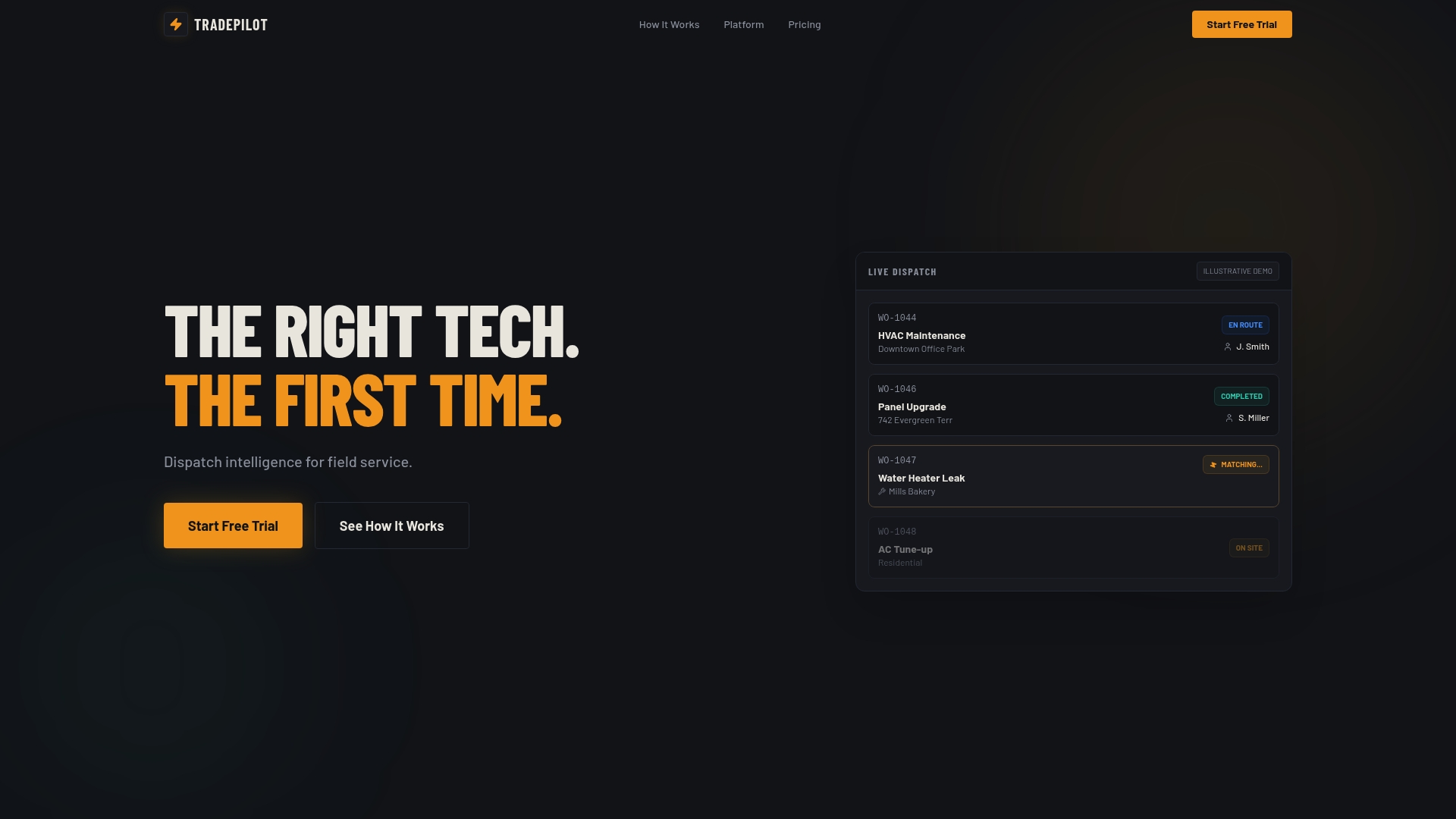
If your network is still assigning jobs by whoever answers the phone first, a pilot is the fastest way to find out what centralized, AI-assisted dispatch actually changes. Request a demo at TradePilot, run it against two or three of your locations, and track drive time, first-time fix rate, and technician utilization against your current numbers. The comparison tends to speak for itself within a few weeks.
Further Reading on Franchise Dispatch
For deeper background, see dispatch automation fundamentals, emergency dispatch workflows, dispatch software cost breakdowns, and franchise operating models for context on scaling multi-location service businesses.
FAQ
What Is Franchise Dispatch Management?
It's the combination of centralized scheduling rules and local execution that assigns jobs to technicians across every location in a franchise network while keeping the customer experience consistent.
How Much Drive Time Can Franchises Actually Save?
Franchise trade businesses using intelligent dispatching like TradePilot have seen 20 to 30% drive-time savings compared to manual or spreadsheet-based scheduling.
How Long Should a Dispatch System Pilot Run?
A pilot at one to three representative locations should run four to eight weeks, long enough to capture normal weekly and seasonal demand swings before rolling out further.
How Do You Prevent Technicians From Crossing Territory Lines?
Set hard territory rules in the dispatch platform that block cross-zone assignment by default, allowing exceptions only through manager approval to cover genuine coverage gaps.
What KPIs Matter Most for Franchise Dispatch?
Drive time per job, first-time fix rate, technician utilization, SLA adherence, dispatcher workload balance, and customer NPS give the clearest read on whether dispatch changes are working.