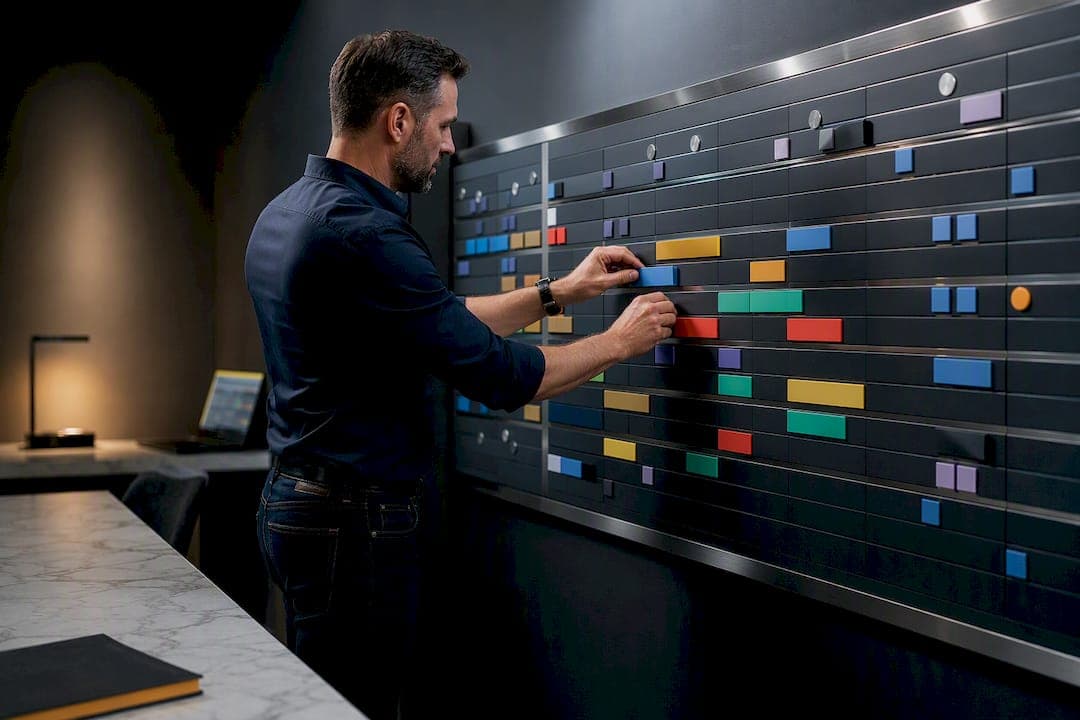
Prevent double booking by gating complex jobs behind a planning check, enforcing skill-first filtering with zone-based rules, blocking 95th-percentile transition buffers as hard unavailable time, and running every booking through one real-time authoritative schedule with automated conflict detection. Platforms like Tradepilot build this logic directly into dispatch so a conflict gets blocked at the point of booking, not discovered when two trucks show up at the same address.
TL;DR:
- Confirm buffers are based on 95th-percentile drive times, not averages, and treat these buffers as hard blocks across all scheduling channels.
- Enforce skill-based filtering before offering available slots and assign primary crew ownership by zone to prevent improvise scheduling.
- Use a single, authoritative schedule that runs real-time conflict checks during booking to automatically block overlaps before they occur.
- Plan complex jobs separately with task dependencies, parts confirmation, and access windows before they reach dispatch to reduce upstream double booking issues.
- Ensure seamless, instant synchronization of all booking platforms, and provide staff training on system rules and conflict resolution to maintain schedule integrity.
Table of Contents
- Quick Checklist: Immediate Fixes You Can Apply Today
- Planning Layer: Make Complex Jobs Schedulable Before Dispatch
- Scheduling Rules and Buffer Formulas That Prevent Overlaps
- Execution Layer: One Schedule, Automated Conflict Detection
- Step-by-Step Rollout: 30 / 90 / 180-Day Implementation Plan
- Metrics and Governance: How to Tell the System Is Working
- Best Practices for Communication Protocols That Prevent Double Booking
- Role of Customer Self-Service Portals in Reducing Double Bookings
- Impact of Calendar Integrations and Synchronization Across Platforms
- Training Staff on Scheduling Tools and Conflict Resolution
- A Dispatcher's Take on Planning-First Scheduling
- How Tradepilot Helps Prevent Double Booking
- Sources
Quick Checklist: Immediate Fixes You Can Apply Today
Most double bookings trace back to five fixable habits, not bad luck. Fix these before you touch anything else:
- Reserve transition buffers as hard blocks. Calculate them from your 95th-percentile drive and pack-down times, not averages, and mark that window as unavailable everywhere.
- Enforce skill-first filtering before a slot is even offered. Never show an open time for a technician who lacks the required certification.
- Assign primary crew ownership by zone, with an explicit overflow rule for who takes the second call when the primary is booked.
- Consolidate every booking channel (phone, web form, dispatcher notes) into one schedule that all of them write to.
- Gate complex jobs on parts confirmation and a confirmed access window before they ever hit the dispatch board.
None of these require new software to start. They require discipline, and about a week to enforce consistently.
Planning Layer: Make Complex Jobs Schedulable Before Dispatch
Most double-booking chaos on multi-technician jobs doesn't start at dispatch. It starts upstream, when a job gets pushed into the scheduling console before anyone confirmed it's actually ready to schedule. A planning-before-dispatch approach treats complex jobs as a separate workflow with its own gate, and that gate should check:
- Task decomposition and sequencing. Break the job into discrete tasks with explicit dependencies, so a rough-in inspection can't get scheduled before the rough-in itself.
- Per-task skill confirmation. Each task carries its own certification requirement as a hard constraint, not a general "electrician needed" note.
- Parts and kit confirmation. No scheduling attempt until the parts list is confirmed in stock or on order with a delivery date.
- Access windows at the task level. A customer available Tuesday morning for demolition might not be home Wednesday for finish work; confirm each window separately.
Pro Tip: Assign a senior technician to sign off on sequence, access, and parts before a complex job is marked "schedulable." This lightweight field review step closes most planning gaps without slowing the process down.
Split ownership clearly: planning is a separate role from dispatch. When both live in the same inbox, complex jobs get shortcut straight to the calendar and cause the cascading conflicts that follow.
Scheduling Rules and Buffer Formulas That Prevent Overlaps
Zone-based assignment is the backbone rule. Each geographic zone gets a primary crew, and an explicit overflow rule defines who takes the second call once that crew's day fills. Without that rule, dispatchers improvise, and improvisation is where double bookings start.
Buffer sizing is where most shops guess wrong. A buffer needs to cover:
- Pack-down and load time at the previous job
- Drive time between sites
- Parking and building access delays
- Setup time at the next site
- A contingency margin for anything that runs long
The FHWA's travel-time reliability research recommends sizing that buffer off the 95th percentile of historical data, not the average. Average drive time looks fine on paper and then collapses your 3 p.m. slot the first time traffic runs long. Once you calculate that buffer, treat it as a hard block across every channel, not a soft suggestion a dispatcher can override to squeeze in one more call.
Skill match should be checked before availability, not after. Filtering by open time slot first and skill second is how unqualified techs get booked and then reassigned last minute, which is its own source of conflicts.
Execution Layer: One Schedule, Automated Conflict Detection
Every booking channel, whether it's a phone call, a web form, or a dispatcher manually adjusting a route, needs to write to the same schedule. The moment a shop runs a separate spreadsheet for emergency calls or a second calendar for one crew, double booking becomes a matter of when, not if.
At the point of booking, the system should run a gate check before the assignment saves:
- Does this technician have a conflicting job at this time?
- Does this fall inside a blocked transition buffer?
- Does the technician hold the required skill for this task?
- Is travel time from the prior job realistic given the new job's location?
If any check fails, the system blocks the save instead of warning about it afterward. That distinction matters more than it sounds. A warning depends on a human noticing and acting on it; a block removes the human failure point entirely.
Real-time GPS and job-status telemetry feed that same schedule, so a job running long automatically ripples forward instead of silently creating a conflict two stops later. When conditions shift enough that no qualified technician is actually free, the system should surface that visit as unassigned rather than force a bad match, and re-optimize the rest of the day around it.
Underneath all of this sits a constraint model. Hard constraints, like certifications, licensing hours, and fixed appointment windows, can never be violated. Soft constraints, like minimizing drive time or balancing workload across the team, get optimized wherever possible. Solvers built on this hard/soft split can generate near-optimal schedules in seconds rather than the minutes a dispatcher would need to check the same logic by hand.
Step-by-Step Rollout: 30 / 90 / 180-Day Implementation Plan
Rolling this out in one weekend guarantees pushback and mistakes. A phased plan lets you validate each layer before adding the next.
- Days 1 to 30: Lock down the basics. Enforce buffer blocks, zone-based crew ownership, and single-schedule discipline (no side spreadsheets, no second calendar). Pilot parts gating on your most complex job type only.
- Days 31 to 90: Build the data layer. Pull 90 days of travel-time history and calculate your real 95th-percentile buffer by zone and season. Build out a skill matrix mapping every technician to certifications and job types. Expand the planning-layer pilot to two or three job categories.
- Days 91 to 180: Automate. Deploy re-optimization and real-time telemetry so the schedule adjusts itself as the day runs. Turn on automated at-booking conflict blocking across every channel. Run dispatcher training on the new tools and hand-check exception cases weekly for the first month.
Pro Tip: Track your conflict rate weekly during the rollout, not monthly. A spike in week two tells you which rule needs tightening before it becomes a habit that's hard to undo.
Each phase should end with a measurable checkpoint: fewer manual overrides, a falling conflict rate, and dispatchers who trust the schedule enough to stop double-checking it by hand.
Metrics and Governance: How to Tell the System Is Working
A handful of numbers tell you whether the fixes are holding or quietly eroding.
- Conflict rate and booking-block rate. How often does the system catch and stop a conflicting assignment before it saves?
- Detection lead time and mean time to resolve. When a conflict does slip through, how fast is it caught and fixed?
- On-time arrival, SLA breach rate, and second-visit rate. These reveal whether buffers and skill matching are actually holding up in the field.
- Average and 95th-percentile travel time. Rising 95th-percentile numbers mean your buffers need retuning before they cause the next round of overlaps.
Run a weekly scheduling review to look at these numbers together, not in isolation. Pair it with a short postmortem on any exception, the job that ran three hours long, the technician sent to the wrong zone, and use it to adjust buffer sizes or zone rules rather than treating it as a one-off. Buffer tuning isn't a one-time setup task; it's a recurring maintenance job as seasons, traffic patterns, and crew sizes shift.
Best Practices for Communication Protocols That Prevent Double Booking
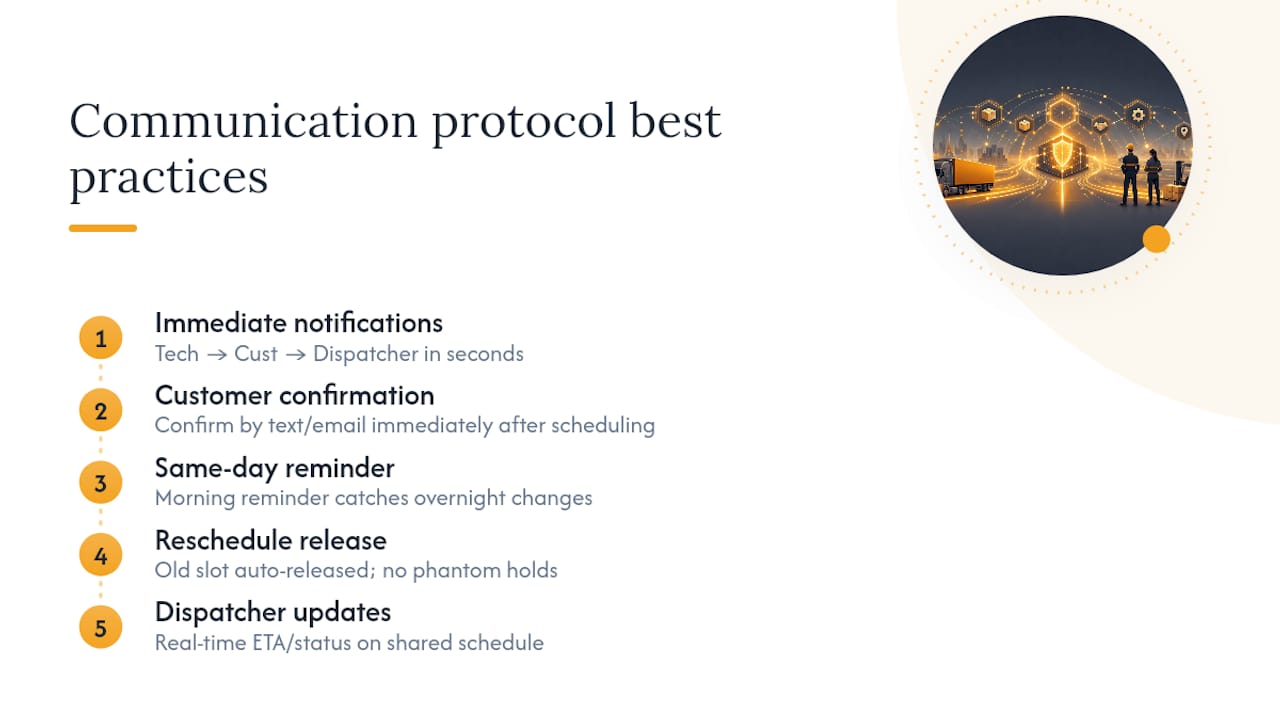
Even a perfect scheduling engine fails if confirmations don't reach the right person in time. Every booking, reschedule, or cancellation needs to trigger an automatic notification to the technician, the customer, and the dispatcher, in that order, within seconds of the change.
Confirmation timing matters more than most shops realize. A booking confirmed by text or email immediately after scheduling gives the customer a chance to flag a conflict on their end before a technician drives out. A same-day reminder, sent the morning of the appointment, catches the cases where plans changed overnight. Skipping either step is how a "confirmed" job turns into a no-show or an angry call when two people show up expecting the same slot.
Reschedules deserve their own protocol. When a job shifts, the old time slot needs to release automatically, not sit as a phantom hold that blocks a technician from being offered to someone else. Manual rescheduling without an automatic release is a quiet but common cause of a technician showing as "booked" when they're actually free.
For dispatchers, an internal notification standard matters just as much as the customer-facing one. If a zone's primary crew gets reassigned mid-day, every affected dispatcher should see that change on the shared schedule within moments, not learn about it from a phone call an hour later. Real-time ETA and status updates close that gap and keep everyone working from the same version of the day.
Role of Customer Self-Service Portals in Reducing Double Bookings
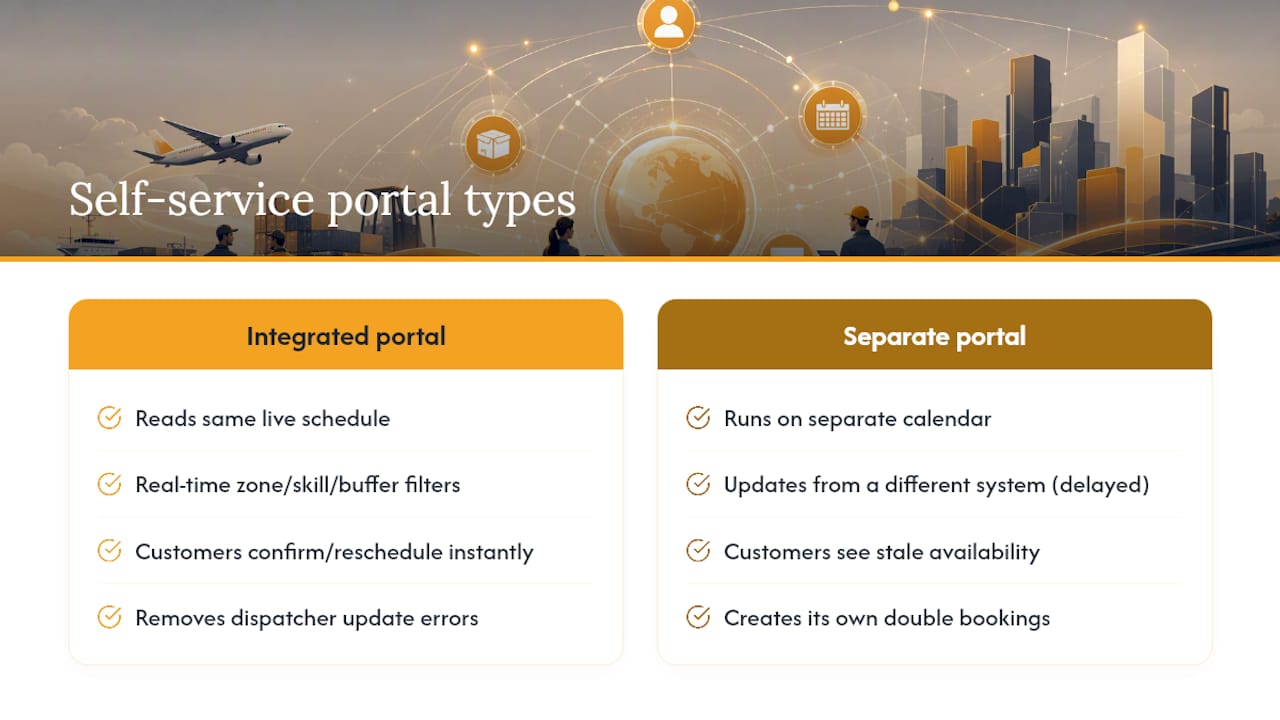
A self-service booking portal only reduces conflicts if it reads from the exact same live schedule your dispatchers use. A portal that runs on a separate calendar, updated by a different system on a delay, becomes its own source of double bookings instead of a fix for them.
Done right, a portal pulls real-time availability, already filtered by zone, skill requirement, and buffer blocks, so a customer physically cannot book a slot that's already spoken for. That removes an entire category of human error: the dispatcher who forgets to update a shared spreadsheet after a phone booking.
Self-service also shifts confirmation and rescheduling into the customer's hands, cutting the back-and-phone-tag that causes many "double bookings" in the first place, where two separate calls each got a manual confirmation for the same window before anyone cross-checked. A portal with instant visibility into open slots removes that blind spot entirely.
The tradeoff is real: a portal needs strict enforcement of skill and zone rules on the backend, or customers will book jobs no available technician is actually qualified to take. That's why self-service works best layered on top of the same constraint model driving your dispatcher-facing schedule, rather than as a bolt-on booking widget with its own separate logic.
Impact of Calendar Integrations and Synchronization Across Platforms
Every disconnected calendar in your operation is a potential double-booking source. If your phone-booked jobs live in one calendar, your web-form bookings live in a second, and a technician's personal phone calendar holds a third version, nobody, including the software, has a complete picture of who's actually free.
Real synchronization means every platform writes to and reads from one schedule in real time, not a nightly batch sync that leaves a technician looking available for eight hours after they've actually been booked. A sync delay of even fifteen minutes is enough window for a second dispatcher to book the same person.
This is also where consolidating inbound channels pays off. Tools that unify inbound calls and technician dispatch, like the Coco Property call model, remove one of the most common integration gaps: a call center or answering service booking off a schedule that isn't the live version dispatch is using.
Integration quality matters more than integration quantity. Three tightly synced systems beat six loosely connected ones. Before adding another tool to your stack, confirm it writes changes back to your authoritative schedule instantly, not on a delay, and that it respects the same buffer and skill rules the rest of your system enforces.
Training Staff on Scheduling Tools and Conflict Resolution
The best conflict-blocking system in the world fails if dispatchers don't understand why a booking got rejected and how to resolve it correctly. Training needs to cover two distinct skills: using the tool, and knowing what to do when the tool says no.
Start with the "why" behind each rule. A dispatcher who understands that a buffer block exists because of 95th-percentile drive-time data is far less likely to override it under pressure than one who just sees an arbitrary restriction in the way of booking a customer.
Conflict resolution training should walk through real scenarios, not abstract policy. What happens when a hard constraint blocks every available technician for an urgent job? Who has authority to approve an exception, and what gets logged when they do? Without clear escalation rules, dispatchers either freeze or quietly work around the system, which recreates the exact problem you built the rules to prevent.
New hires should shadow live bookings for at least a week before working solo, watching how a senior dispatcher handles the exceptions the system flags rather than the routine bookings it handles automatically. Refresh training whenever buffer formulas or skill matrices change; a rule change that isn't communicated is functionally the same as no rule at all.
A Dispatcher's Take on Planning-First Scheduling
Most shops treat scheduling as a dispatch problem. It's not. It's a planning problem that shows up looking like a dispatch problem. By the time two trucks are heading to the same address, the actual failure happened days earlier, when a complex job got typed into the calendar without confirming parts, access, or the right certification.
What's changed the operations I find credible is the shift toward one authoritative schedule with automated blocking baked into the save action itself, not a review step someone forgets to run. An approach matching jobs to technicians by skill, availability, and location quickly works because it enforces that discipline automatically rather than hoping dispatchers remember it during a busy Monday. Shops that pair that with integrated inventory and invoicing tend to see fewer second visits, since a truck never rolls without confirmed parts in the first place.
— Mark Korley
How Tradepilot Helps Prevent Double Booking
A platform built around the prevention logic this guide covers: AI matching that filters by skill, availability, and location before a slot is ever offered, one real-time schedule that every channel writes to, and automated blocking the moment a conflict shows up at the point of booking. Parts and inventory data connect directly to dispatch, so a job doesn't get scheduled until the materials are confirmed, and analytics surface real travel-time patterns so buffer sizing stops being a guess.
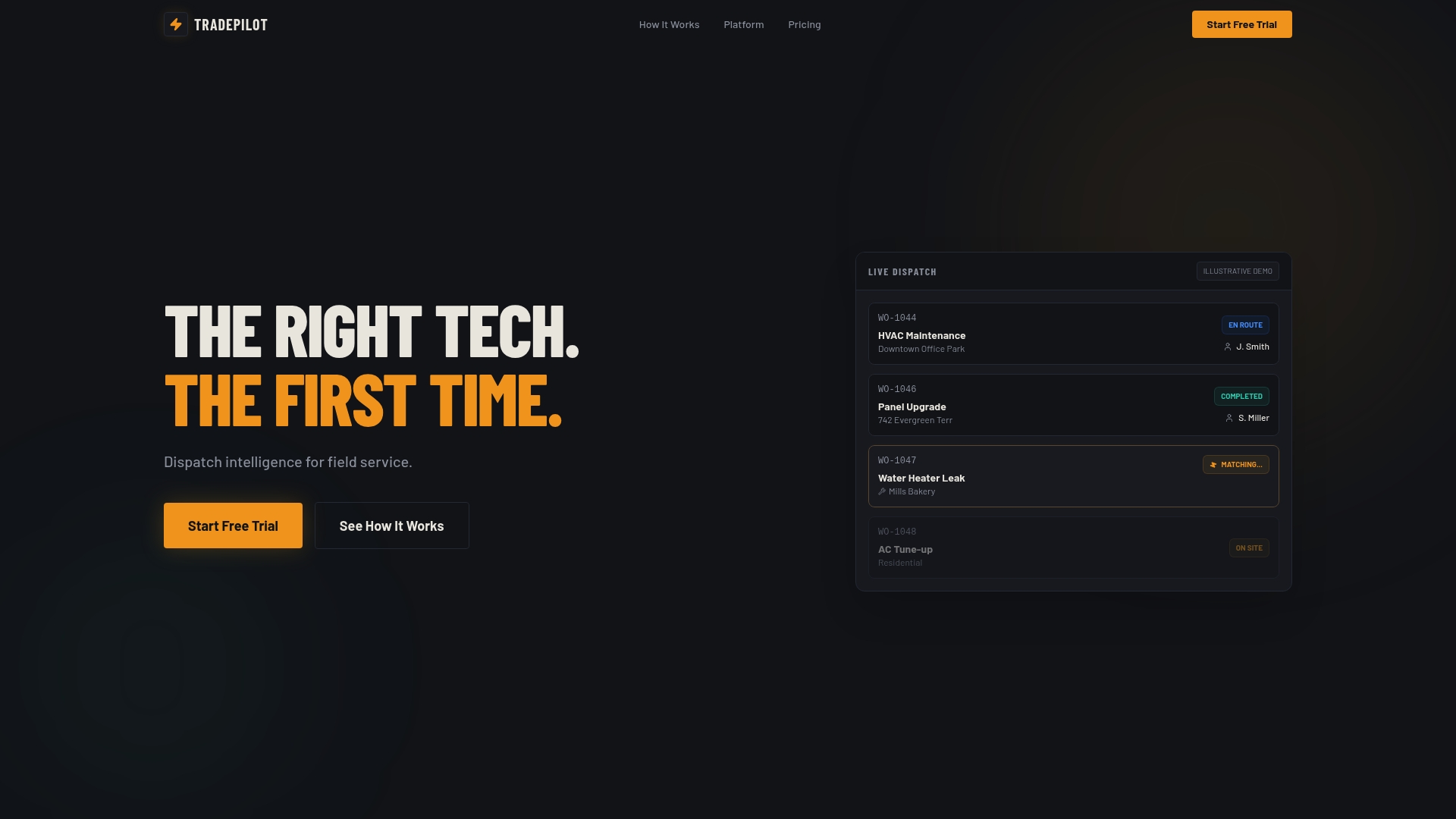
For a shop running multiple crews across several zones, that means fewer emergency reshuffles, fewer second visits, and a dispatcher who can trust the calendar instead of double-checking it by phone. If a team is still stitching together a spreadsheet, a shared calendar, and a phone log to cover one schedule, that gap is where double bookings keep coming from. Start a trial at Tradepilotnet and see how the constraint model handles your next complex job before it ever hits the dispatch board.
Sources
For deeper detail on the concepts covered here, see field service routing optimization for constraint-model mechanics, planning before dispatch for complex-job gating, and Tradepilot's own guide to technician route optimization for applying these rules day to day.
- Field Service Routing Optimization: The Definitive Guide | Timefold
- Complex Field Service Scheduling: Planning Before Dispatch
- How to dispatch multiple field service crews without double booking | URBLD
- FHWA travel-time reliability guidance