
Service schedule optimization means using data, algorithms, and predictive inputs to match technicians to jobs by skill, location, and timing, rather than by whoever's free next. Done right, it cuts travel time by roughly a noticeable amount, and lifts on-time performance significantly. Operations managers running HVAC, electrical, or plumbing crews should start testing it now, and a platform like Tradepilot makes that shift far less painful than building it from scratch.
TL;DR:
- Most companies see a 10% reduction in windshield time and up to 50% improvement in on-time arrivals when implementing routing and scheduling optimization.
- Starting with process improvements such as digitizing records and standardizing job templates provides significant gains before adding automation tools.
- Roll out schedule optimization gradually through phased pilots, tracking key KPIs like travel time, on-time rate, and first-time fix percentage over at least two months.
- Effective software should offer real-time rescheduling, skill-based matching, deep system integration, and mobile access to prevent disruptions.
- Optimization engines perform best when fed accurate job duration forecasts from machine learning models combined with robust constraint handling.
Table of Contents
- What Service Schedule Optimization Really Means
- Core Scheduling Techniques Dispatch Teams Should Adopt
- How Do You Roll Out Schedule Optimization Without Disrupting Operations?
- Which KPIs Actually Prove Your Schedule Optimization Is Working
- The Algorithms Behind Modern Scheduling Tools
- Tradepilot in Practice: Mapping the Roadmap to Real Capabilities
- What to Require When Choosing Scheduling Software
- Legal and Regulatory Considerations in Service Scheduling
- What I've Learned Watching Scheduling Rollouts Succeed and Fail
- See How Tradepilot Puts This Into Practice
- Sources
What Service Schedule Optimization Really Means
Most dispatch boards run on rules: the nearest tech gets the job, or whoever's next in rotation takes it. That's rule-based booking, and it works fine when call volume is low and jobs are simple. It falls apart fast once you're juggling skill requirements, drive times, parts availability, and same-day cancellations across a dozen trucks.
An optimization engine treats scheduling as a math problem instead of a queue. It weighs technician skill, current location, time windows, job duration estimates, and traffic patterns simultaneously, then recalculates the best arrangement every time something changes. That's the practical difference between "who's free" and "who's actually best for this job right now."
The payoff shows up in the numbers. Companies that add routing and scheduling optimization typically see:
- About 10% less windshield time per technician per day
- 25 to 50% better on-time arrival performance
- Fewer missed appointments from realistic, data-based ETAs instead of guessed ones
That range alone should justify a pilot program for most service businesses running more than a handful of trucks.
Core Scheduling Techniques Dispatch Teams Should Adopt
You don't need a full software overhaul to start improving your schedule. Some of the biggest gains come from fixing process gaps before any algorithm gets involved.
- Kill the paper and whiteboard systems. Every job that lives outside a searchable database is a job you can't analyze later.
- Standardize job templates. A "furnace tune-up" should take a predictable range of minutes based on unit type and history, not a dispatcher's gut feeling.
- Use historical data for slotting. Past job durations and seasonal demand patterns tell you when to staff up and how long to block for specific job types.
- Assign by skill and territory, not availability alone. Grouping technicians by geographic zone and certification level cuts drive time and reduces callbacks for jobs that need a specialist.
- Build in buffer time. Fixed 60-minute slots ignore the reality that some jobs run long. Flexible windows absorb that variance without cascading delays into every appointment after it.
- Automate customer confirmations. Text or email confirmations with two-way rescheduling links reduce no-shows and give dispatchers earlier warning when a slot opens up.
- Add a routing or optimization engine once volume justifies it. If you're running more than a few trucks a day, manual re-optimization every time a job runs long or a customer cancels stops scaling.
Foundational fixes like removing paper processes, mining historical data, and tightening customer communication deliver real gains on their own. Software doesn't replace that work. It scales it once you've proven the process works manually.
Pro Tip: Start by standardizing your three highest-volume job types first. Once those templates are accurate, everything else in your scheduling stack gets easier to automate.
How Do You Roll Out Schedule Optimization Without Disrupting Operations?
Rolling out schedule optimization in one big swing is how pilots fail. A phased approach protects your team's trust in the system while you prove the model works.
- Phase 1: Quick wins (weeks 1 to 4). Digitize job records, standardize templates for your top job categories, and apply basic geographic routing rules manually. No software spend required yet.
- Phase 2: Measurement (weeks 4 to 10). Start tracking actual job duration versus estimated, travel time per technician, first-time fix rate, and no-show frequency. You need at least two months of clean data before an algorithm can improve on your current process.
- Phase 3: Pilot automation (weeks 10 to 16). Choose one region, one job type, or one crew for a limited rollout. Set guardrails, meaning a dispatcher can override any auto-generated schedule, and confirm the tool integrates with your existing invoicing and CRM systems rather than replacing them outright.
- Phase 4: Scale with feedback loops. Bring technicians and dispatchers into the review process before expanding company wide. The people living in the schedule daily will catch friction points a spreadsheet analysis misses.
Field-service optimization tools increasingly run alongside existing platforms via API integrations, which means you can pilot without ripping out your current dispatch board. Build a rollback plan into every phase. If technician satisfaction drops or customer complaints spike during the pilot, you need a defined path back to the previous process, not a scramble.
Which KPIs Actually Prove Your Schedule Optimization Is Working
Dashboards full of vanity metrics won't convince ownership that a new scheduling approach is worth the investment. Five numbers matter more than the rest.
- Travel time percentage: the share of a technician's paid hours spent driving versus working. Anything above 25% usually signals routing problems.
- On-time rate: the percentage of jobs where the technician arrives within the promised window.
- First-time fix rate: jobs closed without a return visit, a direct signal of whether the right skill got matched to the right job.
- Technician utilization: billable hours against total scheduled hours.
- Overtime hours: rising overtime despite flat job volume usually means your scheduling, not your staffing, is the problem.
Baseline every one of these for 60 to 90 days before changing anything. Realistic targets beat aggressive ones. If routing optimization typically delivers a 10% travel reduction and a 25 to 50% on-time improvement, set your first-quarter goal at the low end of that range and adjust from there.
Report these weekly to dispatch and monthly to leadership, with the same five metrics on both dashboards so nobody's arguing about different numbers.
The Algorithms Behind Modern Scheduling Tools
Vendor pitches love the word "AI" without explaining what's actually running underneath. Two families of approaches dominate the space, and knowing the difference helps you evaluate what you're buying.
- Mixed-integer programming and constraint programming solve for a mathematically optimal schedule given a fixed set of rules. They work well for stable, well-defined problems but struggle when constraints multiply or conditions change mid-day.
- Routing heuristics trade a small amount of optimality for speed, which matters enormously when a schedule needs to re-solve itself in seconds after a cancellation, not minutes.
- Machine learning inputs predict job duration and no-show probability from historical patterns, feeding better data into whichever optimization method sits on top of it.
- Distributionally robust optimization handles uncertain travel and service times by planning for a range of outcomes instead of a single average, and it can be reformulated into solvable problems for standard solvers.
The honest takeaway: prediction and optimization work best together. An engine fed accurate job-duration forecasts outperforms one running on flat averages, regardless of which algorithm sits underneath.
Tradepilot in Practice: Mapping the Roadmap to Real Capabilities
Tradepilot's AI matches every job to a technician by skill, availability, and location in under a second, which is the automated version of the manual triage described in the implementation roadmap above. The platform bundles dispatch, invoicing, inventory, and analytics into one system instead of forcing you to stitch four tools together.
That matters most in the exact areas HVAC, electrical, and plumbing businesses struggle with when scaling manual scheduling:
- Real-time job-to-technician matching that accounts for certification and current location, not just next-available status
- Integrated invoicing and inventory so a completed job automatically updates parts on hand and billing
- Performance analytics that surface the same KPIs covered above without a separate reporting tool
- A pilot-friendly structure that lets a single crew or region test AI dispatch before rolling it company wide
What to Require When Choosing Scheduling Software
Not every scheduling tool built for retail shift work or restaurant staffing translates to field service with trucks, tools, and drive times involved. Four capabilities separate tools that actually solve dispatch problems from ones that just digitize a calendar.
Real-time rescheduling tops the list. A tool that only optimizes once a day, at 6 a.m., is useless when a 10 a.m. cancellation opens a slot a smart dispatcher should fill by 10:05. Look for platforms that recalculate continuously as jobs complete, cancel, or run long.
Skill-based matching needs to go deeper than a checkbox. Certifications, equipment access, and even customer history (a repeat customer who prefers a specific technician) should factor into the match, not just "electrician" versus "plumber" as a binary tag.

Integration depth determines whether the tool becomes your system of record or one more app dispatchers have to check. Confirm it connects to your invoicing, inventory, and CRM systems, since running the optimization engine alongside existing platforms beats ripping out infrastructure that already works.
Mobile access for technicians rounds it out. If a tech in the field can't see updated routing, log parts used, or confirm a job is complete from their phone, the office ends up manually re-entering data that should have flowed automatically. A field service app built around live technician updates closes that gap.

Legal and Regulatory Considerations in Service Scheduling
Scheduling decisions carry legal weight most operations managers don't think about until a complaint lands. Wage and hour rules under the Fair Labor Standards Act govern how travel time between jobs gets counted toward paid hours in many states, and getting that classification wrong creates real overtime liability, not just an accounting headache.
Predictive scheduling laws, already active in cities like San Francisco, Seattle, and New York for retail and food service, are expanding into other service sectors in some jurisdictions. These require advance notice of shift schedules and penalize last-minute changes. Even where they don't yet apply to field trades directly, the direction of the regulatory trend is worth tracking if your workforce spans multiple states.
Licensing and certification requirements also constrain scheduling more than most dispatch software accounts for by default. A technician without an active HVAC or electrical license in a given jurisdiction legally cannot be dispatched to certain jobs there, regardless of how available they are. Any scheduling system worth adopting needs to enforce those constraints automatically rather than relying on a dispatcher to remember state-by-state licensing rules.
Union agreements and service contracts sometimes specify response-time guarantees or technician assignment rules too, particularly for facilities and maintenance accounts. A facility maintenance provider managing recurring service contracts has to build those obligations into scheduling logic from day one, not retrofit them after a missed SLA becomes a contract dispute.
What I've Learned Watching Scheduling Rollouts Succeed and Fail
The biggest mistake I see isn't picking the wrong software. It's automating a broken process and expecting the algorithm to fix what bad data created. Optimization engines amplify whatever inputs you feed them, good or bad.
The second mistake is dispatcher exclusion. Teams that bypass the people who've been routing jobs manually for years lose the tacit knowledge that no dataset captures, like which customer always runs 20 minutes late or which tech underperforms his own time estimates.
Start with one region or one job type. Measure it honestly. Scale only once the data backs you up.
— Mark
See How Tradepilot Puts This Into Practice
Tradepilot turns the roadmap above into something you can run this week instead of building over six months. The platform's AI matches every job to the right technician by skill, availability, and location in under a second, and it keeps dispatch, invoicing, inventory, and analytics in one system instead of four disconnected tools you have to reconcile manually.
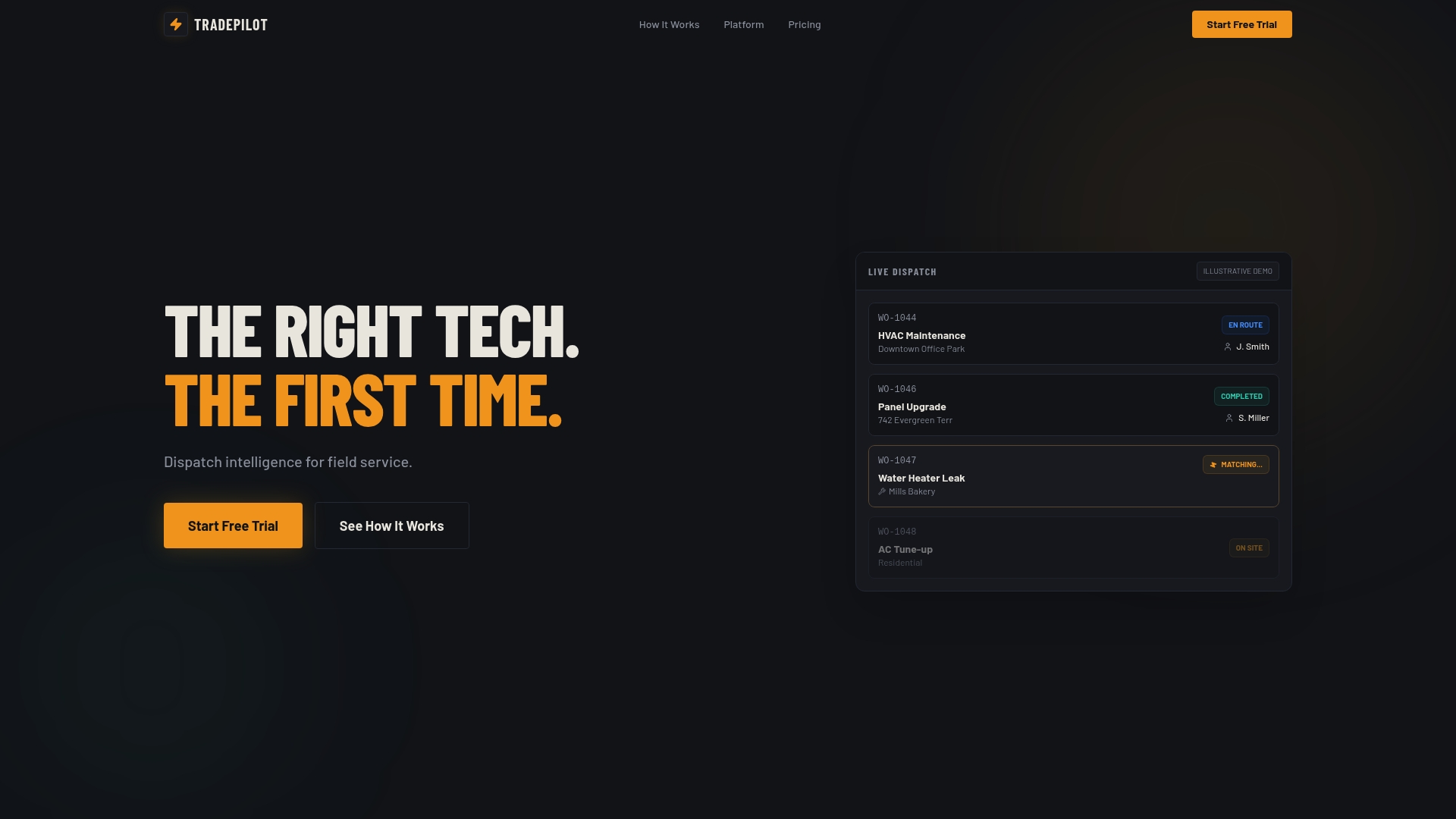
If you're an HVAC, electrical, or plumbing business ready to test AI-driven dispatch on a single crew or region, Tradepilot's AI dispatching platform is built for exactly that kind of pilot. Before you commit budget, it also helps to understand what dispatch software actually costs for a business your size, and how AI improves job duration estimates across a growing fleet. Start a free trial on the Tradepilot landing page and see how it handles your next batch of same-day cancellations.
Sources
- Field service scheduling: the hidden complexity | ORTEC
- Schedule Optimization: 8 Techniques for Service Scheduling
- Distributionally robust home service routing and scheduling (arXiv)