
Schedule a job only when the parts it needs are confirmed available, and match that job to a technician with the right skill and free capacity. That means combining real-time inventory visibility with lead-time-aware hold and release rules, then linking every work order to its parts list before dispatch. Get that sequence right and you cut reschedules, raise fill rates, and keep technicians productive instead of driving back to the shop.
TL;DR:
- Accurate scheduling depends on confirming part availability through real-time inventory data, supplier lead times, and proper task-to-part linkage at order creation.
- Failures often happen due to outdated master data, untracked inbound shipments, or technician skills mismatched with specific job requirements.
- Implementing structured pilot programs and establish clear hold/release rules, with buffer capacity for critical jobs, reduces delays and reschedules over time.
- Delivery routing must be synchronized with parts arrivals, using scan events to automate status updates and prioritize early in-route deliveries for scheduled jobs.
- Weekly KPIs like fill rates, schedule slip, technician utilization, and emergency order costs reveal the effectiveness of parts-aware scheduling practices.
Table of Contents
- How Parts Availability Scheduling Actually Works
- What Data You Need Before Any of This Works
- How to Roll Out Parts-Aware Scheduling Step by Step
- Scheduling Rules That Actually Cut Delays
- Aligning Delivery Routing With the Schedule
- The KPIs That Tell You It's Working
- What This Looks Like in Practice
- What Nobody Tells You About This Rollout
- Get Parts-Aware Scheduling Running With TradePilot
- Sources
- FAQ
How Parts Availability Scheduling Actually Works
Parts availability scheduling runs on a chain of checks that happen before a job ever hits a technician's calendar. Skip a link in that chain and you get the callback nobody wants: a tech standing at a customer's door with the wrong compressor.
Here's the sequence a well-run operation follows:
- Task-to-part linkage. Every work order gets tied to a bill of materials or parts list at creation, not at dispatch time. This is the single most skipped step, and it's why so many "surprise" stockouts aren't surprises at all.
- Inventory status check. The system checks on-hand stock, allocated quantities already promised to other jobs, and inbound shipments still in transit. Only unallocated on-hand stock should count toward "available now."
- Lead-time logic. If a part isn't on hand, confirmed supplier delivery dates push the earliest possible start date. A vague "3 to 5 days" from a vendor isn't good enough; you need a confirmed date tied to an order number.
- Hold/release logic. Jobs sit on hold until a triggering event, like a scanned delivery or a warehouse pick confirmation, automatically releases them into the active schedule.
Microsoft Dynamics 365 Business Central and similar ERP platforms build this kind of real-time inventory sharing into their integrated planning modules specifically so scheduling tools aren't guessing at stock levels.
What Data You Need Before Any of This Works
None of the logic above matters if the underlying data is wrong. Before you build scheduling rules, get these four inputs solid.
- Real-time inventory visibility across every location. Warehouse, depot, and truck stock all need to update on a cadence tight enough to matter, ideally near-instant for high-turnover parts and at least daily for slower movers.
- Supplier lead-time and delivery confirmation data. You need actual confirmed ship and delivery dates, plus a flag for which suppliers offer expedite options and at what cost.
- Reorder points and safety stock by part segment. A $12 thermostat and a $600 control board don't deserve the same stocking rule. Segment parts by velocity and criticality, and set safety stock accordingly, using a structured reorder-point calculation rather than a gut-feel buffer.
- Work-order-to-skill mapping. Confirming a part is available means nothing if the only free technician isn't certified for that repair. Skill and capacity data has to sit alongside parts data in the same decision, not in a separate system nobody checks.
Pro Tip: Run a "parts confidence" audit before you automate anything. Pull 20 recent jobs and check whether the parts data on the work order actually matched what the technician needed. If your accuracy is low, fix the data before you fix the scheduling logic.
SAP's extended service parts planning documentation makes a similar point at network scale: inventory transparency across a distribution network is what makes real-time evaluation of parts positions possible in the first place.
How to Roll Out Parts-Aware Scheduling Step by Step
Trying to flip a switch on this in one week is how pilots fail. Work through it in this order.
- Clean up master data first. Normalize SKUs, verify bills of materials against actual field usage, and tag every stock location clearly. This step is tedious and it's also the one that determines whether everything after it works.
- Pick your integration path. Decide whether you're connecting systems via API, EDI, or middleware, and settle on an update cadence. UPS's parts planning services illustrate how network-level stocking decisions depend on this kind of consistent data flow between sites.
- Configure hold/release rules by segment and priority. Critical, high-priority jobs might release on a lower confidence threshold than routine maintenance. Test these rules against historical job data before going live.
- Set technician matching rules that weigh parts, skill, and capacity together. A capacity-planning framework helps here, so parts availability isn't the only variable deciding who gets dispatched.
- Run a scoped pilot. Limit it to one part category or one crew, run it for four to six weeks, and define rollback criteria in advance, not after something breaks.
- Build an exception playbook. Document who approves expedited shipping, when a loaner part is acceptable, and what the customer gets told when a job slips.
Pro Tip: Give your pilot a hard rollback trigger, like three consecutive weeks of missed release-time targets, before you start. Without one, pilots quietly become permanent half-measures.
Scheduling Rules That Actually Cut Delays
Once the data and integration are in place, the rules you set determine whether the system prevents delays or just documents them.
- Reserve capacity for critical jobs. Set aside a fixed percentage of daily technician hours for emergency or high-priority work so a full schedule doesn't force a critical repair into tomorrow.
- Build buffer windows around real supplier variability, not an average. If a supplier's delivery window swings from one to four days. Schedule against the four, and adjust once tracking confirms the tighter number.
- Use dynamic release thresholds. A job should flip from "hold" to "ready to schedule" the moment inbound parts are scanned into inventory, not when someone manually checks the shelf. Drivant's routing research shows scan events work well as automated release triggers precisely because they remove the manual lag.
- Keep fallback options mapped out in advance. Truck-to-truck restocking, cross-site sourcing, and short-term loaner parts should each have a defined trigger point rather than being improvised call by call.
Aligning Delivery Routing With the Schedule
A confirmed parts order that arrives at 4 p.m. doesn't help a technician scheduled for a 9 a.m. job. Delivery routing has to sync with the schedule, not run on its own timetable.
- Sequence deliveries around technician start times and shop hours, prioritizing early drops for jobs scheduled first.
- Flag rush parts on the manifest itself, so drivers know which stops can't slip even when a route runs long.
- Use driver scan events as automatic status triggers. A scan at drop-off should update the job from "hold" to "released" without anyone touching a keyboard, a practice Drivant's route sequencing guidance treats as standard for time-sensitive parts.
- Build a morning restock pattern for trucks, separate from midday rush deliveries and end-of-day consolidations, so each type of movement has its own expected timing.
- Feed proof-of-delivery data straight into the schedule status, closing the loop between "delivered" and "job is now dispatchable."
The KPIs That Tell You It's Working
Track these numbers weekly, and review the trend monthly, not just the snapshot.
- Fill rate by part segment, with different targets for different tiers. Industry inventory research points to roughly 95% fill rates as a common target for high-velocity SKUs, while slower-moving strategic parts can run lower without hurting operations, since carrying full stock on every low-turn item isn't worth the cost.
- Schedule slip rate and mean time to reschedule, broken out by cause so you can tell parts-driven slips from technician availability or customer-side delays.
- Technician productive utilization, alongside travel and wait time, since a full calendar doesn't mean a productive day if half of it is spent driving back for a missing part.
- Emergency order frequency and cost, which should trend down as your hold/release logic matures. A spike here usually means your lead-time data or safety stock rules need attention.
A useful benchmark: if your emergency order rate isn't dropping quarter over quarter after implementing parts-aware scheduling, the problem is almost always upstream data accuracy, not the scheduling rules themselves.
Run a daily operational dashboard for on-the-ground decisions and a weekly performance review for trend spotting. Trying to manage both cadences off the same view usually means neither gets the attention it needs.
What This Looks Like in Practice
TradePilot's guidance to trades teams comes from watching the same failure patterns repeat across HVAC, electrical, and plumbing operations.
- Truck restock timing. A structured morning restock routine cuts emergency parts runs by catching low-stock trucks before the first job, not after a technician is already stuck.
- Priority-based dispatch mapped to hold/release. TradePilot's automated scheduling approach ties job priority directly to release thresholds, so a critical repair doesn't wait behind routine maintenance in the queue.
- Best-fit matching under parts scarcity. When a part is scarce, matching by skill, availability, and location together avoids sending a tech across town for a job that will just get rescheduled anyway.
- Phased rollout metrics. Start with fill rate and schedule slip on one crew before expanding, the same scoped-pilot logic covered above.
What Nobody Tells You About This Rollout
The technical side of parts-aware scheduling is the easy part. The hard part is dirty master data hiding in plain sight, usually a bill of materials that hasn't matched field reality in two years, and targets set before anyone checked what the current baseline even is.

Cross-team friction kills more pilots than bad software does. Warehouse staff, procurement, and schedulers need a shared definition of "available" before any rule engine can enforce one consistently.
Three things worth doing immediately: audit your parts data before automating anything, set your first fill-rate target based on your actual current number, and get warehouse and scheduling teams talking daily, not just when something breaks.
— Mark Korley
Get Parts-Aware Scheduling Running With TradePilot
This platform is built for the exact gap this article covers: matching jobs to available parts and to the right technician, automatically, instead of leaving schedulers to reconcile spreadsheets and phone calls before every dispatch. It combines inventory visibility, job-to-technician matching by skill and location, invoicing, and analytics in one platform, so the hold/release logic described above doesn't require stitching together multiple separate systems.
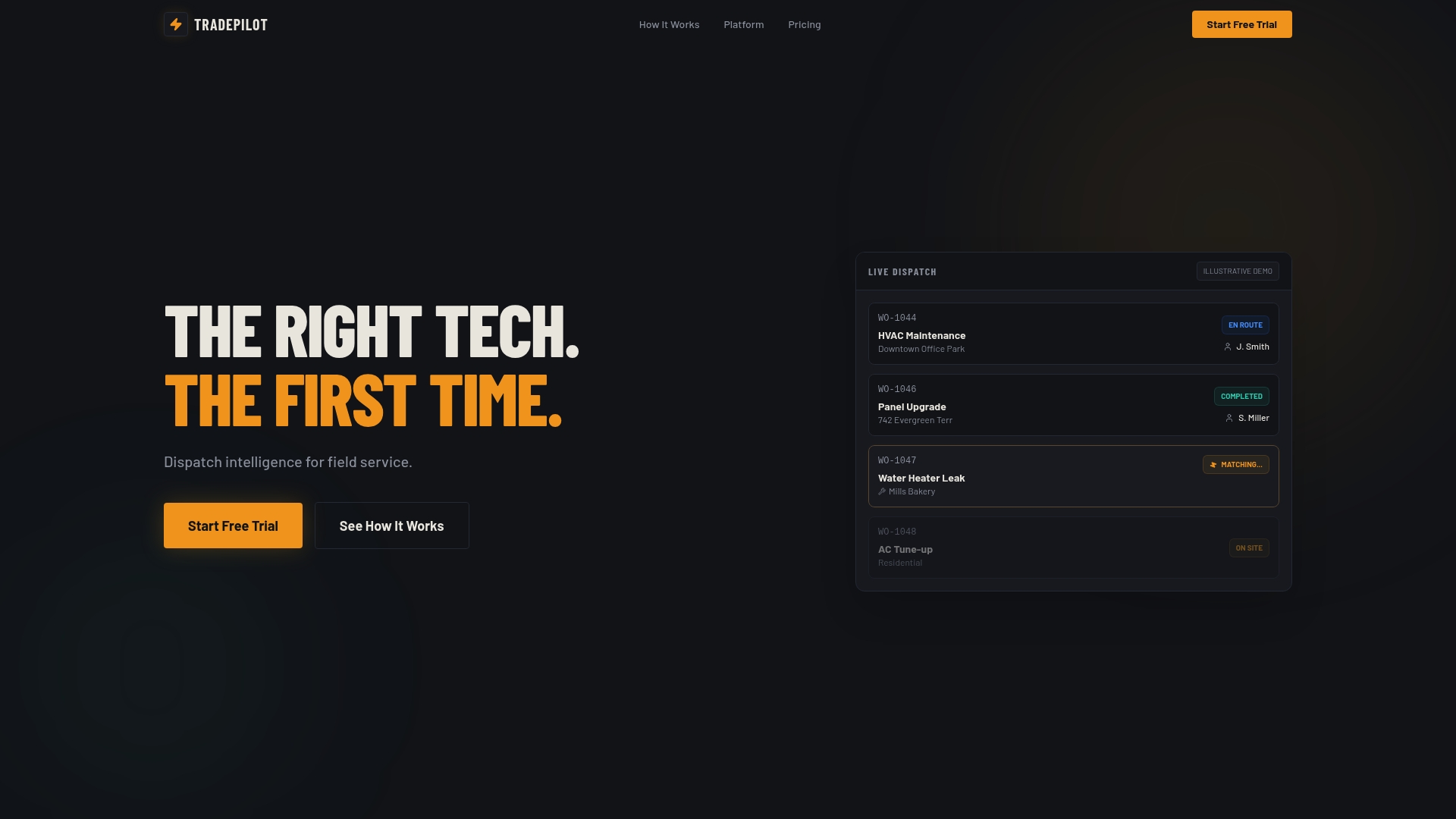
When you evaluate any platform for this, check three things: how it syncs inventory data in real time, whether its APIs integrate with your existing supplier and delivery data, and whether it supports a scoped pilot rather than forcing a full rollout on day one. TradePilot supports all three. If you're ready to see how automated matching handles your actual parts and crew data, start a trial with TradePilot and run it against one crew before rolling it out wider.
Sources
For deeper technical detail beyond this guide, these vendor and industry resources cover specific system capabilities: Microsoft Dynamics 365 Business Central for ERP-integrated inventory, SAP's extended service parts planning for network-level planning, UPS's parts network planning for logistics strategy, PartsOS's AI forecasting tools for demand prediction, and Drivant's route planning guidance for delivery sequencing.
- UPS Network and Parts Planning
- SAP S/4HANA extended service parts planning
- Auto parts delivery route planning | Drivant
FAQ
What Is Schedule Availability?
Schedule availability refers to the confirmed open capacity a technician has for a given time window, factoring in skill match, location, and, for parts-aware scheduling, whether the required parts are already on hand or confirmed for delivery before that window.
What Is the Best Scheduling Tool for Parts-Aware Dispatch?
The best tool combines real-time inventory data, lead-time tracking, and technician matching in one system rather than three disconnected ones. Platforms like TradePilot are built specifically to link inventory status to dispatch decisions in under a second.
What Is a Good Tool for Coordinating Schedules Across Teams?
A good coordination tool gives procurement, warehouse staff, and schedulers shared visibility into the same inventory and job data, so no team is working off stale numbers. Look for automatic status updates triggered by scan or delivery events rather than manual check-ins.
What Are the Key Components of a Reliable Parts-Aware Schedule?
The core components are task-to-part linkage, real-time inventory visibility, confirmed supplier lead times, hold/release automation, and technician-to-job matching by skill and capacity. Miss any one of these and the schedule will drift from what's actually happening in the field.
How Do You Handle Rush Orders Without Breaking the Schedule?
Flag rush parts on delivery manifests and reserve a portion of daily technician capacity specifically for expedited jobs. Set a clear expedite-approval process in advance so rush decisions don't rely on ad hoc phone calls between procurement and dispatch.